




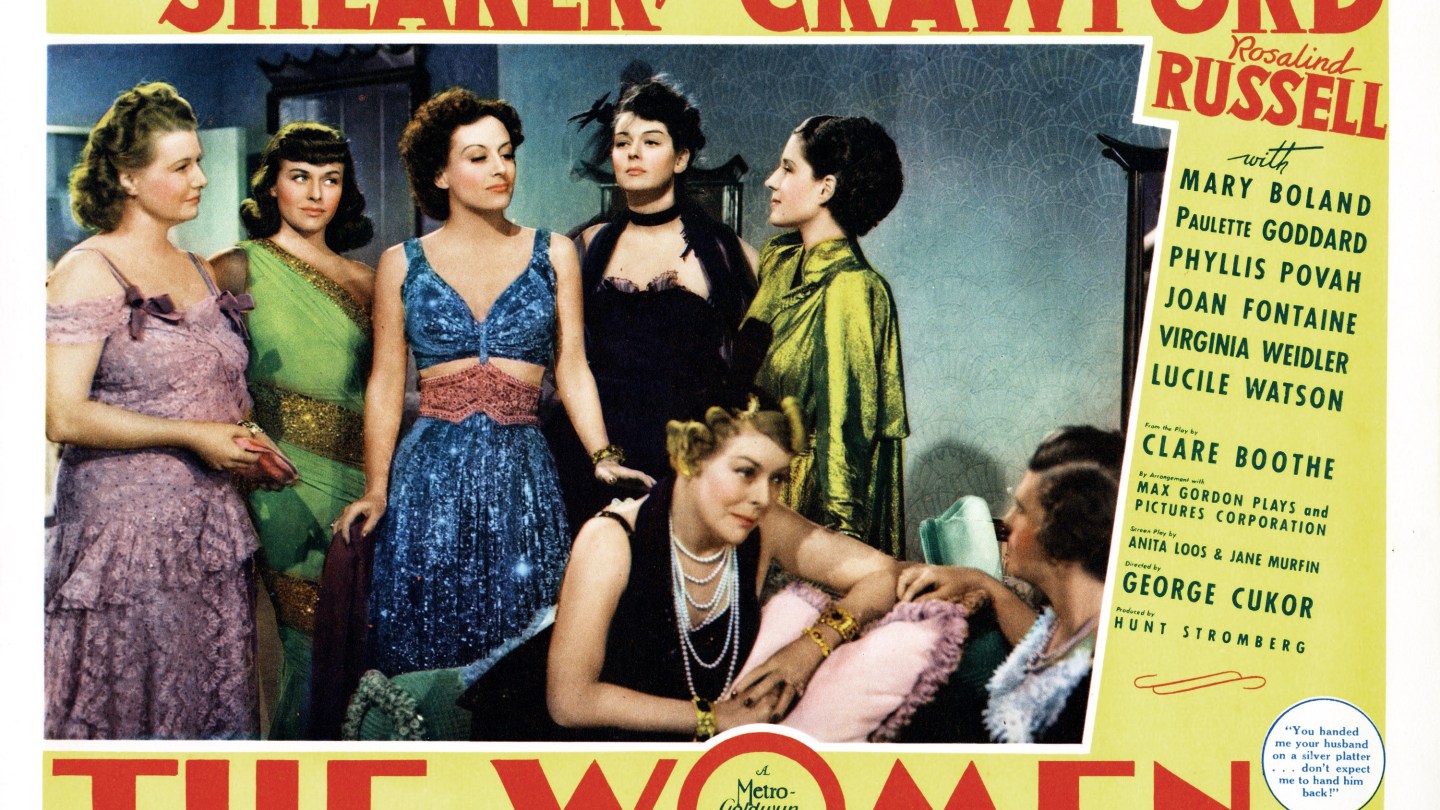


Illeana Douglas’ new book Jungle Red! The Making of MGM’s The Women, published on Sept. 15 by Lyons Press, delves into the titular 1939 classic which boasted an all-star cast of actresses — among them Joan Crawford, Norma Shearer, Rosalind Russell, Paulette Goddard and Joan Fontaine — and provided a template for modern female-driven projects like Sex and the City and The Real Housewives.
In the following exclusive excerpt from the book, Douglas makes the case that the greatest Hollywood “feud” of all time did not involve Crawford and Bette Davis or sisters Olivia de Havilland and Fontaine, but rather Crawford and Shearer.
If MGM had been primed to sell The Women as “the Catfight of the Century,” they didn’t need to invent antics or drum up stories of feuds. Everyone knew that Norma Shearer and Joan Crawford really didn’t like each other. In March of 1939, before Crawford had even set foot on set, Howard Strickling had approved a Look cover promoting The Women that depicts Shearer and Crawford glaring at each other, with a headline that reads, “They Don’t Like Each Other… Inside Stories of 31 Hollywood Feuds.”
On April 25, 1939, MGM’s production, listed as #1091: The Women, began shooting. A movie based on the stories of what happened behind the scenes might make a good sequel. When director George Cukor was asked whether he was fearful that longtime rivals Shearer and Crawford would try to upstage each other, he laughed, saying, “They’re too smart for those antics.” He was being optimistic. The best publicity angle, since there were no men in the cast and no juicy romances, was to exploit their longstanding “feud”. How much each actress fueled their “feud” is a matter of opinion, but since every squabble — the billing, the dresses, the trailers, and their eventual showdown because of Crawford’s knitting needles — was dutifully reported on, you have to imagine someone was spilling the tea.
Anita Loos, screenwriter of The Women, said, “Norma and Joan could never have been personal friends— they came from different worlds. Norma thought Joan crude and pushy and Joan considered Norma overbearing and uppity — but they both knew the ‘feud’ was good copy, and so they helped it along.”
When Shearer hosted a wrap party luncheon, chiefly to show the press how well they were getting along, Crawford skipped it. She seemed delighted to let the bad feelings percolate, telling gossip columnist Hedda Hopper, who was cast in the film, “So many people say Norma and I don’t like each other. Who are we to disagree with the majority opinion?”
Shearer then refused to attend the premiere and penned an open letter to the trades downplaying her role and casting shade on the one actress she had least wanted to work opposite, Crawford. “I’m asked about the so-called power and influence I had at the studio. I don’t think anyone acted more like an employee than myself. Just because of my marriage to Mr. Thalberg, and as a consequence of my friendship with the other executives, there have been any number of times when I did not put up as stiff a fight as another actress would have. I didn’t want to appear to be taking advantage. For instance, I didn’t want to make The Women. I did make it, for the reason I just explained, and partly because I was taught by Mr. Thalberg to think of what is good for the picture as a whole rather than what is good for me as an individual.”
Crawford had her reply teed up. She praised Russell for walking away with the film. Of her other co-star, Shearer, Crawford said, “Norma Shearer, as usual, played the perpetual virgin, the wronged wife.” She did give her one compliment. “I love playing bitches, and Norma helped me tremendously with this part.”
When Cukor came on board to direct The Women in February of 1939, only one queen, Shearer, was attached, set to play the leading role of Mary Haines. She had seen the play on Broadway in 1936, and it was inevitable she would star in it. But when Shearer spoke to Hopper, who reported on every casting decision — including her own — Shearer distanced herself, saying, “You know, I hesitated a long time before playing this part. Then I decided that fighting to hold a husband is every woman’s problem.”
Shearer referencing holding on to a husband when talking to Hopper was significant. After her husband Irving Thalberg’s death, she was in the process of reinventing herself. Doing a comedy about a bunch of bitter, funny wives complaining about men, when her husband was gone, was not in sync with her carefully crafted image of herself as the grieving widow of a man who was already gaining mythological status.
She could also read the newspaper. The Women was no longer a Norma Shearer vehicle but, courtesy of Hunt Stromberg, “George Cukor’s The Women.” Every day, names were being mentioned: “Suzanne Kaaren gets a role in an MGM picture on the strength of a single test. George Cukor picks her for The Women” (Hollywood Diary). Shearer waited on the sidelines, nervously wondering who her co-stars would be.
The stable of talent at MGM was vast, and with 135 roles up for grabs, Cukor was auditioning all viable options except, it seems, Crawford. In March, the press was reporting that Crawford had been turned down for the role of Crystal, while it was announced that eighteen-year-old Lana Turner had been cast.
Hairstylist Sydney Guilaroff wrote, “When Norma was cast as the jilted wife, Joan Crawford set her sights on Crystal. She relished the notion of going head-to-head with Queen Norma, now without the protection of her late prince.” Crawford was resentful that even in Thalberg’s absence, Shearer was still getting all the plum roles. Stromberg promised Crawford that Idiot’s Delight would be her next film, but then Mayer decided to give the part to Shearer.
“‘No tits Shearer,’” Crawford complained, “could neither dance nor sing and had no experience playing fast women.” Crawford had been looking forward to working in Idiot’s Delight with Clark Gable, and perhaps rekindling their on-again/off-again romance. Instead, it was Shearer he held in his arms. “She had no chemistry with Gable, and that’s what the picture was all about.”
Crawford was envious that Shearer had just received, with the studio’s backing, her fifth Oscar nomination — for Marie Antoinette. MGM consistently threw their voting bloc to Shearer, while Crawford had never even been nominated, despite standout performances in Paid (1930), Grand Hotel (1932) and Sadie McKee (1934). She was not about to let The Women slip through her fingers — even testing for the role, something unheard of for an actress of her stature. Eventually she won over Cukor, convinced Stromberg the picture needed her, and beat out teenager Turner by telling Mayer, “The woman who steals Norma Shearer’s husband can’t be a nobody.”
Crawford may have, as she said, “resented the hell out of Shearer,” but playing Crystal only made sense if she appeared opposite Shearer. Without her, Crawford would be left playing a supporting part, a “heavy,” as Mayer called it, and for nothing. Shearer was pragmatic. She may have feared working with Crawford, but she knew The Women would garner more attention if Crawford was in the film, but only if Shearer could control the narrative, like later claiming it was her idea to cast Crawford.
In the opening credits of The Women, Cukor had the cheeky idea of depicting each actress on-screen as some kind of animal. Crawford is a leopard. Shearer is a young deer. An innocent little deer does not do Shearer justice. A more accurate representation would be a lioness, for Shearer persevered in the jungles of Hollywood, marrying the boss, becoming “the first lady of MGM,” picking up six Academy Award nominations, even winning Best Actress for The Divorcee (1930). But Shearer was threatened by Crawford from the day she was hired as Shearer’s body double in Lady of the Night (1925). As for Crawford, Shearer’s marriage to Thalberg solidified the rivalry. Less than a year after Shearer’s wedding, Our Dancing Daughters (1928) was released, making Crawford a breakout star in the public’s eyes, but not at MGM, and not with Shearer, who called Crawford “an ambitious upstart” and referred to her as “common.”
Crawford’s chief resentment was that Shearer got the best female roles at MGM only because of Thalberg. After Crawford was relegated to a succession of dancing films, like Hollywood Revue of 1929, and Untamed (1929) — an unhinged, “jungle-themed” musical — Crawford confronted Thalberg. “Why do you save all your good roles for your darling Norma?” she asked. “Don’t you think I deserve some consideration?” Thalberg punished her for impertinence and put her in Montana Moon (1930), a low-grade musical Western.
In 1938, after being labeled “box office poison,” Crawford needed a hit badly and lobbied hard for Idiot’s Delight. The part of a former showgirl masquerading as a Russian countess, opposite Gable, seemed tailor-made for Crawford. Stromberg told her that Shearer wanted to play the part. Of all the slights, this was perhaps the biggest grudge Crawford carried into The Women. “I cried buckets over Idiot’s Delight,” she said.
After The Ice Follies of 1939. Crawford was at a low point professionally. She needed a hit. Her philosophy of going after the role of Crystal was simple. “It’s going to be a good picture. I need a good picture. If I can’t get one of my own, let me sneak into someone else’s.” She convinced Stromberg to talk Cukor into testing her. Though intrigued by the idea of an on-screen rivalry, Cukor was not a fan of Crawford’s acting, which he felt was mannered. After testing her for Crystal, though, Cukor consented and told her the part was hers. What changed? Crawford was not shy about her open and persistent dislike of Shearer. Once, years before, when she was asked what she thought of Shearer, she smiled and said, “Well . . . I’m an actress . . . and she’s married to the boss.”
Cukor may have decided, possibly with the influence of Stromberg, that the competition with Shearer would make their scenes sizzle. Crawford was excited, telling the press after she won the part, “Even people who didn’t like me admitted I had intestinal fortitude, taking my career in both hands and gambling.”
When Hopper asked Shearer what she thought about Crawford being cast, Shearer graciously said she was looking forward to it, and that The Women was “going to be a fascinating experience for her.” Butter wouldn’t melt in her mouth, as they say, but before shooting began, she made sure her contract stipulated that only she would have top billing, with her name above the title. It was a battle she would later lose, first to Crawford, then Russell.
Shearer arrived early her first day to check the set and saw that there were three star trailers parked side by side. In accordance with being number one on the call sheet, Shearer had been assigned dressing room number one, nearest to the camera. It had been redecorated for her in coral, pink and cream. It was also air-conditioned. Inside there was an upholstered floral lounging sofa where she could rest and practice her lines, with fresh orchids on her dressing table. Shearer noticed that one of the trailers — dressing room three — was sticking out one foot further than the other two. When she inquired as to who was in dressing room three, she learned it was Crawford. Russell had been assigned number two. Shearer demanded Crawford’s trailer be moved back one foot in accordance with the others.
Crawford’s arrival had been accompanied by glowing stories from reporter Harry Mines in his Raves and Raps column. “The Women has been before the cameras at MGM,” he wrote, “but not until yesterday did Joan Crawford start work. Joan has a new and fancy portable dressing room, decorated in mauve. It was difficult to get a peek at the quarters, as baskets of flowers took up most of the space. Miss Crawford’s friends have deluged her with posies and telegrams on her first day in production.”
Crawford stepped out of her limousine that first day of filming accompanied by her maid. Her uniformed chauffeur carried her record player and records, and one of her beloved dachshunds, Pupchen, acquired during her marriage to Franchot Tone. Crawford had a special clause in her contract allowing her to bring Pupchen to the studio when filming. An insurance policy protected the company in case the dog ever bit anyone or barked during a take.
Cukor did not have to worry about a barking dog. It was Crawford’s vocalizing to opera that could be heard loud and clear during Shearer’s rehearsals. Though the set was not far from her dressing room, Crawford insisted she be driven to it via limousine. Shearer later followed suit, always making sure her limousine arrived after Crawford’s.
Hairstylist Sydney Guilaroff recalled that Cukor’s greatest challenge was not directing on-screen but trying to keep the peace off-screen. He wrote that one solution was to always keep the actresses busy, separating them whenever possible. If one was rehearsing, then he could send another one to a fitting, or have them get a hair and makeup test. That way they were unlikely to be in the same space at the same time. “This worked well,” he said, “until Shearer and Crawford had their one face-to-face scene together.”
To rattle Shearer, Crawford called in sick, and Cukor had to rearrange the schedule. Harry Mines, in the Los Angeles Daily News, ran a story that Crawford was under doctor’s orders not to work, and was ill from a combination of “intestinal flu and arsenic poisoning.” It’s hard to believe Crawford came across arsenic on the set, unless someone slipped it in her tea! (Hmm…)
After two days, however, it was reported that she had made a remarkable recovery — or at least was well enough to continue. “On her sickest morning,” Mines wrote, “Joan had to do her most important scenes with Norma Shearer. Despite the tough break, Miss Crawford sallied through, doing such a good job that few realized how bad she was feeling.”
The scene in question takes place after the fashion show in Crystal’s dressing room. Mary Haines (Shearer), Sylvia (Russell), Peggy (Fontaine) and Edith (Florence Nash) discover Crystal is trying on dresses and has asked the saleswoman (Frederika Brown) to charge the clothes to Mr. Stephen Haines’s account. Mary crosses the hall to confront Crystal and enters Crystal’s dressing room. Cukor began to rehearse.
What happened next has been written about and reported from so many angles it’s like the film Rashomon (1950). Every bystander recalls what happened with slight variations, but all agree on one thing: Crawford, after years of perceived slights at the hands of Thalberg and Shearer, saw an opportunity to get even, and she did. Without Thalberg, there would be no repercussions. Crawford perhaps even sensed there was a bit of schadenfreude from Cukor, the cast, and the crew, knowing this moment would come, and wondering which cat would draw the most blood.
Read the full article here