




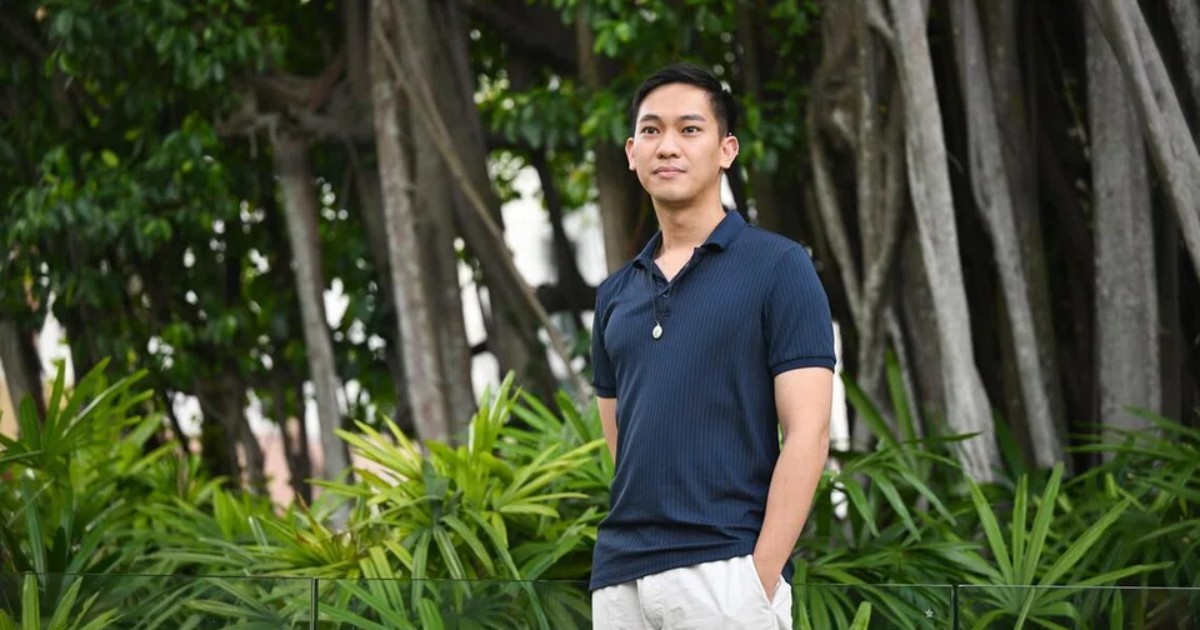

SINGAPORE – In January 2024, National University of Singapore student Joshua Lee began experiencing abdominal pains, which he brushed off as aches from recreational rock climbing.
“I thought I had just pulled something,” said the 25-year-old, who was pursuing a bachelor’s degree in psychology at the time.
However, in June that year, the pains became worse after what he described as a “pretty bad” fall while climbing. He realised something was wrong after almost passing out from the pain one morning.
Mr Lee went to Mount Alvernia Hospital near his home, where an MRI scan uncovered a mass in his abdomen.
He later underwent further tests and in July 2024 discovered he had stage 3 testicular cancer, which had spread to the lymph nodes in his belly area.
While Mr Lee – who had no family history of cancer – said he was mentally prepared for the possibility of cancer, he was concerned about how his loved ones would take the news.
“My girlfriend, she had it rough because we had just got together,” he said. “We got together in April, and I got the diagnosis in July.
“My first instinct at the time was to reassure her it was okay if she wanted to walk out (on the relationship).”
More young adults diagnosed with cancer globally
Mr Lee is one of an increasing number of younger adults being diagnosed with cancer here in recent years.
Data from the latest Singapore Cancer Registry Annual Report showed that for the period between 2019 and 2023, there were 4,995 cancer diagnoses for those under 40 – a 34 per cent increase from the years between 2003 and 2007, when the number stood at 3,729.
Between 1968 and 1972, the earliest period on record in the report, the number of cancers for people under 40 diagnoses was just 1,710.
“While cancer is still more common in older adults, the younger age groups are seeing faster rises in age-specific incidence compared with older adults,” said Dr Gloria Chan, a consultant with the haematology-oncology department at the National University Cancer Institute, Singapore (NCIS).
“Locally, the most rapid increase in age-specific incidence rates of cancer was observed in those under 50 years old,” she said, adding that the greatest increases were among males between the ages of 30 and 39 and females aged between 40 and 49.
This reflects a global trend, said Dr Eileen Poon, medical lead for the National Cancer Centre Singapore’s (NCCS) adolescent and young adults oncology programme.
She noted that data from the Global Burden of Disease study, published by the Seattle-based Institute for Health Metrics and Evaluation, showed a 79 per cent increase in early-onset cancer worldwide between 1990 and 2019.
“People under 50 are the only age group to experience sustained increases in cancer incidence since 1995,” Dr Poon said.
A study of more than 500,000 people in the United States – led by researchers from the NUS Yong Loo Lin School of Medicine and published in peer-reviewed medical journal JAMA Network Open in 2023 – found cancer diagnoses in patients under 50 increased by an average of 0.28 per cent annually between 2010 and 2019.
While instances of early-onset cancer are not driven by any single cancer type, colorectal cancer is one clear example showing a long-term increase in younger adults, said Dr Chan.
“A recently published population-based study highlighting the trends in early-onset colorectal cancer in Singapore reported an approximate doubling in incidence, from about five per 100,000 in 1968 to about nine per 100,000 in 2019,” she noted.
This increase has largely been driven by rectal cancer rising about 1.5 per cent annually among young men here, she said.
Breast cancer, meanwhile, is the most common cancer for younger women here, showing a steady rise in incidence among those in their 30s and 40s, she added.
[[nid:704499]]
Reasons for the rise
The experts noted that this rise cannot simply be attributed to better detection of cancers.
“Mortality rates for some early-onset cancers are actually higher because these cancers are detected at more advanced stages in younger people,” said Dr Chan.
“Researchers have identified a ‘birth cohort effect’ showing that each successive generation born after the 1950s carries a higher cancer risk than the one before,” Dr Poon said.
This means that someone born in 1990 is four times more likely to develop colorectal cancer compared with someone born in 1950, she noted.
She noted that emerging evidence points to changes in the early-life exposome – a term referring to all environmental exposures over the course of an individual’s life – as likely contributing factors.
These include the rise in ultra-processed foods, obesity, sedentary lifestyles and alterations to the gut microbiome, she added.
Regular physical activity and avoiding excess weight are among the strongest protective factors against cancer, Dr Chan said, noting obesity’s association with several cancers, such as colorectal, breast and endometrial cancers.
People should have balanced diets with more vegetables, fruits and fibre, while eating less processed meats and red meat, as well as ultra-processed foods, she added.
“These factors are especially relevant for colorectal cancer,” she said, adding that people should also avoid smoking and alcohol as far as possible.
Young people should also go for cancer screenings once eligible, she added, highlighting the importance of cervical and breast cancer screenings for women.
“Not all young-onset cancers are preventable and many people who do ‘everything right’ can still develop cancer,” she noted.
“Small, consistent lifestyle choices made over time can meaningfully lower cancer risk.”
For Mr Lee, treating his testicular cancer meant going through orchidectomy, or the removal of his left testicle, in July 2024.
“It was the first time in my life I felt emasculated,” he said, adding that the thought of going through the procedure made him think seriously about having children.
Following his surgery, he had to receive chemotherapy, going through 28 sessions at NCCS, which resulted in a variety of side effects, including nausea, hair loss, weight gain and brain fog.
To focus on his treatment and recovery process, Mr Lee took a six-month leave of absence from his studies.
The process was successful and his cancer went into remission by end-October 2025, and he was able to complete his degree programme in December.
He noted that his journey has come full circle in a way, as he recently started work with the Singapore Cancer Society as a psychosocial services programmes executive, providing support to cancer patients and cancer survivors.
The society helps cancer patients, including teens and young adults, and their families with a variety of services including cancer screening and education, rehabilitation programmes as well as financial and welfare services.
Mr Lee said his Catholic faith, together with support from his family, friends and girlfriend, as well as a support group for young adults with cancer, helped him get through this difficult period in his life.
Young adults diagnosed with cancer should try to find something to ground them as their condition can easily result in them falling into despair, he said.
“You have to have something you love, someone you love, in your life to remind you that you don’t just live for yourself. I think that’s important.”
[[nid:666217]]
This article was first published in The Straits Times. Permission required for reproduction.
Read the full article here