
In the final hour of Netflix’s Monster: The Lizzie Borden Story, the titular murderess, having finally made her peace with the act of violence that has defined her life, turns to the loyal companion who’s been by her side through it all. “Okay,” she says. “Let’s make it mean something.”
Lizzie (Ella Beatty) is talking about her wealth and notoriety, which she wishes to channel into a force for good. In the moment, though, all I could hear was showrunner Ian Brennan muttering that sentiment to himself. The latest addition to his and Ryan Murphy’s murder-verse tries desperately to draw something, anything meaningful out of Borden’s saga, with all the finesse of a college freshman trying to crank out a 15-page term paper in the two hours before deadline — and with all the same power of persuasion.
Monster: The Lizzie Borden Story
The Bottom Line
Lots of killers, tons of filler.
Airdate: Thursday, Sept. 17 (Netflix)
Cast: Ella Beatty, Vicky Krieps, Charlie Hunnam, Rebecca Hall, Sarah Paulson, Jessica Barden, Joey Pollari, Billie Lourd
Creators: Ryan Murphy, Ian Brennan
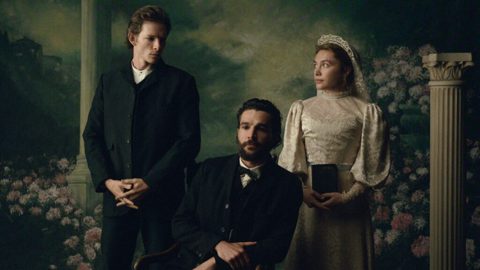
As the subtitle indicates, Monster: The Lizzie Borden Story is first and foremost a retelling of the real events you probably first heard of as a playground chant (one whose melody becomes a recurring motif), or perhaps saw depicted in more detail by Chloë Sevigny and Kristen Stewart in 2018’s Lizzie. While the real-life Borden has always denied responsibility for the August 1892 deaths of her father and stepmother, the series wastes no time playing coy; it takes as settled fact that it was indeed Lizzie who wielded the axe.
As for why, there, too, the series has a clear-cut answer: because they’re emotional sadists whose sole pleasures in life are tormenting the help and insulting their daughter. Playing Abby and Andrew, Rebecca Hall and Charlie Hunnam gorge on the scenery like they’re trying to make themselves sick; one dinner sequence even ends with them spewing geysers of vomit. There’s zero nuance to their performances, and also nothing unique about them to make them memorable. But as a way to get you to sympathize with the devilish Ms. Borden, I can’t say their cartoonish villainy is ineffective.
The only real question left is the how, and that too is more or less established in the Max Winkler-directed premiere. Vicky Krieps plays Maggie, a new housemaid who makes an immediate impression on the family with her skill, her work ethic and her anachronistic style (punk shags in Manic Panic shades, literally a century before they’ll be cool). Lizzie falls in love practically at first sight, and Maggie seems charmed right back. Under Maggie’s guidance, the sweet, shy, sheltered girl who’d never so much as heard of la petite mort blossoms into one confident enough to start rattling the gilded cage her parents have trapped her in. At Maggie’s suggestion, she begins to wonder if killing them might not be her only way out.
Then, having put together so many puzzle pieces so quickly, The Lizzie Borden Story finds itself with the problem of having eight hours’ worth of content to fill. I wish I could say that the series has an easy solution for that, too. Instead, it flails about for a number of stalling tactics, none of them particularly satisfying.
One is simply to slow down the pace of the storytelling. Bits of exposition are repeated in rapid succession (“It’s the culmination of my life’s ambitions, really,” says a character of a completed project, and then, a few minutes later, “It’s everything I ever dreamed of, really,” just in case you weren’t paying attention the first time). Lizzie and Maggie indulge in dreamy nature idylls that clumsily evoke historical lesbian dramas like Portrait of a Lady on Fire or Ammonite, only, for some reason, with way less sex. Intriguing tangents are brought up to go nowhere — no sooner has the show finally started to explain why Abby sucks so much than it’s done her off, thus nipping in the bud any interest we might taken in her.
The other method, more successful at padding that run time but even more annoying in its spirit, is to insist that The Lizzie Borden Story is actually about something much, much bigger than itself. That Borden is in fact part of a whole historical lineage of female killers, all of whose tales are linked together by some lazily nebulous concept of What It Means to Be a Woman in Society, and that there’s therefore something pretty Female Empowering about the fact that Lizzie has decided to axe-murder her parents, if you really think about it.
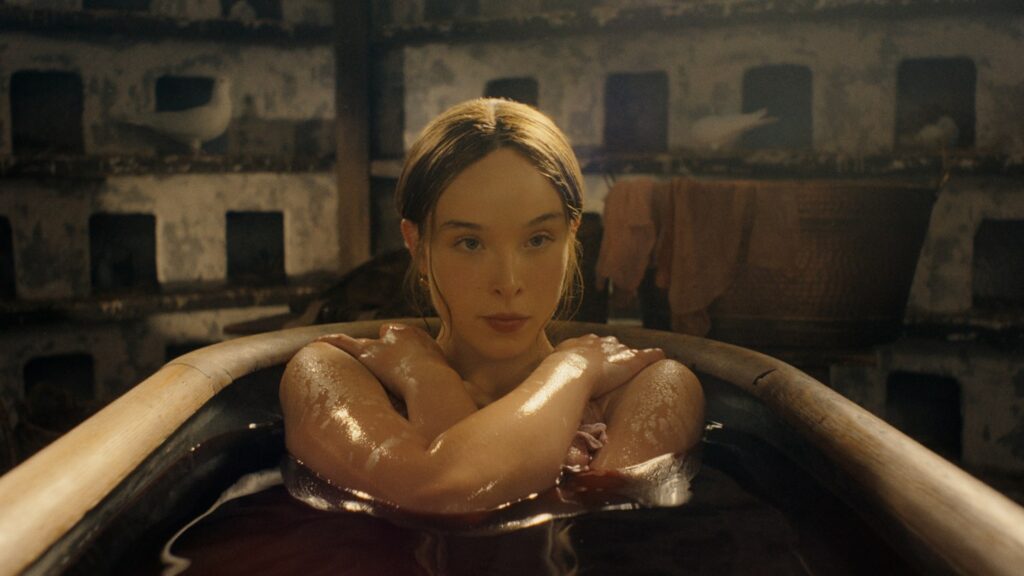
The show attempts to do all this by braiding Lizzie’s story with those of arguably the only other female killers as famous as she is. In the late 19th century, Lizzie and Maggie spend long hours reading each other the story of Elizabetta Báthory, the 16th-century countess accused of bathing in the blood of virgins. Krieps plays Elizabetta in flashbacks, which adds nothing significant to our understanding of either Elizabetta or Maggie but does provide the actor an opportunity to don another anachronistic hairstyle (this time, it’s severe bangs and tomato-red streaks).
Meanwhile, in the 20th century, Lizzie has in turn captivated Aileen Wuornos (played by Sarah Paulson in a broad performance more suited for Saturday Night Live). The series lavishes much more attention on Aileen than it did Elizabetta — like, to the point where one wonders if what Murphy and Brennan truly wanted was to do Monster: The Aileen Wuornos Story, and were only stopped by the existence of 2003’s Monster, the Aileen Wuornos story. In this Monster’s telling, Aileen worships Lizzie to the point of booking an overnight stay at her old home and hallucinating interactions with her. To this sex worker turned killer of johns, Lizzie is a role model, a spiritual sister, someone who just gets how the pressures of womanhood can drive a gal to violence.
Never mind that none of these three killers have anything in common — not their backgrounds, not their motives, not their methods, not their outcomes. Never mind that The Lizzie Borden Story’s further attempt to reframe Lizzie as not just a self-actualized independent lady but an outright icon of the women’s suffrage movement comes out of nowhere. Or that for a show supposedly so in tune with the struggles of womanhood, it has no sympathy to extend an embittered wife and mother like Abby (who, for all her abuses, was not a literal murderer), and no curiosity to offer a rebel like Maggie (whose goals or desires or even personality traits always seem to be changing at the whims of the plot).
All of these people, you see, are female. For Monster, that’s reason enough to lump them together — even if, in the end, it has nothing more substantial to say than, “Women be choppin’.”
Read the full article here