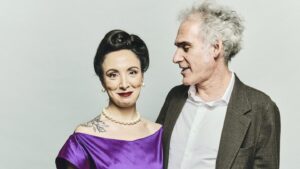

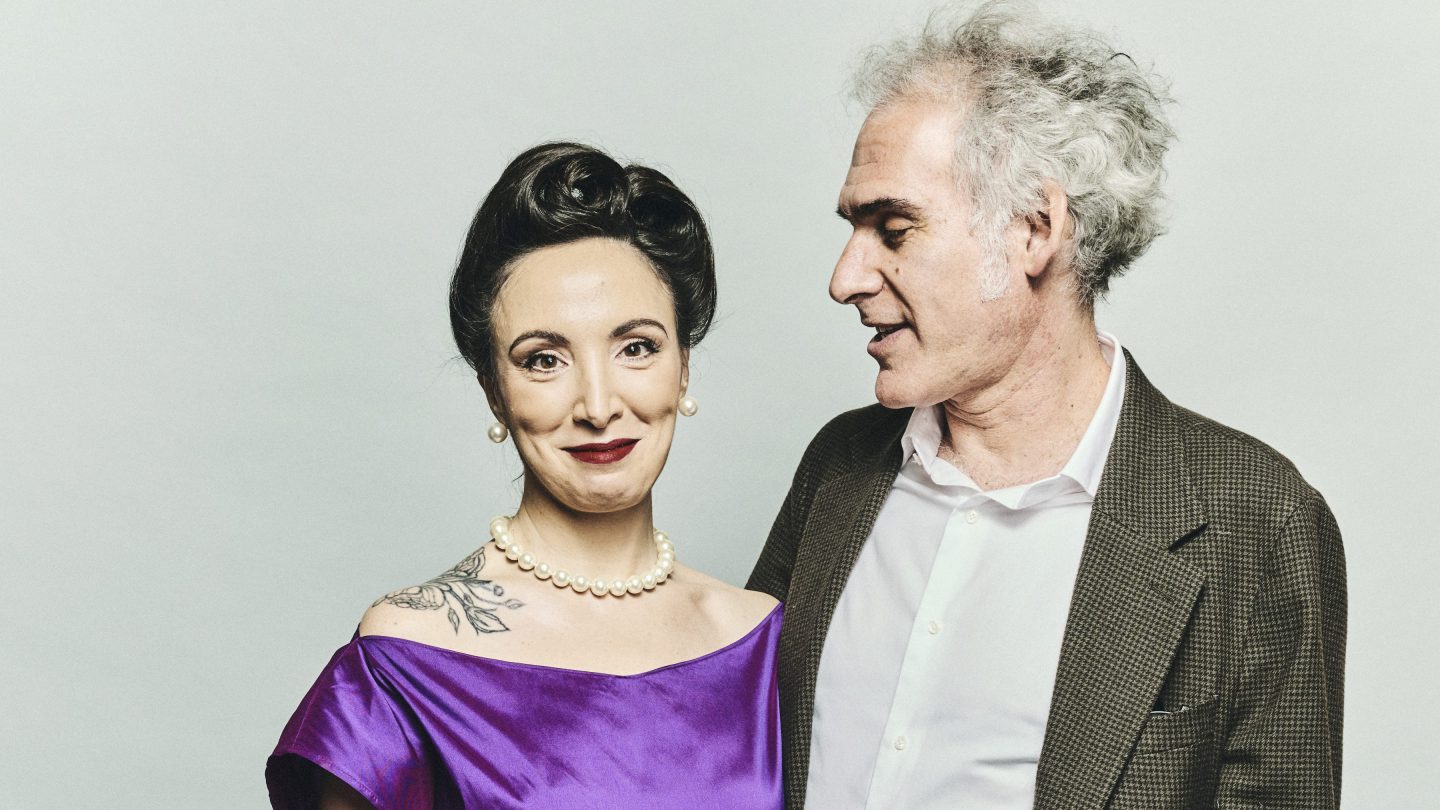

Ronald and Mary Bronstein have been making movies professionally as long as they’ve been a couple — they met for the former’s directorial debut, Frownland, in which Mary starred, and were married by the time she directed her first movie, Yeast, which Ronald edited. This was back in the 2000s, and much changed from there in both life and work. Ronald developed a bond with Yeast costar and crew member Josh Safdie, as they co-wrote hit indie films that Josh and his brother, Benny — yes, many intersecting family matters in this filmmaking web — would go on to direct, like Good Time and Uncut Gems. Meanwhile, Mary’s career slowed down when she and Ronald had kids and she “held down the fort” for the family, as she puts it.
They each log onto Zoom separately on a December afternoon energized, though, to now be at an “equal standing” in their professional lives — both having reached major new milestones. Ronald is a first-time Golden Globe nominee for producing and co-writing Marty Supreme, which he also co-edited with Josh Safdie (who directed solo), while Mary is up for best director at the Spirit Awards for If I Had Legs I’d Kick You, her first feature since Yeast. (Both Marty and Legs are backed by A24.) If I Had Legs stars Rose Byrne, who’s won the lion’s share of critics’ best-actress prizes so far, as a mother reaching her breaking point in taking care of her young daughter suffering from a pediatric feeding disorder while her husband is away on business. Several years in the making, the film is inspired by Mary’s own experiences in motherhood and was produced by Ronald.
They spoke with The Hollywood Reporter in the midst of their dizzying respective press tours for their first joint interview. “When we heard that we were a power couple, we were delighted,” Mary says, before Ronald chimes in: “We’d been like a power-outage couple until this year.”
You met working together, correct?
MARY BRONSTEIN Yes, it was the last week of college for me. I was handing in a paper for the very riveting class of History of Eastern European Theater, and I was late doing so for obvious reasons. I had to go to the professor’s office, and right next door to the professor’s office was a leaflet asking for a young actress to play a teenager.
RONALD BRONSTEIN I’ll just interject to say I had cast the project with all of the very profoundly idiosyncratic people that I had amassed in the years leading up to its making. But I had to canvas the city blindly to find the only female role in the film because I —
MARY — Didn’t know any women. He didn’t know any women. (Laughs) The flyer, which I actually just took down and took with me so no one else could respond to it, did not explain what the movie was, did not say who was making the movie. I had to talk with you about being in the movie, and it mentioned things like The Smiths lyrics. It had a little Peanuts cartoon.
RONALD The first few years when Charles Schulz is basically — I mean, it’s just a chronicle of a manic depressive.
MARY I don’t know if Charlie Brown is ever manic, but depressive for sure. But yeah, so I took that down and we started working on what I found out later was Frownland. Ronnie was basically working in projection booths buying one reel of film at a time. We started dating, we moved in together. We got married all before the movie was finished.
RONALD You would think at the beginning, a certain good, fair, rational judgment would lead you to believe you should wait until the project is done to start dating, to go from a professional capacity to a personal intimate one. But when your movie takes six years to complete, it’s not tenable.
Then the next movie that both of you do is Yeast, right? Which Mary directed.
MARY Yeah. When Frownland did come out [in 2007], we’d already been married about a year and we had been working inside such a bubble. We were not part of a group or a movement, we didn’t know any other people that made movies except just the group of people that made this movie. Frownland premiered at South by Southwest in 2007, and through the course of supporting that movie, through that festival run, I became so enraged at the other movies I was seeing (Laughs). So I decided that I needed to make my own movie. Ronnie was very supportive of that. He basically did on Yeast what I did on Frownland in that he was there for every aspect of it. He was holding the camera; he edited. I’m in almost every scene of the movie. He helped me with directing myself. I learned how to do that that way.
RONALD The second Frownland was lobbed out at the world, it certainly was received in quite an aggressive and hostile way. But that vacuum gets punctured and you get flown willy-nilly out of it. I remember Mary saying to me at some point, in such a sweet, innocent, and unpretentious way — we were in bed one night, and she said, “I can think of any number of reasons to make something, but I can’t really think of many to share that thing with anybody.” But what was nice about Frownland is that it had amassed a small group of ardent supporters, and all of a sudden they became the crew of Yeast.
MARY Yeast was an exercise in immediacy.
RONALD Exactly. All of a sudden, we were able to make this movie on just a few thousand dollars.
MARY I decided I needed to make it right then, right there. And so we did it on MiniDV, which was already outmoded at the time. We just borrowed people’s cameras for free. Josh Safdie and Benny Safdie held camera and did sound. They were just kids that we met at South by Southwest; we met Greta [Gerwig] there, and she was in the movie. And from Yeast, Ronnie’s relationship grew — today with Marty Supreme — as Josh’s main creative partner.
Roger Ebert called Frownland an “unceasing panic attack.” Similar phrasings have been used to describe the Safdie films that you’ve worked on, Ronald, and definitely If I Had Legs I’d Kick You. How would you explain what I’d call a shared grammar between you, in how you make your movies and how audiences receive them?
MARY I think it comes down to: Any couple gets together around a shared sense of how you see the world or how you experience the world. When I met Ronnie for Frownland, it was an audition of personality. We got to know each other in a very deep way through the process of making that film, and then the years before I made Yeast. Those similarities go deep to the core of our relationship. We’re both people that feel things very deeply. As children, we were called too sensitive. We both tend to be very anxious people, although in our relationship helpfully or maddeningly, we’re not usually anxious about the same thing at the same time.
We have a very similar outlook on the world in that way. We don’t see the world as a place that gives us what we want readily. We don’t see the world as a place that’s an easy, nice place for people with problems, distant from the norm. These are things that are just part of us and come out in our films and come out in different ways. What’s cool about it, I think, is that Ronnie really concentrates on things that can only be particularly masculine, and I concentrate on things that only can be particularly feminine.
RONALD That was very well said, Mary.
MARY Thank you.
RONALD If there’s one sort of organizing principle that I think connects Mary’s work and my work and our approaches: If you look at humankind en masse, I see one big seething, primal hoard. It’s hard not to feel profound feelings of antipathy. But if you look at people on a one by one basis and you zoom into any one individual close enough and you understand their circumstances, it is hard not to want to sob your shitty little heart out of your throat. That’s really what we are attempting to accomplish in our work, is to find some radically subjective way to understand an individual — and of course, by showing an individual who’s not in a position to behave well in life, that’s the furthest you could go if you’re really trying to test the limits of how empathy functions.
MARY When we are together, just hanging out, that’s our favorite thing to do — dissect why people do the things they do. Why did the guy act like that? Why did the guy say that? It’s an obsession almost on: Why? In our writing and in our work, what we’re obsessed with is: Why would that person not say hello to me at a party?
RONALD It’s funny that people could look at both of our work and say, “Oh my God, these people are making wrong choices all the time.” But the irony is that when we’re writing, they’re making the exact right choice in the context of that moment.
MARY Also, Ronnie and I are similar in that what we like to do to relax — we don’t put on a Godard movie or a Truffaut movie. It’s much to people’s chagrin to hear that we put on —
RONALD It’s between Cops and Judge Judy. That’s about it.
MARY It’s how you see the most unsympathetic people that you’re never going to meet in a million years. In the worlds that Ronnie and I travel, we’re never going to meet these people. But we love it because it inspires these types of conversations that I’m talking about. Both of these shows are empathy tests as well, which is how I describe my film.
RONALD It’s very difficult to get work like this made because the operative struggle underneath it is ultimately not a commercial one. Even though we’re both hyper-conscious of entertaining people, not boring people. And what Mary is doing is harder because she is a woman and she’s applying these same principles to female characters and women’s stories. There are more hurdles in place, more speed bumps. The amount of tenacity that was required of Mary to get Legs made — you could call her a martyr to that set of ideas because it was just an Olympian struggle.
MARY I appreciate that, and that’s something we talk about a lot too. Our careers have grown at different paces and in different ways, but it all comes back to the same place. It finally got to this place where, look, David, you’re here talking to the both of us — both in equal standing with these two movies that people are talking about. The amount of years it’s taken for us to get here that people are interested in, it’s like, “Hey, wait a minute, and those guys are married?” I’m so proud of that.
Mary, you’ve described the decision to direct Legs as a reassertion of the fact that you are a filmmaker and this is who you are. Yeast is the last film you directed all those years ago. I’m just curious how that existed between the two of you — both the period between Mary’s films, and what it was like as Legs started becoming a reality.
MARY When the real life events that are the seed of the idea for Legs were happening, Ronnie and Josh were starting to make Good Time.
RONALD No, no, no.
MARY Oh, you had made Good Time.
RONALD If I Had Legs is an abstracted version of very, very personal terrifying things that happened to our family.
MARY Yes. But I’m trying to remember when that was happening.
RONALD My point is I’m honoring the decision to abstract those details. But yeah, I have my own experience that was taking place at that time in terms of how the traumatic events were affecting me because I was stuck [working] in a projection booth, covering the health insurance, while Mary was dealing in the trenches with the really, really difficult, difficult situation.
MARY I was just trying to get the timeline down. (Laughs)
RONALD Oh. It was when Josh and I rewrote Uncut Gems from scratch.
MARY Okay. So basically, in the midst of when I’m in San Diego and this is happening — and Ronnie’s still [working] in the projection booth and they’re rewriting Uncut Gems — I said to him, “I’m writing this movie and I have to make this movie, or I’ll die. I’ll disappear. I’ll cease to exist.” And Ronnie was nothing but supportive. Ronnie — well, you are an artist, you’ve always been an artist. He’s always my first reader. He was so excited to be able to read it. I remember when he finally did read it, on the last page he wrote in big red pen, “Home Run.”
RONALD It was the best script I’ve ever read in my life.
MARY So supportive. And then it was an unprecedented change in our family and our family routine, when finally after so many years, I was actually going to make the movie. The roles get a little bit reversed. All of these years, when Ronnie’s making all these other movies, I’m holding down the fort, I’m doing all the child stuff, I’m doing all the domestic labor and such — and when you make a movie, you are not there. You are just not there. I felt a lot of guilt as a mother and as a person who usually is the one to do these things, and that’s my own hangup. It was a little hard for me to be like, “I am doing this. See you.” I always think of JD Salinger building a little shack in his backyard and being like, “I’m off to write for 10 hours. Nobody talk to me.” That’s not possible when you actually want and value your family. It’s difficult on both of us, but when I did it, it was an unprecedented switch.
RONALD The crushing amount of labor and toil that would go into making a movie is not comparative to the quotidian toil that’s involved with keeping the home healthy and safe and monitoring your child’s development on a day-to-day basis.
The timing of it worked out only in that once Mary had written this script and was like, “I can’t do this anymore, I have to reclaim my identity as an artist,” it just so happened I was right at that phase where I was able to quit my day job. Once we actually were able to find financing and Mary was able to go into production on Legs, the way that I was going to handle taking over our home was just like a knight putting on his armor to fulfill his destiny. I really felt like I owed that to Mary, so Mary never heard from me. She never heard any kind of prosaic or quotidian complaint about some annoying hassle I was dealing with. I really, really wanted to give her the full space and experience to execute her vision. I do feel good about that. It’s not like a form of penance. It comes from a position of deep respect.
MARY I appreciated that. We still live in a society where even when I’m on set and I’ve told the school, “Don’t call me, I’m not available, call my husband,” they call me. That’s not Ronnie’s fault. That’s a societal thing. You call the mother, you ask the mother. I was planning a bat mitzvah while I was filming this film as well. Again, not a slight on Ronnie. But that’s been our hard thing. One thing that we’ve promised each other is that to make this work, we’ll never be in production at the same time. That would be impossible.
To go back to what we were talking about earlier, though, it sounds like you’re both very in-sync with each other creatively.
RONALD It’s hard to know sometimes where my opinions and thoughts begin and where hers end. There are comments that she’s made to me over the years that play on an endless sampling loop in my brain. They always sound like they were maybe issued as an insult. One time Mary said to me, “Ronnie, if you were able to ascertain how little real estate you actually occupy in the minds of other people, you would be incredibly liberated.” Huh? But it’s: Chill out.
There’s another thing that she said, with award season coming up, that I think about all the time. Mary said to me a few months ago, “Making a movie is pushing a very, very heavy boulder up a giant mountain. And then you reach the summit of that mountain and you just tip the boulder over to the other side and there it goes, and you don’t go down with it.” That struck me as I really related to this idea. The boulder starts picking up speed. Some people flee, others attempt to take cover, some died getting out of the way, others get crushed. But you stand there and you watch with a kind of fatalistic equanimity and you don’t go down with it.
MARY It’s out of your hands.
RONALD It’s such a miracle that we were able to get these two respective visions onto the screen without compromise. And here we stand. It is something that I’m incredibly proud of. Sometimes it’s nice to take a step back and take stock at it and be like, “Wow.” The 13- or 14-year-old versions of ourselves would be proud of where careers landed because we stayed true to the values that we formed at that time.
MARY I want to say one more thing. Ronnie, Josh and Eli [Bush] produced my movie as well, and I can say with pride that I didn’t make any creative concessions. I made the exact movie I wanted to make. In large part, it’s because of the support I received from them. Eli is newer to me, but Josh and Ronnie, I’ve known for so long that I had their complete trust. They trusted me.
When we were trying to get this movie made, there was talk from other companies and stuff, “We’ll make this movie if another person directs it,” or if somebody more well-known directs it. That was a no-go situation, especially from Ronnie and Josh saying, “There’s no way.” Then we said no to those people. Those are the moments — those are the things that got us both there, having complete trust and confidence in our ideas, but also in each other.
RONALD I’ve now produced a few projects in between — I see it as a great palette cleanser in between the work that I make with Josh, and I’m a very hands-on producer. I can be annoying and neurotic and very detail-oriented. But with Mary, we all were like, “We just need to get out of the way. She knows every frame of this movie. It’s imprinted on her brain before she’s even shot a single frame.”
Read the full article here