




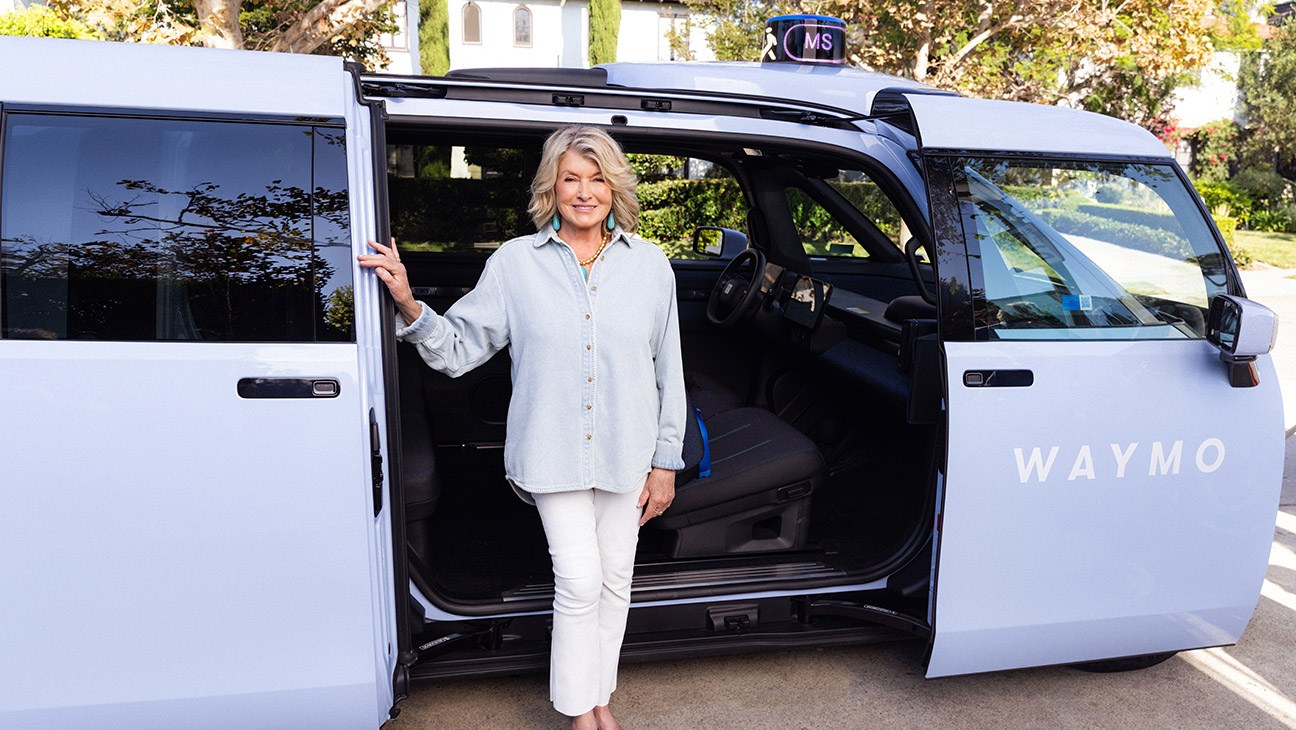


Martha Stewart is teaming up with Waymo, Alphabet’s autonomous-driving company, on a social campaign announced Thursday that recasts its new Ojai vehicle as her latest “home away from home.”
In a 52-second spot inspired by Architectural Digest’s Open Door video series, she welcomes viewers into the vehicle and assesses it as if it were one of her own residences. “When choosing a property, good homes are essential,” she says, praising its “excellent architecture and curb appeal” before touring three screens and asking Gemini about the weather.
“I’d hand you the keys, but there aren’t any,” she jokes. “So make yourself comfortable and enjoy the ride. Welcome home.”
The launch arrives with a touch of off-script irony. When The Hollywood Reporter caught up with Stewart to discuss the collaboration, she was headed to a garden club meeting in Bar Harbor, Maine, and had to pause to direct her lost human driver toward the historic Pot & Kettle Club gentleman’s club.
That exchange would not happen in a Waymo, or at least not in the same way: Its AI-powered Driver controls the vehicle, while Google’s Gemini answers questions inside the cabin.
The all-electric Ojai, which began carrying select public riders this year, is Waymo’s first vehicle designed specifically for autonomous ride-hailing rather than adapted from an existing passenger car. Built by Chinese EV manufacturer Zeekr and outfitted with Waymo’s technology in Mesa, Arizona, it resembles a compact passenger van.
Its elevator-like sliding doors open onto a low step, wide entrance and completely flat floor. The current configuration accommodates up to four passengers — one in the front passenger seat and three across the rear — while embedded braille, screen-reader compatibility and a seat-integrated support handle address accessibility.
Stewart is unsparing about the alternative. A New York yellow cab, she says, puts passengers in a crowded back seat behind a glass barrier with few amenities. “It’s a pretty horrible experience,” she says.
Ojai, by comparison, has doors that slide open at the touch of a finger, unobstructed space and screens within easy view of its passengers. “There’s legroom. It’s comfortable,” she says.
She also sees the cabin as productive space. “Any car is my office,” Stewart says. Although she generally prefers the front passenger seat, Ojai’s rear cabin may convert her.
With no human driver, “you’ve got this space really all to yourself,” says Jackie Hyun, Waymo’s head of marketing.
One screen sits in front and two are positioned in the rear. Their displays adapt to occupied seats, giving the nearest rider full control while unused screens show trip status or ambient imagery. Riders can start the trip, reposition the passenger seats and set the temperature through a screen or the Waymo app. Calm Mode dims the displays and reduces the information shown.
A linked Spotify account can follow a rider into the vehicle, and YouTube Music is also integrated. Hyun says Ojai’s trunk, additional legroom and “party space” make it particularly suited to airport trips and small groups.
That proposition is especially relevant in Los Angeles, where hours spent crossing the city can become part of the working day. Waymo has said local riders already use driverless trips to take meetings, film social content or work between appointments. Ojai pushes that behavior further, functioning as a private mobile office or green room in a city where transportation and entertainment are intertwined.
Waymo has also been methodically placing itself within entertainment culture. Its Spotify integration was promoted through a campaign with Saweetie, while singer-songwriter Julia Michaels performed “No Heartbreak’s Killed Me Yet” from the back seat of a Waymo to introduce YouTube Music. Waymo vehicles have appeared in music videos from Kesha and KATSEYE, while custom-wrapped cars have promoted artists including Sabrina Carpenter and BLACKPINK.
Stewart extends that strategy beyond pop music. She gives an unfamiliar machine the imprimatur of one of America’s most recognizable authorities on domestic life, helping Waymo position Ojai not simply as a robotaxi but as an aspirational personal space.
Two distinct AI systems are at work inside it. The sixth-generation Waymo Driver is the purpose-built autonomous-driving AI. Its 13 cameras, four lidar units, six radar units and onboard computing perceive the road and perform the entire driving task. The sensors provide overlapping fields of view extending as far as one third of a mile, with heaters, wipers and cleaning systems designed to keep them functioning through undesirable road conditions, including snow and grime.
That cold-weather capability is central to Waymo’s national expansion plans, as is the reduced number of sensors compared with its fifth-generation system. Waymo says the newer system costs less while delivering greater resolution, range and computing power.
Gemini is an optional conversational AI assistant for passengers. It can answer general questions, provide information about the trip and nearby locations, adjust cabin controls or request that the vehicle pull over. It operates separately from the Waymo Driver: Gemini cannot steer, alter the route or access the Driver’s real-time driving data.
While it might seem like a paradigm shift for Stewart — whose brand is associated with hospitality, entertaining and gracious living — to embrace AI, she says it’s nothing of the sort.
“This is the future. I’m all about the future. I don’t live in the past,” Stewart says. Her interest began with the science fiction she read and watched during the 1960s. “You dream about it. You see the possibilities, and now the possibilities are a reality.”
Stewart, 85, co-founded Hint, an AI-powered home-management app, and says she regularly uses both Gemini and Anthropic’s Claude. Asked whether AI threatens the human touch at the center of her work, she says it is “extremely useful” and improving daily.
Once AI hits the streets, consumer unease over crashes, surveillance and threats to livelihoods builds.
Pressed on whether there was anything she would not trust Waymo or AI to do, Stewart answers, “No, not at all.” She says she felt no hesitation during her first driverless ride in Los Angeles. “Nothing,” she says. “I just hoped that all the cameras were working.”
Those cameras create concerns of their own as law enforcement agencies seek footage recorded by Waymo vehicles. The company says its cameras are intended for mapping, safety and improving the technology rather than facial recognition or biometric identification. It requires valid legal authority before releasing information and says it may challenge requests it considers overly broad or unenforceable.
Inside Ojai, Waymo says Gemini does not retain riders’ audio, though it may keep written transcripts to evaluate and improve the assistant.
Safety also remains under examination. The National Transportation Safety Board is investigating multiple incidents in which Waymo vehicles passed stopped school buses in Austin, Texas. In December, Waymo recalled and updated the software in 3,067 vehicles equipped with its fifth-generation autonomous-driving system.
Waymo’s own analysis compares its autonomous-driving performance with human-driver benchmarks over equivalent distances in the same operating areas. Covering more than 220 million fully autonomous miles through March, the company reported 82 percent fewer injury-causing crashes and 94 percent fewer crashes causing serious or fatal injuries. The comparisons count collisions regardless of fault.
“Within a few minutes … the guard comes down because the driver is so reliable,” Hyun says. “Our car drives the speed limit. It’s safe. It never does a California roll.”
“Jobs change over time with different technologies,” Hyun says of criticism that autonomous vehicles could displace professional drivers. She points to jobs maintaining, charging and preparing vehicles at Waymo depots. “We definitely see that as our responsibility to continue to make sure that people are taken care of in all regards.”
Ojai recently began welcoming select riders in San Francisco, Los Angeles and Phoenix. Waymo plans to bring the vehicle to Denver, Las Vegas and San Diego as it expands access.
Stewart has used Waymo only in L.A. “I’m waiting for New York,” she says.
There, perhaps, a driverless car might finally save Martha Stewart from another yellow cab, a late arrival to her garden club meeting and having to give directions from the back seat.
Read the full article here