




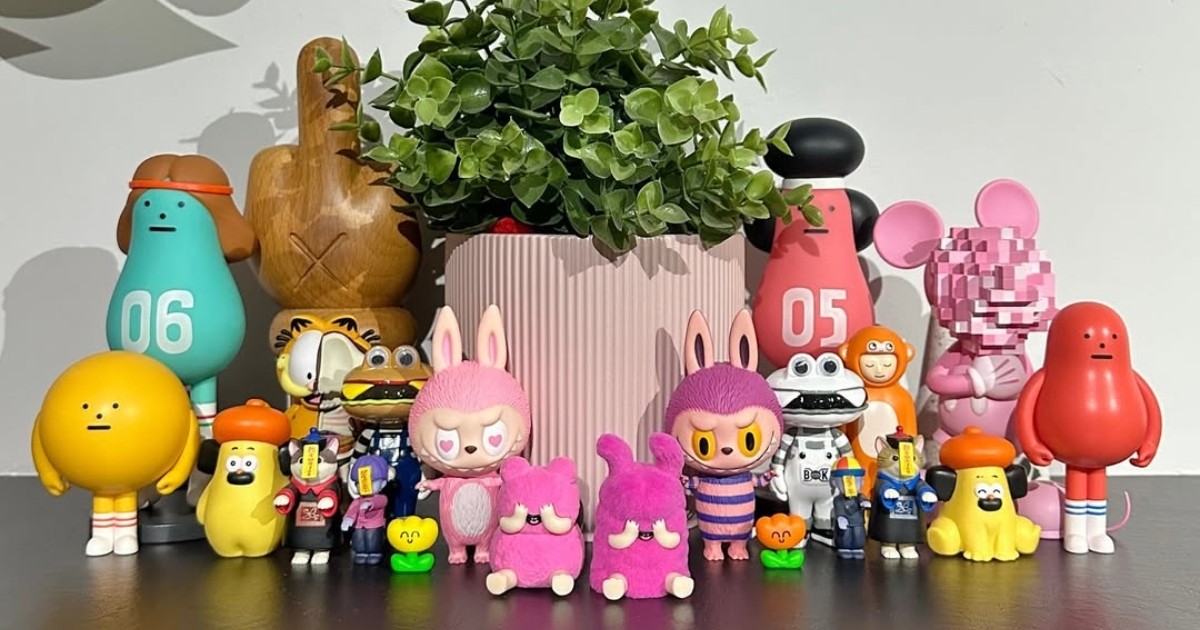


From blind boxes to trading cards and plushies, collectibles are trending.
Fuelled by popular brands like Pop Mart, Pokemon and Sanrio, the phenomenon has grown exponentially in recent times beyond niche collectors and children, drawing in buyers across all age groups and walks of life.
In August 2025, China’s Pop Mart — the makers behind the famed Labubu dolls — recorded a nearly 400 per cent surge in first-half net profit compared to a year ago, reported Reuters.
Even brands like Milo — who are not usually in the toys or collectibles space — are hopping on the trend with their viral “Milo plushies”.
[[nid:717452]]
The trend has not gone unnoticed by the Government either.
The unboxing craze has become so intense that Home Affairs Minister K. Shanmugam revealed in March that the authorities will be introducing new regulations for blind boxes as a way to mitigate the risks associated with gambling-like behaviors.
Where do the toys go?
Looking beyond the dopamine hit that the opening of blind boxes give, there is also a hidden environmental cost to all the mania.
Where do the toys that don’t make the cut for your bag charm or display case end up?
For collector Pyron Tan, it’s something he’s noticed as his collection grew.
“Sometimes I look at a toy and think ‘why did I even buy this?'” the 45-year-old told AsiaOne in an interview.
Pyron has been into toys and collectibles for the past 24 years.
His journey started when he became fascinated by the toys at a flea market visit during his art college days back in 2002. His lecturer had assigned him a project which required him to purchase a toy for a 3D model and short animation.
“My classmates and I went to a toy flea market at Clarke Quay back in the day, and that visit completely changed everything. It was like stepping into another world. After that, there was no turning back,” said the graphic designer.
“I think I enjoy collecting because it connects to my creative side. Toys are like small pieces of art to me.”
While many collectors tend to focus on a specific niche — whether it’s a certain brand of plushies, trading cards or figurines — Pyron takes a less selective approach.
“I collect a bit of everything,” he said. “From vintage toys, blind boxes, action figures and plushies to art toys. Basically anything that looks fun or interesting.”
According to him, the number of toys in his collection is “honestly uncountable”, but probably fall in the “few hundreds” range.
Space a major issue
Finding the room to keep one’s collectibles can quickly become a challenge.
“The biggest problem for all collectors is space. You can’t just keep buying forever,” said Pyron.
He faces this issue despite regularly conducting “spring cleans” by selling items online, at flea markets, gifting them to friends or donating them.
Meanwhile, for 46-year-old Jian Yang who has the largest collection of Barbie dolls in Asia, the answer doesn’t always lie in letting go. Sometimes, it may be about extending the life cycle of a toy.
“I actually keep things that I don’t love anymore because one day they will come back round and I will love them again,” the managing partner of Distilleri told AsiaOne. “I’m having a massive ’90s resurgence and I’m loving all the ‘junk’ dolls from that era again.”
But beyond storage, what happens to these toys and collectibles in the long-term?
“It comes up quite often among collectors… what happens to all these toys when we get older or when we’re no longer around,” shared Pyron. “One thing I’ve learned is to slowly streamline and focus on what I really like, instead of buying everything randomly.”
Impact on the environment
According to a report cited by the Yale Environment Review, toys make up around six per cent of all landfill plastics globally. The number may sound small, but in France alone, 40 million toys are discarded into landfills each year.
Speaking to AsiaOne, Dr Tu Wei Ming, Nanyang Assistant Professor at Nanyang Technological University’s School of Civil and Environmental Engineering said that most toys and collectibles contain harmful materials.
They are made from plastics such as polyvinyl chloride (PVC) and acrylonitrile butadiene styrene (ABS) alongside other materials such as paints, coatings and synthetic fabrics. They also often contain plasticisers called phthalates to stay flexible — which has negative impacts on both environmental and human health.
“When disposed of in landfills, PVC can gradually fragment through mechanical stress and weathering, contributing to long-term microplastic formation and environmental contamination,” warned the assistant professor.
Stressing that microplastics is a key concern, Asst Prof Tu explained that particles can contaminate soil, groundwater and aquatic systems, which then enters the food chain and ultimately contributes to human exposure.
Evidence also suggests that they may be associated with health conditions such as respiratory inflammation, endocrine disruption and neurotoxic effects.
“Long-term exposure has also been linked to chronic inflammation and oxidative stress, which may increase the risk of certain health conditions, including some cancers,” he added.
In Singapore, most waste is incinerated and converted into energy, with the ashes sent to Semakau Landfill alongside other non-incinerable trash — but Asst Prof Tu says it’s “not a complete sustainability solution”.
While it is useful in a land-scarce country where landfill space is extremely limited like ours, the process still has “important limitations”, such as not eliminating emissions.
“Burning plastics releases carbon dioxide, contributing to climate change. In addition, certain materials can produce toxic by-products during combustion, although modern facilities use filtration systems to reduce pollutants,” said Asst Prof Tu.
Incineration also produces residual ash, which must still be disposed of at Semakau Landfill, which is projected to reach capacity by 2035.
“Overall, incineration should be viewed as a waste management solution rather than a sustainability solution. It helps manage volume and energy recovery, but it remains lower in the waste hierarchy compared to reduction, reuse and recycling, which have far greater long-term environmental benefits,” he said.
The assistant professor added that incineration also represents a permanent loss of materials, which means the plastics or metals are not kept in circulation, and new raw materials still need to be extracted and manufactured — which Asst Prof Tu says may have the largest environmental impact throughout the cycle.
This is because plastics require crude oil extraction and metals require mining, both of which are highly carbon-intensive and can cause irreversible ecological damage such as habitat loss, soil degradation and water contamination, he explained.
He noted that at the production state of these toys and collectibles, environmental burdens are further amplified — as the synthesis of materials such as PVC can generate toxic by-products including dioxins and other persistent organic pollutants.
In addition, energy-intensive processes such as injection molding and metal smelting rely heavily on electricity and heat, which in major manufacturing hubs such as China and Vietnam, are still partly dependent on fossil-fuel dominated energy grids, leading to substantial greenhouse gas emissions.
But if plastic bottles and other materials can be recycled — why not toys?
This is because many toys, collectibles and their packaging are often made from mixed materials, including different types of plastics, paints, coatings, adhesives, metal components and electronic parts, explained Asst Prof Tu.
While cardboard boxes — often used as packaging — are generally recyclable, many toy packages include other components such as laminated paper, plastic windows, foam inserts, metallic finishes and multi-layer materials that are difficult to separate, and as a result, only certain components may actually be recyclable.
They are tightly combined during manufacturing, making separation for recycling challenging and unattractive for recycling facilities.
Said Asst Prof Tu: “In practice, although some individual materials within toys and packaging are technically recyclable, the proportion that is successfully recycled is much lower. A significant share ultimately ends up in landfills or incineration facilities due to contamination, material complexity and limited recycling infrastructure.”
Awareness of environmental harms
These environmental concerns aren’t lost on the collectors themselves.
“Yes, I acknowledge that the toy industry is a huge contributor to waste. Especially due to plastics and the mindless consumption of some,” said Jian.
To counter this, he started the #flushablefashion project — creating doll fashion from upcycled materials such as tissue paper. The initiative is also the name of his sold-out book. A capsule collection of designs from the project was exhibited in April during Eco Fashion Weekend, a three-day sustainable fashion festival.
Pyron, on the other hand, turned to adjusting his purchasing habits.
In a bid to be more eco-friendly while still enjoying his hobby, he has started buying more from second-hand markets instead of getting brand new toys.
“It’s like thrifting clothes, but for toys. Many times, you can get them under retail price,” he explains.
Recognising that the excessive packaging that comes with the toys is also an issue, Pyron once gave feedback to a toy company about reducing packaging size and waste.
“Some boxes are much larger than the actual toy and use Styrofoam. I suggested using smaller, fully recyclable paper-based packaging instead. It could reduce waste and possibly lower costs,” said Pyron.
According to the National Environment Agency (NEA), Styrofoam packaging is of concern in countries where waste is sent directly to landfills, as it is non-biodegradable and remains in the landfill for a long time.
In Singapore, all incinerable waste, including Styrofoam packaging, is incinerated safely at waste-to-energy incineration plants fitted with pollution control equipment.
Still, NEA urges the use of reusables as they remain the more environmentally friendly option.
Pyron also believes manufacturers can contribute to sustainability efforts by reducing plastic use, including Styrofoam, using more recyclable materials and limiting the number of variations produced for the same toy.
“Usually, the OG version is the most popular, and the rest end up in the sales bin,” he noted.
The collector also added that companies can also test demand before mass production, likening it to the Housing and Development Board’s BTO projects.
“If the BTO flats did not meet the minimum 70 per cent application ratio, the project would be cancelled. If no one wants it, maybe don’t make it,” he said.
And it seems some manufacturers are on the same page with the collector.
https://www.instagram.com/unigonsplay/p/DMlD6kPpdog/
One such brand is Unigons — the local design brand behind the Fortune Merlion blind boxes.
The company collaborates with regional brands like Yeo’s, IF Coconut and Swire Coca-Cola to transform plastic waste into “something treasurable”, the design brand told AsiaOne.
They do so by recycling used polyethylene terephthalate (PET) plastic bottles into 3D printing filaments, which are then used to craft toys and collectibles.
“Brands play a powerful role in shaping how products are made, consumed and ultimately discarded, especially in the world of packaged goods,” they said.
“The widespread use of single-use PET plastic has led to a lasting environmental impact. While our efforts address only a small fraction of this waste, we aim to use our creations to raise awareness and drive meaningful change with brands.”
According to Unigons, some ways that manufacturers and companies can contribute to sustainability efforts include adopting recycled and environmentally-friendly materials, rethinking packaging to reduce waste and moving away from short-term novelty items.
Changing mindsets
As a collector himself, Pyron encourages other collectors to be more intentional with their purchases, instead of buying for profit or on a whim.
He also advised them to “practice mental discipline” and to sit on their purchases for a while to prevent impulse buying.
“If you’re having sleepless nights then okay, maybe it’s true love,” he joked.
Jian echoes Pyron’s advice on being mindful while enjoying the hobby, warning that many collectors cross into “hoarding without realising it”.
“If we take time to appreciate what we have, we will buy less. The collection will become more valuable to you. That should always be the end goal,” he said.
[[nid:723106]]
carol.ong@asiaone.com
Read the full article here