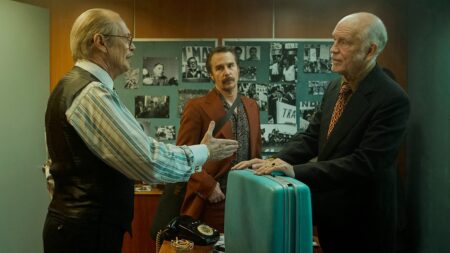








It was hard for La Bola Negra to make much noise over the whole of Cannes, if only because the gay Spanish epic did not premiere until the very end of the film festival — at which point, it promptly emerged as one of its clear breakouts. Directed by creative (and, previously life) partners Javier Ambrossi and Javier Calvo — known colloquially as Los Javis — the film earned strong reviews, was acquired by Netflix in a splashy deal, and won the festival’s coveted best-director prize (in a tie with Fatherland’s Pawel Pawlikowski). It was a smash hit, at least for those who remained on the Croisette in those final days.
So Telluride, where La Bola Negra made its North American premiere this weekend, has represented the moment for the movie to prove itself as a true word-of-mouth hit. It’s done that and more. On gondolas and in line for premieres, around cafés and passersby on Colorado Avenue, it’s among the films I’ve heard about the most — a sweeping emotional experience that doubles as a deftly ambitious and subversive exploration of Spanish queer history.
The filmmakers, alongside star Carlos González, gathered on Sunday for a post-screening Q&A (moderated by yours truly) at the Palm Theater on the town’s western edge, where they met an electric response. As Calvo summed up the grand vision behind the movie: “Let’s give all the straight people the war movie they want, but let’s give our community the love story that they want — why can’t we have it all?”
La Bola Negra, loosely adapted from Alberto Conejero’s play La piedra oscura, tells its story in three separate timelines that gradually converge. The 1937 section is drawn most directly from Conejero’s work (Conejero also co-wrote the screenplay), set during the Spanish Civil War. The modern strand, set in 2017, follows a young man named Alberto (González) investigating his family history while negotiating complex relationships with his partner (Julio Torres) and mother (Lola Dueñas). And the final third, taking place in 1932, marks La Bola Negra’s most audacious gambit: It imagines the entirety of Federico García Lorca’s great unfinished work, also called La Bola Negra (translated to The Black Ball) — its themes of lust, shame and legacy rippling through the stories that follow.
Made for under $15 million, the Spanish-language drama offers immense scope, which was by design. “We thought, ‘Let’s make the gayest war movie ever,’” Ambrossi said. “That’s the politics behind this. And no one told us to change it a bit. And now, here we are.” The movie was made, per Calvo, with reverence for great war films like Apocalypse Now, using minimal CGI and making the most of every practical location, extra and visual effect they had at their disposal. La Bola Negra was also shot on 35mm, and brought in starpower via small but pivotal roles for Glenn Close and Penélope Cruz (whose mere mention elicited loud applause from the audience).
The movie’s emotional pull is anchored by a bracing examination of gay identity, of what’s inherited and passed on between generations. “It made me understand the importance of art in a physical way — the things that come to us, the pieces of art from past generations that tell us about who we were and what happened to us,” Calvo said of Lorca’s work. “At a time when art is being questioned, we have to remind ourselves that it speaks the best language.”
“He represents the war, all the dead…in our country that remains hard to talk about,” González added, noting that when he was taught García Lorca in school in Spain, the legendary writer’s sexuality was never discussed.
La Bola Negra lifts the veil on that silence — immersing audiences in its impassioned, maximalist filmmaking. “It’s very visceral. This is the black ball that is inside all of us as LGBTQ+ members of the community,” Ambrossi said. “We’ve been rejected.” La Bola Negra offers the chance, he then explained, to be seen.
**
Netflix will release La Bola Negra in theaters on Oct. 16 before streaming 47 days later on Dec. 2, the longest theatrical-exclusive window in the company’s history.
Read the full article here