




[Warning: Some spoilers ahead regarding plot points in Marty Supreme.]
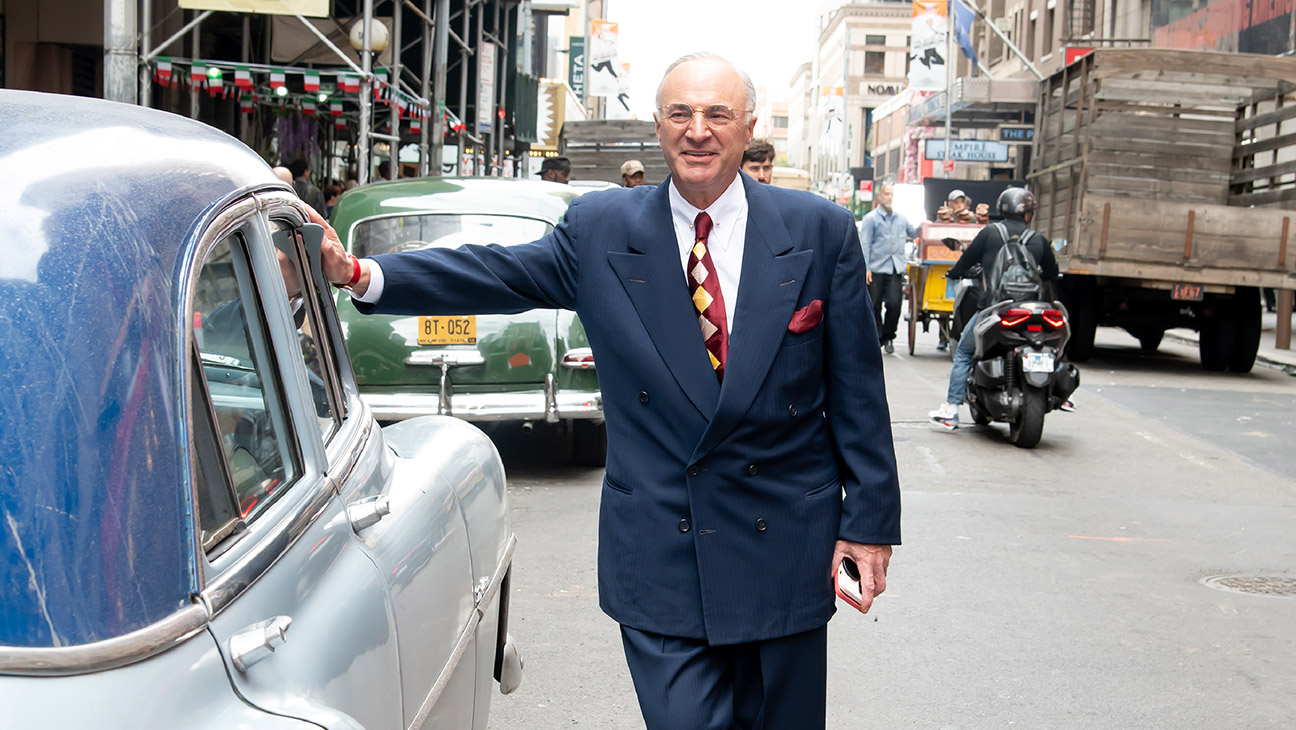
In one brutal scene from Josh Safdie‘s Marty Supreme, Timothée Chalamet’s aspiring table tennis champion pulls down his pants to accept a punishment from Milton Rockwell, a fictional business mogul portrayed by real-life business mogul Kevin O’Leary. Marty had turned his back on Milton’s slimy offer for financial support, only to later crash a party begging for his forgiveness. Milton asks Marty to grab a ping-pong paddle from another room, then, before an audience in the living room, beats his buttocks with it until they’re bright red.
For O’Leary, here was his introduction to the magic of moviemaking. “That’s really Chalamet’s ass — he didn’t want the stunt double. I said, ‘Timmy, I’m going to have to belt your ass, are you sure you want to do this?’ ” O’Leary tells The Hollywood Reporter. “He immortalized his ass on film for the rest of time. That scene freaks me out even now.” Don’t mistake that for remorse. After filming concluded, O’Leary admitted to Safdie, “This is pretty fucking crazy, man.” Safdie then asked his actor if he’d do the same if he were in Milton’s shoes.
Without missing a beat, O’Leary replied: “Oh, I’d do worse than this.”
Making his acting debut in Marty Supreme, O’Leary delivers an undeniably impressive performance. The powerhouse investor, who broke out as co-founder of the family technology company SoftKey (which sold to Mattel for $4.2 billion in 1999), showcases both the charisma he’s displayed as a main Shark Tank judge for more than 15 years and the naturalism of a relatively seasoned character actor. The way O’Leary tells it, he pulled it off because he basically played himself. “I have no idea what the rules of acting are. I really don’t. I don’t give a shit. I’m never going to take acting lessons,” says the Montreal native. “I felt that I am Milton Rockwell — if I was in 1952, that would be me.”
It might sound like an odd admission, since Milton is so dislikable. Several critics have dubbed him the villain of Marty Supreme, and at minimum, he stands in direct opposition to our frenetically ambitious hero. “I’m not a villain,” O’Leary says. “But I know people say that.”
In conversation, O’Leary initially projects a clear separation between actor and character. The 71-year-old Zooms in from Miami in street style, wearing a color-blocked, floral-patterned satin bomber jacket over a black T-shirt and a gold chain — a far cry from the crisp suits of Marty Supreme, or Shark Tank for that matter.
But at times during our interview, O’Leary blurs the lines between himself and Milton. Like Milton, O’Leary is a very rich man (his net worth is estimated at around $400 million), constantly on the hunt for worthy investments and deals. He doesn’t care whether he rubs people the wrong way — he publicly supported Donald Trump in the lead-up to the 2024 election, though has recently emerged as a cable-news talking head across the partisan spectrum — and conveys unshakable confidence in his own opinions about the state of the world. He even speaks of Marty Supreme as if the characters are real. He successfully suggested a script change through what seems like personal vendetta.
“I felt at the end that Marty had not paid the price that he should have,” O’Leary says. “I was deeply dissatisfied with the ending. … There’s no way in real life I would let this little fucker get away with this.” His final exchange with Chalamet was altered accordingly.
O’Leary insists his Shark Tank “asshole” (his word, not mine) persona isn’t a character, either. When I relay what Safdie told me about casting O’Leary in Marty Supreme — “I needed someone who you did not like … in a deep, unconscious way,” Safdie said — O’Leary simply smiles. “I love it. I cannot please everybody. I just tell the truth.”
When O’Leary first got wind of Safdie and co-writer Ronald Bronstein’s interest, he chartered them a private plane to meet him at his lake house up in Canada. He loved the script’s scope and admired its portrait of postwar New York, centered on a hustler in restless pursuit of his own American dream. O’Leary related to it and also saw an educational opportunity for audiences.
“Why is it that America’s so successful? It’s captured in the trials and tribulations of what you see in the film — the chaotic, kinetic, insane storyline,” O’Leary says. He spends a few minutes drilling down for me — in intonations familiar to any viewer of Shark Tank or his CNBC segments — why the U.S. remains the “No. 1 economy on earth,” adding, “This is a good reminder of why you shouldn’t fuck with it,” he says.
But these days, some people do want to “fuck with it.” I ask O’Leary why he thinks he’s viewed as the villain in Marty Supreme — and maybe in general — in light of the political shifts cemented by Democratic Socialist candidate Zohran Mamdani’s mayoral election victory in New York. “You’ve caught a very interesting theme there — people get confused about capitalism,” he says, before extolling capitalism. “[Mamdani] is a great experiment. Let’s just see in four years how that all worked out. We should give it a shot and see how far he gets, but I think reality is going to bite his hiney pretty damn fast.”
In October, O’Leary publicly criticized the Marty Supreme production for hiring and paying extras instead of just filling in backgrounds with AI inserts for cheap. “I remember doing shoots back in 1984 in arenas where we put cutouts in the seats,” he says now, arguing his comments were taken out of context. “They did that in Ben-Hur. You didn’t make people sit there for 16 hours. Today, I think we would do that with AI and it would be the same thing.”
O’Leary prefers to be right about pretty much everything, so it’s notable that he acknowledges that making Marty Supreme has changed his outlook on AI in art — which makes sense, since he’s working with award-winning masters of the craft, from production designer Jack Fisk to cinematographer Darius Khondji. “We did not shoot until [Darius] was happy with every aspect, and I thought, ‘What a pain in the ass,’ ” O’Leary says. “I’m used to reality TV. We bang out multiple episodes in one day.” But Safdie’s and Bronstein’s methods, especially, struck him: “What specifically changed my view was the fact that so much of the improvised lines made it into the final cut. That only happens in the magic of 4 a.m., when somebody says something that the other actor riffs off of.”
O’Leary mostly acts opposite Chalamet and Gwyneth Paltrow, who portrays Milton’s wife, a past-her-prime 1930s film star mounting a stage comeback. “I don’t really get intimidated with anybody anywhere,” he says of his scene partners. (O’Leary actually knew Paltrow a bit, as the Goop founder has guest-hosted Shark Tank several times.) But again, working with them helped him see what the art is all about.
“I don’t want to act with an AI agent — how’s that going to work? I don’t know how you can do it any other way than just have those actors in that moment,” O’Leary says. “Or if an extra is in an interaction with the principal, you can never use AI because you’ll never have the cadence. It won’t work next year. It won’t work the year after that.”
More big-time directors are already sending O’Leary their scripts now that the word is out about his auspicious debut. In the strongest evidence that he’s gone Hollywood, he declines to name anyone — “I wouldn’t do that to them” — but he’s already proving selective. He doesn’t want to play a “nasty agent,” one role he was offered. In fact, he doesn’t want to do much of anything other than more Milton Rockwell types — or, just as accurately, Kevin O’Leary types. He does not plan on testing his versatility anytime soon.
“Twenty years ago, Mark Burnett took me to Shutters near where his offices were back then in L.A., and he said, ‘I’m casting for a new show called Shark Tank, and I’m looking for a real asshole, and you’re it,’ ” O’Leary says. “Twenty years later, Josh Safdie says the same thing. So I’m figuring this asshole thing is starting to work for me.”
This story appears in the Dec. 17 issue of The Hollywood Reporter magazine. Click here to subscribe.
Read the full article here