


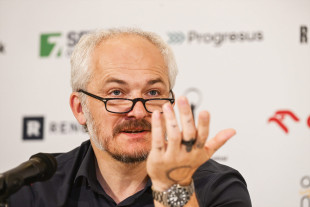


The 60th edition of the Karlovy Vary International Film Festival (KVIFF) in the fest’s 80th year in existence unspools July 3-11.
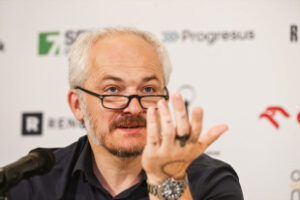
The Czech festival‘s Crystal Globe and Proxima competitions, as well as other selections, are full of movies from various parts of the world. And that’s just how KVIFF artistic director Karel Och and his team like it.
In a conversation previewing the film lineup for KVIFF 2026, Och discussed how he approached the double anniversary edition, a number of firsts and how the global scope of the program ties in with the early, and already ambitious, early days of the festival.
Happy 80th anniversary and happy 60th edition, Karlovy Vary! Did you approach this year’s selection for the double anniversary any differently?
I would say the anniversaries did not change the usual approach towards the official selection. Maybe it did somehow subconsciously in a way. I personally spent long hours in the National Film Archive while preparing our Out of the Past program, going through all possible and existing documents of the festival since 1946, mainly internal documents, but also the festival dailies. I guess somehow I had to have that in mind, but that was more for the classics section.
Your lineup this year includes the first-ever KVIFF films from Myanmar and Colombia, as well as your first-ever Swiss Crystal Globe competition movie. Can you share any insight on those firsts?
When it comes to the contemporary cinema selection, we are proud of having Colombia and Myanmar for the first time.
Thinking of one of my predecessors in my position, Mr. A. M. Brousil [who was one of the festival’s founders and its long-time director of programming], I always take a lot of pride in repeating the fact that in 1962, this gentleman already created a programming section called Symposium of Young and New Cinematographies of Asia, Africa and Latin America.
He not only programmed the films, but he also brought the filmmakers to Karlovy Vary, which in the early ’60s was not that common. That was why Glauber Rocha from Brazil could meet Pier Paolo Pasolini from Italy and become friends with him in Karlovy Vary. [The two auteurs screened their directorial debut films at KVIFF in 1962, with Pasolini bringing Accattone, his provocative drama about a pimp living on the outskirts of Rome, and Rocha bringing his socio-political drama Barravento.]
So that global perspective is part of the KVIFF DNA?
Somehow, we have always striven to bring films from as many countries in the world to the main competition. But this year, I have to particularly underline the works-in-progress sessions as a source for selected films.
Two of the films that we mentioned we found there. The Colombian film Five Years, Four Months [from directors Esteban Hoyos García and Juan Miguel Gelacio], we scouted in San Sebastian, and I was in touch with the filmmakers ever since. And the Swiss film [Jan-Eric Mack’s A Happy Family], I saw at the Les Arcs Film Festival works-in-progress [showcase] in France in December.
The fact that we could select these films is a result of both the world knowing that we are open to supporting any possible country in the world, but also a result of the industry platforms opening up to the entire world.
That is a nice benefit!
The world is getting smaller in a way. We often complain about social media and the internet creating a lot of messes, but on the other hand, we can connect more easily, we can communicate more easily, and we can travel around and discuss movies with Colombian filmmakers or filmmakers from Myanmar, and co-produce films.
I am glad you mentioned that because I wanted to ask you about a comment you made in unveiling the 2026 official selection. You highlighted that the filmmakers presenting their work at Karlovy Vary this year “cross boundaries, both spiritually and physically.”
What we noticed with my colleagues across the program is that you often see movies directed by a filmmaker born in one country that was directed in a different country, and it’s maybe speaking about a community from a different country.
For example, the competition movie Hijamat [directed by Nader Saeivar and produced and edited by Jafar Panahi] is a German film directed by an Iranian filmmaker, taking place in the Turkish community in Germany, and it feels perfectly natural, because the story and the approach are profoundly human. So, this all just adds to the diversity of the stories and cultures.
Before I let you go, please tell me about the benefits and the pressures of getting as many film submissions as KVIFF receives each year? Is the figure still around 1,500-plus?
We’re always somewhere between 1,800 and 2,000 submissions these days. The line where it got really difficult and time-consuming was the mark of 1,500 films. But at the same time, we are really happy about it, because the more submissions you have, the bigger the chance is that you discover a hidden gem. So, the numbers, as high as they are, they are a source of joy for us, and not a source of frustration. It is always a great joy when you discover that your work and the work of your colleagues is appreciated.
Read the full article here