





On a balmy July Saturday in Southern California, deep in the air-conditioned bowels of the San Diego Convention Center, Dave Green watched his own unreleased movie for the first time in three years. Despite the very long gap, doing so took some convincing. His film, Coyote vs. Acme, had been in development at Warner Bros. for years, only for the studio to shelve it as a tax write-off in 2023 after production completed. Following fan outcry, Warners then decided to explore offers to sell it, only to — after rejecting various bids — seemingly take it off the market. A “funeral screening” was held; the movie sat in indefinite limbo. Outrage on social media did not cease until, miraculously, a savior came through years later in the form of Ketchup Entertainment, an upstart distributor that paid $50 million for the rights last year. At last, it will release the film in theaters on Aug. 28.
The first public screening was slated for Comic-Con’s coveted Saturday evening slot, in tribute to the fans who never gave up. Green intended to skip it. “I was crazy nervous. I was like, ‘I’m not going to sit through the movie. I can’t watch it again. It’s too intense,’ ” he says. Producer Chris DeFaria, with whom Green has spoken every day for the past six years, told him he’d regret missing out: “He’s like, ‘No.’ He reminded me, ‘This is the reason why we do what we do.’ ” The screening went over like gangbusters. “Chris was right,” Green says now. “I sat through it. I was reminded of the movie we made.”
It’s the kind of happy ending that Hollywood has been projecting on the big screen for a century — and is far rarer behind the scenes. The arc of Coyote vs. Acme stands out as a defining bumble of David Zaslav’s stewardship of Warner Bros. Discovery, culminating at a particularly rough time for the studio and its chief. His planned merger with Paramount is in a holding pattern, devolving into yet another PR nightmare, and he’s seen the likes of The Bride! and Supergirl bomb hard at the box office. Meanwhile, Coyote will hit theaters at last as a true underdog, with attendance fueled by an unprecedented fan campaign. If it’s a hit? Well, boom goes the Acme dynamite.
***
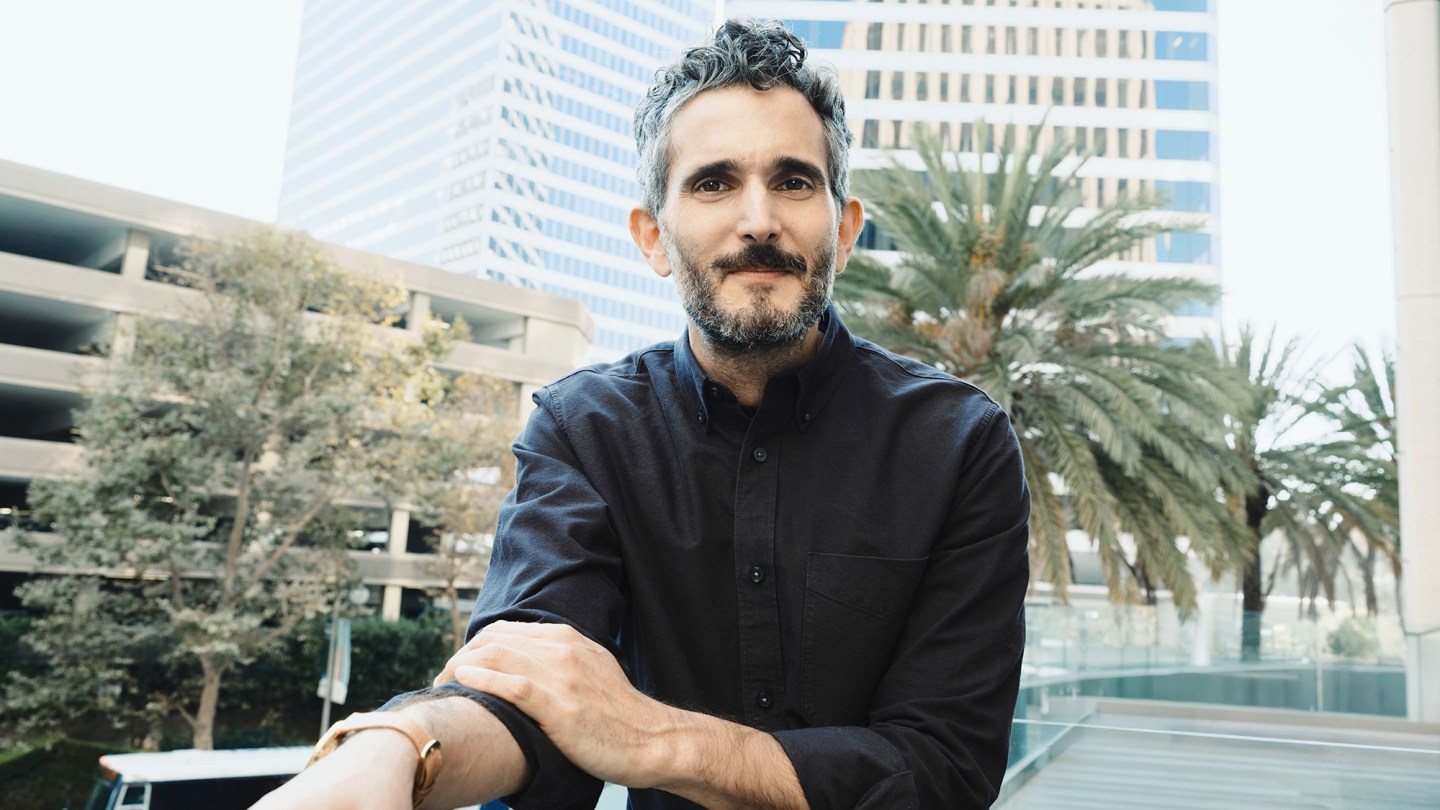
In conversation, Green is warm, remarkably even-keeled given his movie’s roller-coaster ride and ever so careful — prepared to forge ahead and helm large-scale films, even as his latest was so recklessly yanked around, shoved to the brink of oblivion. He’s speaking over Zoom from his attic, standing in front of a massive whiteboard of small note cards taped backward, their contents kept hidden. “Those are for Hex,” he says, referring to his next movie — in development with another major studio, 20th Century, and shrouded in secrecy. “I don’t want people zooming in.”
A production assistant on Sam Raimi’s Spider-Man sequels in his early 20s, Green burst onto the scene in the late 2000s directing music videos, like a cover of Talking Heads’ “This Must Be the Place” by recurring collaborator Miles Fisher, and comedy shorts, notably the David Cross vehicle Meltdown. By 2012, he’d been tapped by Walt Disney Pictures to helm Earth to Echo, a modestly budgeted sci-fi original. Disney then ditched the movie, offloading it to the scrappy Relativity Media — sound like a familiar trajectory? — before it made more than three times its budget at the box office.
Green proved himself to be both in touch with audience demand and sufficiently thick-skinned to navigate the chaos of Hollywood. During this period, DeFaria was president of animation at Warner Bros. and had met with Green about an unrelated idea that did not move forward. “When you agree to do a studio movie, you’re setting up for a long-term relationship,” DeFaria says. “It’s minimum three years, sometimes more, that you’re going to be living with this — and you’d better find something you love about it.” Green understood this intimately, the producer continues: “For a guy like Dave to work his way up the honest way wasn’t that surprising.”
DeFaria had left Warner Bros., completed a brief stint at DreamWorks and returned to independent producing by the time Green came back into his orbit in 2019. A Looney Tunes riff called Coyote vs. Acme had been spearheaded for Warners by James Gunn — who was not yet associated with the studio as he is now — as the co-chairman and co-CEO of DC Studios. The development had gone dormant by the time DeFaria was brought in by his old colleagues to revive the project. Gunn remained attached as producer, but, per DeFaria, “He had moved on to other movies. … We didn’t really have any interaction with the previous filmmaking team.”
Gunn’s idea, inspired by Ian Frazier’s 1990 New Yorker comedy piece “Coyote v. Acme,” imagined Looney‘s Wile E. Coyote initiating legal action against the megacorporation behind the defective products — giant rubber bands, faulty parachutes, rocket ship roller skates — that had doomed his endless pursuits of the Road Runner. The studio turned to Green, who was coming off the relatively unsuccessful Teenage Mutant Ninja Turtles: Out of the Shadows but had made his name directing hybrid movies (that is, using both animation and live-action), to put his own spin on the material.
In an email, Gunn says of Green, “I think there are very few directors out there who could balance the fun, the insanity and the sweetness of the story.”
“I remembered pitching, ‘OK, can it be a true-crime documentary? How deep into the legal thriller genre can we go?’ ” Green says. He pored over the Frazier piece, with one question leading his interpretation: “If Wile E. were to sue Acme, would he have a good case?” Green made a presentation, now rather famous among his colleagues, that outlined his meta-layered vision, complete with shots of Michael Mann’s The Insider and stuffed with references to other legal dramas like The Verdict and Erin Brockovich. His north star was Who Framed Roger Rabbit, Robert Zemeckis’ 1988 classic that remains the gold standard of the cartoon hybrid form — and was told through the unexpected cinephilic lens of film noir.
“He was taking this joke to a point where there’s a certain amount of filmic rigor with it,” says screenwriter Samy Burch, who came aboard after Green was hired. Adds DeFaria, “It didn’t blink. It was very clear on establishing a level of seriousness, a level of credibility, a level of commitment to the genre.” Green got the job, which he attributes to having learned the art of politely persuading executives to wade outside their comfort zone. “I wanted to test the boundaries of what was possible,” he says.
This extended to hiring Burch, a former casting director who at the time only had her spec of May December — a dark, strange, hardly studio-friendly script — to show for herself. (Todd Haynes later directed a lauded movie out of it starring Natalie Portman and Julianne Moore, and Burch received an Oscar nomination.) She met with Green, who was looking for a new writer to partner with, and they hit it off. “In no reality, in any other world would I have ended up hired on this movie if not for Dave,” Burch says. “He was coming at this with wanting to put key people in place that don’t just have a long list of credits of kids movies or movies like this — he was trying to get a unique alchemy going, which is really brave.”
The film cannily tugs on the heartstrings, pulls off classic slapstick comedy and sneaks obscure film references into its visuals. Wandering into a live-action world, the traditionally animated Wile E. is represented by a hapless billboard attorney named Kevin (Will Forte) and his niece-cum-associate, Paige (Lana Condor); in the courtroom, they go up against the bullying, burly defense attorney Buddy Crane (John Cena). True to the original cartoons, Wile E. is nonverbal. His fight comes to represent a larger struggle against corporate greed — a rich theme that took on far greater resonance once the film had to go up against its own Goliath, in the form of Zaslav.
Even during production, Green had to stick to his guns. “Samy and I pushed for the weirdness and the specificity as much as possible,” he says. “There are things that survived in the movie today that we had to fight to protect the whole time. We won so many of those battles.” This includes “the existence of animated Peter Lorre,” the late, great character actor (The Maltese Falcon, Casablanca) who was animated in Looney Tunes cartoons throughout the ’40s and ’50s.
“There was definitely a desire to change out that character for a more recognizable character,” Green says with a smirk. “It’s a very deep cut.” Lorre is in the final version. Indeed, he helps open the movie.
***
Filming on Coyote vs. Acme took place in Albuquerque — a city associated with Looney Tunes ever since Bugs Bunny took “that left toyn at Albuquoyque” — in the spring of 2022, during which time Warner Bros. merged with Discovery Inc. and Zaslav took over the company. “In the best possible way, I don’t remember those corporate changes,” Green says. “When you’re working on a project that spans multiple years, you just get used to shifting tectonics like that.” That summer, Green moved to London for more than a year of postproduction, at which point Zaslav’s strategy of writing off certain completed or nearly completed films, like Batgirl and Scoob! Holiday Haunt, was fully underway.
Still, Green did not worry about his own film’s fate. “We saw what happened to Batgirl, and we were shocked and our hearts were broken — and we assumed that we were safe because we had told ourselves that it’d happened in a window of the merger completing,” Green says. “We figured, ‘Oh, once this merger is complete, they’re not going to be able to do things like this again.’ “
But they did, a few months after Green had returned home. The movie was officially shelved in November 2023 for a reported $30 million write-off. There were questions about whether it could make back its $70 million budget; the SAG-AFTRA strike ended literally that day, the industry’s turbulent year hitting an anxious peak. Meanwhile, test screenings had confirmed what Green and others already knew: Creatively, Coyote vs. Acme was a success.
DeFaria got the call first, then he called Green. “As he often does when faced with news that he doesn’t want, Dave goes, ‘What are you talking about? What are you talking about? That’s insane’ — those were his first lines, I believe,” DeFaria recalls. “But he was immediately right in there with, ‘What are we going to do now? How are we going to make sure that the world sees this movie?’ ” Green later put out a statement that said he was “beyond devastated by WB’s decision. But in the spirit of Wile E. Coyote, resilience and persistence win the day.” It remains his pinned post on X.
“We wanted to make sure that it was never viewed as a failure, that it wasn’t being shelved because it was a bad movie,” DeFaria says. “That was something I knew people who canceled the movie were going to start to put out there. We quickly began to take control of the narrative and make sure people understood that it was a very good movie.” A-list filmmakers like Phil Lord and Christopher Miller raved about Coyote vs. Acme on social media, emphasizing that quality was not at issue here. Furious fans got louder and louder. Looney Tunes had been foundational to Warner Bros. for more than 80 years; it was as if Disney had killed off Mickey.
Ketchup then swooped in as a most unlikely hero. The independent company was initially known as the nontheatrical partner of Open Road Films, the specialty distributor behind best picture winner Spotlight that declared bankruptcy in 2018. More recently, Ketchup has put out an odd range of smaller titles on its own, from the prize-winning Jessica Chastain drama Memory (2023) to the one Hellboy movie you probably haven’t heard of, The Crooked Man (2024), to The Day the Earth Blew Up: A Looney Toons Movie (also purchased from Zaslav-era Warners). Buying Coyote vs. Acme was a massive gamble, a reminder there are still big swings to be taken in a town more terrified of them than ever.
Green is grateful for the risk they took. But when asked to reflect on his feelings, back when Coyote‘s existence was still in peril, he demurs: “I was obviously very surprised. … I thought about our team of people, and I felt responsible for all of them.” Pressed a bit on whether he felt upset or frustrated as the saga dragged on, he says, “I was reading so much of what was happening live along with everyone else.” We talk some more on the subject, and at no point in our extensive back-and-forth about the treatment of Coyote vs. Acme does Green express anything resembling anger or disillusionment. You can believe the sentiment or not, but his collaborators make clear it’s consistent with his attitude during the worst of it. Indeed, this attitude may just have saved the movie.
“Dave was a great guy throughout the ups and downs. He was never overly bitter and negative, although a little bit of bitterness and negativity was understandable in the given circumstances,” Gunn says. “However, I think you see, when people show true character in the face of adversity, the world rises up to meet them. And in this case, it did — Coyote vs. Acme being saved is because of Dave’s character and because he made a great movie too powerful to be buried. And gosh, perseverance is kind of what Wile E. and the movie are all about.”
“We got to make this movie. We got to get away with this completely untraditional outside-the-box family movie,” Green says when asked about his current feelings toward Warners. “It’s a miracle that this movie exists in the first place. I have to zoom out and remember that they gave us the gift of the ability to make this movie.” He takes a moment, then adds: “I’m not trying to rationalize. I’m just saying making the movie, to me, is the win.”
When Green and DeFaria first sketched out how they’d make Coyote vs. Acme, they asserted the core quality of Wile E.: He wakes up, takes out his knife and fork, sets his trap to make some Road Runner stew, and fails to catch him. Then he gets up and does it again. The filmmakers realized he might just be the most optimistic character in all of Looney Tunes. He might just be someone we could all learn from.
Everyone who worked with Green on this movie still compares him to Coyote himself — methodical, committed, unfailingly optimistic. “I can’t tell you how many times he was like, ‘Well, that didn’t work — got to go rethink this!’ ” Burch says. “It’s crazy how many times some things were tried over and over.” DeFaria adds with a laugh, “Dave will show up every day and continue to set the table every day for his Road Runners.”
And so we return to Green’s attic, surrounded by those Hex note card secrets. He’s back on the horse (or the careening rocket) with this latest film, gently pushing more boundaries and honoring older cinematic modes — in this case, “a complete departure from Coyote, leaning into the kinds of movies I grew up loving, more of a genre movie that is based in horror and comedy in an R-rated sense,” Green says. It may, again, strike some fear in bottom line-minded studio execs. It may get stuck in yet more corporate nonsense.
Given all that, is Green nervous about working within the system once more? Were there any lessons learned? “I’m like Wile E. Coyote, right?” he says, smiling. “I’ll probably make the same mistakes the next time.”
This story appeared in the Aug. 12 issue of The Hollywood Reporter magazine. Click here to subscribe.
Read the full article here