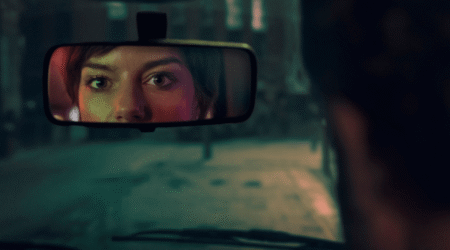








Ira Sachs had been talking about making some version of The Man I Love, his vividly sad but vibrant drama set in New York circa 1984, for over a decade by the time the moment to do it had arrived — and yet it was only well after production when he realized where it all came from. This was an instinctual work, mined from decades of memory. Sachs took on his first job in New York in 1984, then lived through a decade or so of “deep, painful and also transcendent experiences of gay life.” That informed the texture of The Man I Love as much as the aftermath of the pandemic, during which Sachs confronted his increasingly intertwining relationships to art and mortality. And he was thinking a lot about pleasure, too: “emotion and drama and story and color and skin and sex.” Sachs threw this charged mix into a pot, started editing, and saw something profoundly autobiographical unfold.
“I was struck by the loss in the film, and I was struck by the sadness within that loss, but I was also struck by the strength,” Sachs says now, in his first interview about his new movie. “I’m certainly the only person who could make this film.”
Quietly, Sachs has built one of the steadiest, most well-regarded filmographies of his generation in American indies: He’s directed seven features over the last 15 years, four of which went on to receive Spirit Award nominations for Best Feature — and that includes his two most recent efforts, the sexy Passages and the talky Peter Hujar’s Day. The Man I Love will premiere only 16 months after his latest, at the Cannes Film Festival, his second placement in the Main Competition after the 2019 Isabelle Huppert vehicle Frankie. It stars Oscar winner Rami Malek as Jimmy George, a beloved queer entertainer who’s dying of AIDS — but remains determined to keep working, and specifically to mount a new play.
“Our intention was to make a film about life,” says Sachs, who co-wrote with his longtime collaborator Mauricio Zacharias. Adds Malek, a longtime fan of the director: “He is such a unique filmmaker with a very, very specific perspective and voice that I wish more people were aware of. Hopefully this film exposes so many to what that man is capable of and has created over his body of work.”
Jimmy was modeled after experimental artists like Ron Vawter, of The Wooster Group, and Frank Maya, a pioneering gay comedian — men who died young but fought to create until their last breath. Vawter, for instance, was on stage, unable to complete a theater piece, merely six days before he died on a plane. “There’s something quietly defiant about making art in moments of uncertainty, and that refusal to disappear felt so moving to me and striking — there was a driving force emanating from me given what I was feeling,” Malek says. “It began from somewhere very, very personal.”
“I think about all these radical people who did not seem consumed with bourgeois success, though they were all struggling with the idea of sustainability, and they were not trying to fit in,” Sachs adds. “When I first described this film to a friend, I told him it was about a man who was trying to figure out what to do with the remainder of his life. If you imagine that you’re going to no longer be in the world, what would you miss most? I wanted the film to be filled with those things.”
If not a musical, The Man I Love is certainly Sachs’ most musically driven film, drawing from classics like All That Jazz and A Star Is Born in the way that live singing not only defines the movie’s sense of mood, but propels it narratively. “That was really interesting — how do songs become dialogue, even if it’s not a musical?” Sachs says. Malek gets a few showstoppers, including one heartrending scene where Jimmy performs Melanie’s “What Have They Done to My Song Ma” before his family. While most of these tunes predate the ‘80s, for Sachs, it’s evocative of the time all the same.
That sense of a living past extends to the ensemble, which Sachs built out with casting director Avy Kaufman. Jimmy’s creative community is populated with dozens of real-life artists that Sachs has known over the years. They’re often boisterously stuffed into the frame together in scenes of performing and partying. “I know this wide variety of artists who are here with the most essential passion, of making work that they care about,” he says. “I took very seriously the casting of the theatrical troupe in the film, to find people who came with enough history that they could embody the depth of what it is to make theater in New York City.”
Inspired by the likes of Robert Altman and Ken Loach, Sachs doesn’t make movies with protagonists, per se; in his worldbuilding, he leaves room for spontaneity. The Man I Love embodies this through its steamy but aching love triangle between Jimmy, his partner Dennis (Tom Sturridge), and their cute new neighbor who pursues Jimmy, Vincent (Luther Ford). Jimmy guides us into the milieu, but Sachs’s camera will start following Dennis, say, out of one scene and into the next, as he grapples with his dying lover’s appetite for life.
For Malek, the bond between him and Sturridge, a longtime friend, proved crucial: “When we first sat down to talk about this film, in a pub in London, I just remember Tom putting his hand on top of mine, and I felt this sense of being cared for…. It always existed in these beautiful moments where we would catch each other’s eye.” The star was then kept intriguingly off balance by Ford (who makes a beguiling feature-film debut here), as Jimmy launches into a complex affair with Vincent. “Luther has this ability to balance his youthful exuberance with a sense of having more life experience than one would expect from someone at that age,” Malek says.
Jimmy remains the center of The Man I Love, of course, and Malek’s mercurial and impassioned turn is unlike any in his career to date. They met after Sachs watched Malek’s Emmy-winning work in Mr. Robot for the first time. “This actually wasn’t a given,” Malek says of getting cast in The Man I Love. “Ira was essentially seeing if I was the right guy for it…. I don’t think I’m ever the obvious choice, to be quite frank, and I think that’s nice. I choose quite carefully and this felt like a very big risk worth taking. And to that, it’s a film about people who create and what that costs.”
“Rami makes the film dangerous,” Sachs says. “The story could change at any moment, and in that way, Rami aligns with Gazzara and Falk and Cassavetes. It’s possible that he’ll jump over the counter and steal the milk, like a scene from Mikey and Nicky.”
Sachs has increasingly worked outside of the American system to get his projects off the ground. The Man I Love is not only a New York story shot in New York, but is representing its country in unusual fashion for Sachs — it’s one of just two American films in competition at Cannes this year, alongside James Gray’s Paper Tiger, a signal of the challenges currently faced by the U.S. indie market.
“If you live within the context of American Independent cinema, you feel a little bit alone, to be honest,” Sachs says. As soon as you start to think of yourself within a broader community of people all over the world — Asia, Latin America, the Middle East, Europe — it just becomes exciting…. I feel excited because I feel in conversation with a lot of people, but also anxious because I’m exposing myself in a world I really respect.”
Sachs talks a lot about the notion of “personal cinema” — it’s what he lives by in his filmmaking, and he’s open about how each of his movies is imbued with a different, sometimes abstract form of memoiristic sensibility. Even with that, though, The Man I Love’s autobiographical shades took him aback. “After I shot this, I looked at my first film, Vaudeville, which was a backstage drama about a group of actors putting on a show with a narrative trajectory built around three men in a love triangle,” he says. “I was like, ‘Oh, I just remade my first film — from 1989.’”
He pauses, again considering the past-present continuum of this movie. He admits he’s a little nervous about our interview, pointing to his glass of wine with a grin. “I feel like I need to go into the world with this movie with as much of me as possible — and the fearlessness of Jimmy in the face of mortality is really beautiful,” he says. “It came from a very deep place for me.”
**
The Man I Love premieres May 21 at the Cannes Film Festival. Stay tuned for more Cannes 2026 first looks and exclusives.
Read the full article here