



Christmas is being dismantled, piece by piece, at Paris Hilton’s Beverly Hills estate.
Assistants pluck bulbs — mostly pink — from the towering tree in the foyer before moving on to the forest of pink-tinted pines lining the living room. Up on the roof, a team of workers disassemble holiday lights that just a few weeks ago shrouded this 30,000-square-foot mansion (likely the only one in the neighborhood with a hot-pink tennis court) in what must have been a brilliant, shimmering — and let’s go out on a limb here, probably pink — halo.
“It’s more than just a color,” Hilton notes while surveying the proceedings, a glimmer of self-awareness nearly detectable in her smile. “Pink is a lifestyle. It’s a movement.”
Indeed, it is — and it’s one that’s followed Hilton, 44, through a long public arc that has often been lucrative, frequently eyebrow-raising and always impossible to look away from. Once known primarily as a hotel heiress turned tabloid fixture, she has over the past couple of decades cycled through reality television, DJ gigs, a sprawling fragrance and lifestyle empire, several successful sorties into publishing (with the Fanning sisters currently circling an adaptation of her 2023 best-selling memoir, Paris) and, lately, political activism, speaking out on the excesses of the troubled-youth industry and the scourge of deepfake pornography, finding unlikely new allies in power players like Rep. Alexandria Ocasio-Cortez.
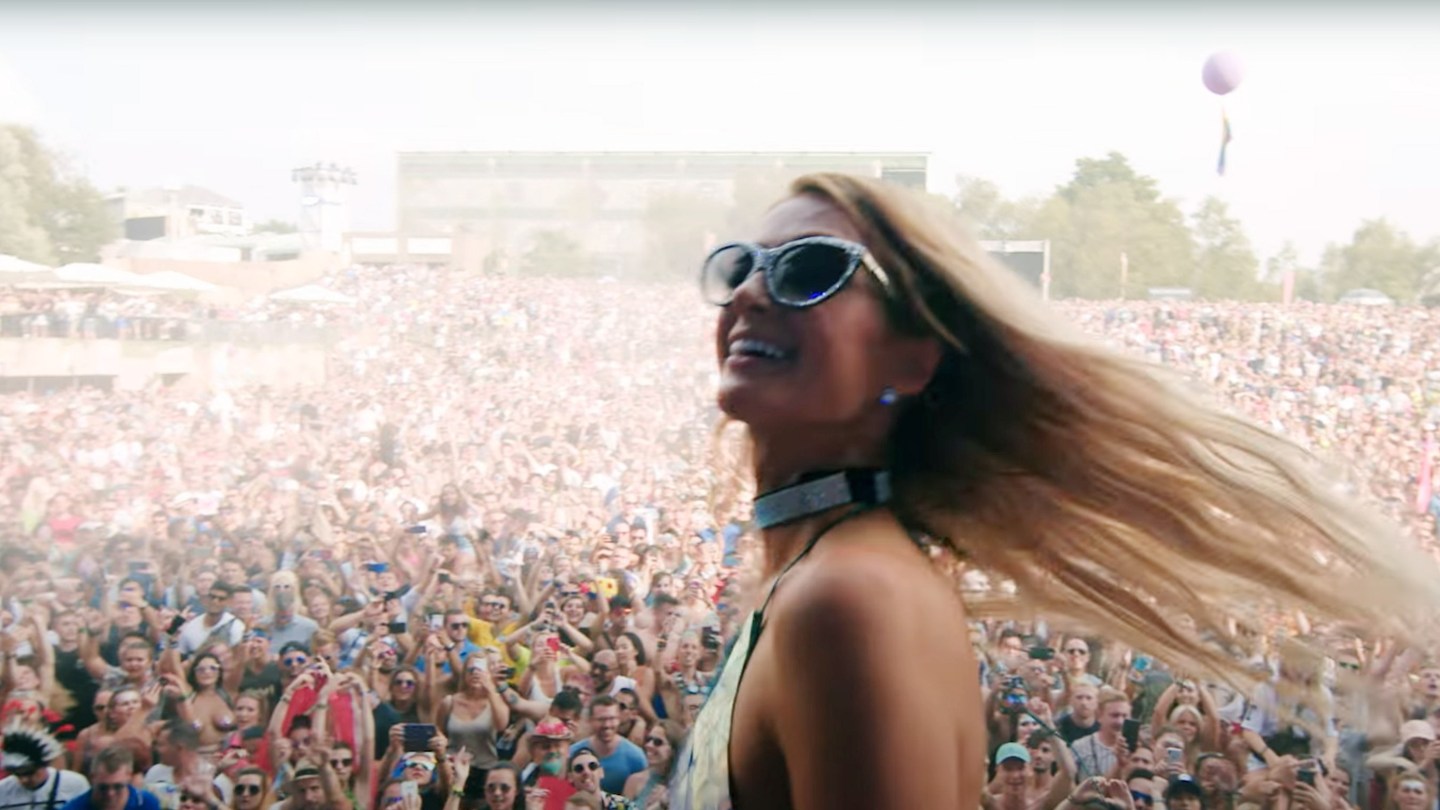
At the moment, though, on this spring-like day in mid-January, Hilton’s attention is firmly fixed on her latest endeavor: a bid at pop stardom, with the release of Infinite Icon, a concert film in which she performs a slew of frothy tunes from her recent album of the same name.
“It’s always been my dream to be a pop star,” she says, this time without a flicker of irony, as she settles into a front-row seat in her mansion’s heavily draped screening room. “So, I manifested it. I became a pop star.”
As if on cue, two of Hilton’s five pint-sized pups — “my little angels,” she calls them — scamper onto her lap for a cuddle. Her other angels, London Marilyn and Phoenix Barron — her 2- and 3-year-old with husband Carter Reum, the venture capitalist who staked Lyft, Warby Parker and Pinterest — are currently racing around the grounds playing hoop-and-cone games with a small platoon of nannies.
That’s right, Paris Hilton, the most notorious party girl of the early 21st century, is now a mom.
When her name first started popping up in headlines, back in the early 2000s, it was usually as a punchline. She was an “Heir Head,” the self-styled ringleader of the “Bimbo Posse,” known almost entirely for showing up in tiny dresses with tiny dogs at all the right nightclubs. “Famous for being famous” was how she was frequently described, and while it wasn’t exactly nice, it wasn’t totally untrue. Hilton back then wasn’t so much a personality as a collection of tabloid tropes — the voice, the clothes, the cringy catchphrases (“That’s hot!”) — which the public was fed in gossip column-sized bites. She was Page Six junk food. Ultra-processed celebrity.
But that was then, this is now. And like Britney Spears and Lindsay Lohan — the other members of that posse and two of Hilton’s closest contemporaries of the mid-2000s, both of whom have since been reevaluated by a culture more willing to acknowledge the excesses of its own scrutiny — it may be time to reexamine the media’s long-standing assumptions about Hilton. Because it turns out we missed some things.
In fact, with enough distance, it now looks less like Paris Hilton was a footnote of turn-of-the-century tabloid culture and more like she was a future prototype — a revolutionary force who, for better or worse, cleared the path for a whole new type of fame. The kind that doesn’t require any theatrical or musical training or even talent. The kind built on attention rather than achievement, on visibility rather than accomplishment, on the self itself as the product.
The kind that back then seemed silly, shallow and entirely disposable — and that ultimately turned out to be the perfect pioneer for our culture today.
***
The great-granddaughter of hotel mogul Conrad Hilton, she was born famous, a nepo baby decades before “nepo baby” became a thing. As a teenager, she was already popping up in Page Six, the New York Post’s notorious gossip column, for her underage hijinks at nightclubs in both New York, where her family occupied apartments at the Waldorf Astoria, and Los Angeles, where they owned a mansion in Beverly Hills.
But it wasn’t until she was 19 that Paris Hilton officially became “Paris Hilton.” That’s when, in 1999, The New York Times ran a feature in its Style section anointing her and her younger sister, Nicky, then 16, as the city’s newest “It” girls. Suddenly, the Hilton sibs were successors to a long line of Manhattan nightlife legends — famous revelers like Edie Sedgwick and “Baby” Jane Holzer.
Hilton, though, took a radically different approach to It-dom. She became the first to figure out how to monetize it in a big way. “People were like, ‘We’ll pay you money to show up to this club,’” she recalls of those early years. “So, I started doing that. All the time.”
At first, the money wasn’t too outlandish, but before long, as club owners realized how much publicity she could drum up just by showing up, Hilton was raking it in, earning tens of thousands of dollars, then hundreds of thousands, not just at clubs in New York and Los Angeles but Las Vegas, where in 2001 she opened the Palms Casino Resort wearing a dress made out of casino chips. By the end of the 2000s, as her fame hit its zenith, so did the paychecks, with Hilton earning as much $1 million an appearance.
“People used to knock her for not doing anything,” says photographer Jeff Vespa, who’s known Hilton for decades. “But she’s always been the hardest-working person I’ve ever met. When she showed up at a nightclub, she was the entertainment. She was the focus of everybody’s attention. She was social media before the internet. She was Insta before Insta.”
“I was definitely somebody who understood the power of personal branding before people were talking about personal branding, but it wasn’t like I planned it,” she says, admitting she had no idea at the time that she was blazing any trails. “I didn’t think, ‘I want to be an influencer,’ because there wasn’t even a word for it. I was just living my life, and the paparazzi just followed my every move.”
Predictably, Hollywood took notice. Hilton began taking meetings at networks all over town, including at Fox, where executives in the comedy department had been toying with the idea of updating Green Acres, but with a reality twist. When Hilton walked into the conference room, light bulbs must have popped on over every head at the table. She was literally born to play the lead in The Simple Life.
“I had no idea what we were getting ourselves into,” Hilton says of the show, in which she co-starred with her real-life best friend Nicole Richie (after Paris’ more camera-shy younger sister turned down the part) as a pair of bratty city slickers stuck in the middle of rural America. “Basically, the producers just said, ‘Paris, you play a rich, spoiled airhead.’ They kind of set up the personality type they wanted. In real life, I obviously knew how to clean and do all the things that I pretended I didn’t. But I played into what I thought the audience would want.”
The Simple Life was not TV’s first reality show — it wasn’t even the first celebrity-centered reality show. That would be MTV’s rock ‘n’ roll family saga The Osbournes, which started airing in 2002, a year before The Simple Life’s debut. But it was the first to take a sitcom-style setup and play it out in an unscripted format, inventing what would become a dominant model for the reality genre for years to come.
Without The Simple Life, there’d have been no Jersey Shore or Undercover Boss, and certainly no Keeping Up With the Kardashians. In fact, Kim Kardashian might still be designing closets for her rich celebrity friends if Hilton (one of her early clients) hadn’t offered her a cameo role on The Simple Life. Kardashian’s three-episode arc, in which she organized Hilton’s wardrobe — “Yes, Paris,” was pretty much the extent of her dialogue — was her first major media exposure, the launching pad for her and the whole Kardashian family’s entire social media and personal-brand marketing empire. (And yet, Kim declined to be interviewed for this story.)
But just before the 2003 premiere of The Simple Life, Hilton found herself once again ahead of the culture, although not in any way she wanted. An ex-boyfriend, professional poker player Rick Salomon, released a private sex tape they had made together back in 2001, selling downloads on early websites and VHS copies at video stores. Today, of course, leaked celebrity sex content is as commonplace as Viagra ads on TV. Hulk Hogan, Jennifer Lawrence, Fred Durst, Kirsten Dunst, Scarlett Johansson, Kardashian herself — they’ve all had their 15 minutes of shame. It’s called the Scandal Economy.
Back then, though, in more shockable days, Hilton was worried the X-rated home video would derail The Simple Life’s premiere. Fortunately, cooler heads prevailed. The series debuted on Dec. 2, 2003, and was an instant hit: 13 million viewers tuned in for the first episode, growing to 13.3 the following week, placing it in the same ratings neighborhood as shows like The O.C., Alias and Will & Grace — with one early episode even beating a speech by President Bush.
This time, the light bulb went on over Hilton’s head.
“Everyone was like, ‘Oh my God! Paris’ new show has more viewers than the president,’” she recalls. “He was talking about some world event that night — I don’t remember what — and we got way more viewers than he did. And that’s when I realized I could parlay this into a huge business and a brand.”
Parlay is putting it mildly. Within a year, Hilton had struck a deal with licensing company Parlux Fragrances and launched her own perfume. It quickly became one of the fastest-moving celebrity scents of its era, with major retailers — Macys, Sears, Kohl’s — selling out almost instantly. She followed up with handbags, jewelry, shoes, sunglasses and other accessories, which also flew off department store shelves. There was a book, a best-seller called Confessions of an Heiress, and then, in 2006, a pop album, Paris, which debuted at No. 6 on the Billboard 200 and spun off a single, “Stars Are Blind,” that became something of a cult hit at dance clubs for a while.
While there’s a long history of stars cashing in on their fame — Elizabeth Taylor was peddling a perfume back in the 1980s and Farrah Fawcett was selling hair products even before then — for those stars, branding was a side hustle, an extra income stream on top of their day jobs entertaining people on stage or screen. Hilton was the first to do it the other way around — her primary occupation has always been being famous, her main business being self-branding. Playing a version of herself on TV and recording an album — those were her side hustles.
And whatever else you can say about her, she is very good at being famous. In the past, celebrity branding deals were aimed at modest specialty markets. But Hilton was the first to do it on industrial scale, long before Kim made a killing peddling Skims online. Altogether, Hilton’s perfumes and other products have generated, by some estimates, some $3 billion in sales in the 20 years since she launched her first fragrance.
Today, all her various businesses — along with the scents, clothing and accessories, there are now housewares, a film and TV production shingle, a live events division (including her DJing gigs in Ibiza, where she draws crowds in the thousands) and even a few hotels in the Philippines (once a Hilton, always a Hilton) — operate under a single umbrella company. Its headquarters, buzzing with about 20 employees, now occupy a guest house on the property, not far from the pink tennis courts. “We’re building the next Disney,” is how Hilton’s CEO, Bruce Gersh, a former Time Inc. and Meredith Publications exec, describes the mission. “This is a company rooted in commerce.”
The company is called 11:11 Media — and Hilton has an explanation for that. “It’s been my lucky number since I was a little girl,” she says. “My mom taught me that when you see 11:11 on the clock, you make a wish. So, when I started my company, I wanted to name it something that felt meaningful and magical. Because I believe in manifesting. I believe you can create your own reality.”
She really means it. “Even this house I live in right now, it’s exactly what I was dreaming of as a little girl,” she goes on, gesturing around the $55 million, 12-bedroom estate she and Reum purchased from Mark Wahlberg in 2023 — rechristening it “Slivington Manor” (a play on her “sliving” catchprase, a mash-up of slaying and living). “All of it, the house, the pets, my businesses, the way I live my life — it’s all the manifestation of the dream life that I wanted to create.”
The mansion did require one or two upgrades. Apart from painting the tennis court, Hilton installed a stained-glass window emblazoned with a giant letter “P” into one of the house’s highest spires. At night, it’s said to light up like the Bat Signal.
***
It was supposed to be a fluffy celebrity documentary. But one day during the production of 2020’s This Is Paris, Hilton turned up for filming looking tired and noticeably depressed. The director, Alexandra Dean — whose previous work included an American Masters episode on Hedy Lamarr — asked Hilton what was wrong. Hilton brushed away the question, mumbling something about not sleeping. “Let’s talk about my fragrances,” she told her.
Dean, however, didn’t let it go. She kept digging. And eventually she convinced Hilton to open up — on camera — and divulge a family secret that had been haunting her for years. For the first time, Hilton revealed her harrowing odyssey through the troubled teen industry. How when she was 16, her parents — understandably alarmed by their daughter’s tendency to disappear for days at a time, only to pop up in tabloid gossip columns — enrolled her in a series of residential programs supposedly designed to help discipline-challenged youth.
The details she shared were disturbing, starting with the induction, when Hilton was literally dragged out of her bed at the Waldorf Astoria at 3 in the morning by a pair of transport orderlies — as her parents stood by and watched — and forcibly dispatched to a “campus” in southern Utah. Friends of the family were told Paris had been sent to boarding school in Europe, but for the next two years, until she turned 18, she was bounced from one “emotional growth program” to another, each more sadistic than the last. She says she endured strip searches, forced manual labor, physical restraints, beatings, isolation, ritual humiliation, sleep deprivation, and what she describes as sustained psychological and sexual abuse.
“It was incredibly horrific,” she says. “For years afterwards, I would have these severe nightmares imagining that I was back in these places. It wasn’t until I started telling my story that those nightmares went away.”
Beyond helping her sleep better, sharing her secret in This Is Paris — and later, in her 2023 memoir, in which she also disclosed being diagnosed with ADHD as an adult — was a tectonic shift in Hilton’s public narrative. It flipped the script on everything everyone thought they knew about her, reframing her entire life’s performance. Suddenly, she wasn’t just a tabloid punching bag anymore. She was a victim … and a survivor.
“I think a lot of what was going on with Paris in her early life was a trauma response,” notes her husband, who also serves as her main business adviser. “She endured a lot.”
Hilton and Reum weren’t strangers when they connected — they traveled in adjacent circles and had bumped into each other before — but it wasn’t until they were seated next to each other at a dinner in the Hamptons that things clicked. This was in 2020, just before the documentary came out — and right before the pandemic. Paris made the first move. “It just, like, happened,” she says. “I was like, ‘Let’s go outside and talk.’ And then I kissed him. And we’ve been inseparable ever since.”
“She always says we’re a lockdown love story, because we were together three months and then COVID happened,” Reum recalls. “We were in the house in our pajamas, working, watching Netflix, becoming the best of friends.”
They clearly did more than watch Netflix. Phoenix Barron was born in 2023, and London Marilyn a year later. Since then, Hilton has become something of a homebody. “I only go out now if I’m getting paid,” she says. And that’s maybe the biggest reframing of all, a totally new look for a woman who was once infamous for dancing on table tops at Limelight and Skybar — motherhood.
For now, while the kids aren’t much bigger than the Chihuahuas and Pomeranians yapping around the house, she seems to have a handle on it. But, given her own rambunctious past, future parenting may turn out to be challenging.
“Yeah, I think about that a lot,” she says when asked how she’ll deal her children when they enter their teens. “It’s the one thing I’m anxious about. I just want my kids to feel so much love and have this really fun house so that they won’t want to sneak out. We can have movie nights here in the screening room and they can go on the water slide and on the pink tennis court.” Plus, she adds, “The security system is insane here. It’s like Fort Knox. It’s not possible to sneak out.”
Still, if the Waldorf Astoria couldn’t keep Hilton in check at 15, what chance will Slivington Manor have with her kids? At least Hilton’s own experiences as a teenager, as appalling as some of them were, have left her more prepared than most for the blood-chilling terror of raising adolescents. She remembers the trauma she inflicted on her own parents — “They hired an educational consultant because I was failing all my classes, they didn’t know what to do with me,” she says — and is braced for the inevitable karmic payback.
Hilton’s struggles as a teen had one other upside, as well — they gave her celebrity superpowers. Later, as her fame grew, she discovered that there was nothing the media could throw at her, no snarky headline or unflattering photo — or both, like when the New York Post ran its infamous 2007 “Bimbo Summit” front page of Hilton, Lohan and Spears crammed in an SUV together — that could hurt her more than she’d already been hurt. Unlike the others on that Post cover, Hilton was able to flick away such indignities like lint off her Juicy Couture tracksuit.
“I didn’t realize it until as an adult I started reflecting back on my life,” she says, “but the pain and trauma I went through did prepare me for Hollywood in so many ways.”
It’s also made her fearless, which may explain why, 20 years after releasing her first album, she’s decided to take another crack at Britney Spears-style pop stardom. It’s a long shot, she knows, especially considering pop stars don’t really exist anymore — not even Britney is much of one these days — but she’s going for it anyway, despite the obvious risks. “I’ve been through so much,” she says, “I feel like nothing can really scare me anymore.”
Her new album, a poppy throwback called Infinite Icon, came out last fall, with mixed reviews but debuting at a respectable No. 38 on the U.S. charts. The concert film of the same name, in which Hilton belts out tunes surrounded by a phalanx of gyrating chorus boys, opened in limited theaters on Jan. 30 (the same debut date, coincidentally, as Melania, the first lady’s new doc). So far, it’s grossed a modest $200,000.
But no matter. Even if pop stardom turns out to be the one dream Hilton can’t manifest, she has plenty of others. In fact, improbable as it may sound, it turns out she has a knack for politics.
Back in 2020, she testified in front of the Utah State Legislature, urging lawmakers to look into the teen camps where she’d been abused. Then, two years ago, she appeared before the U.S. House of Representatives, advocating for federal reform of the troubled youth industry. And just last month, she was back in front of Congress again, speaking out for legislation targeting AI-generated deepfake pornography — something she’s been prey to — and winning over some unlikely new fans, like Ocasio-Cortez.
“People don’t recognize enough how effective Paris Hilton is in her advocacy,” the congresswoman posted on X after the hearings. “Not only does she throw her public power behind survivors, but she also brings a fierce behind-the-scenes operation with her.”
So, yes, given the current surreal state of American politics, it’s not completely inconceivable that Paris Hilton could at some point run for high office — maybe even win. She’s clearly been thinking about it.
“Yeah,” she says, petting the furry, pocketbook-sized gremlin snuggled in her lap, “I could paint the White House pink.”
Read the full article here