




In a phone call hours before Netflix sealed the deal for Warner Bros. on Dec. 4, Ted Sarandos played hardball with David Zaslav: Sign a deal for Netflix to buy Warners today, or we’re pulling out of the bidding.
It was a message hammered home in an email that Netflix’s attorneys at Skadden sent to their counterparts at Debevoise and Wachtell Lipton.
“Our client’s expectation is that we will be signed as soon as practicable this evening, and the deal announced before open of market tomorrow morning,” the email reads. “We have been instructed by our client to convey that this is our best and final proposal and that if we are not done before open of market tomorrow morning, our proposal shall be deemed withdrawn, null and void. We will withdraw from your process, abandon pursuit of the transaction and terminate discussions.”
The blunt email and fateful call from Netflix’s co-CEO to Warner Bros. Discovery’s CEO ultimately pushed the WBD board to make that final decision, a last-ditch text message from Paramount CEO David Ellison notwithstanding.
The text from Ellison, in which he emphasized that their latest bid was not “best and final,” was not enough to persuade the board, which was in the middle of meeting to discuss Netflix’s final offer and its ultimatum, as it “did not present any actionable improved proposal for consideration and it would not have been appropriate to do so in the midst of the WBD Board’s deliberations.”
The following morning, of course, Netflix announced its blockbuster $82.7 billion deal to acquire Warner Bros., in a move that stunned Hollywood.
And it only took six weeks from Sarandos’ first phone call to Zaslav on Oct. 16 to a signed agreement.
The deal with Netflix came together fast, filings with the SEC show, with Paramount and Ellison pursuing the company for months before Netflix even considered entering the fray. But when they did, the race was on, and the price for Warners grew ever higher.
The filing from Warner Bros. Discovery on Dec. 17 paints a picture of Netflix as a buttoned-down operation, quick to respond to concerns from the board, in contrast to Paramount, which the WBD board suggests was slow to make changes to its proposed bids (WBD, it is worth noting, is selling its shareholders on the Netflix deal in the filing, so it isn’t a neutral party).
The filings frame Sarandos as the Netflix counterpart to Zaslav, a dynamic that makes sense with Netflix’s other co-CEO Greg Peters known as the product guru, rather than the programming guru.
But did Sarandos have to persuade Peters to go along with the deal?
“I think that we assumed we might come in with different perspectives on it as well,” Peters told CNBC Dec. 17, when asked whether he and Sarandos had a difference of opinion on the Warners deal.
In fact, it was the hard data analysis on Warners that got the co-CEOs aligned on the deal.
“We did the work, and really the work speaks for itself, which is, you get in and you actually build the models, you understand, ‘how would these titles contribute?’” Peters continued, noting that the company is constantly looking at the data to justify licensing deals. “We have a very elaborate, deep understanding of how that works. When you’ve got that that model, then you do the hard work and you beat it up and you challenge yourself on all the assumptions. But when you conclude at the end of the day that there is a tremendous amount of value creation in this kind of deal for our members, the people that we serve, and for the creative community as well, we looked at it and we said, we’re excited both to move forward.”
And the filings indicate that they moved forward quickly. Netflix’s first official bid arrived Nov. 20, just over a month after Sarandos first called Zaslav to express interest.
Samuel Di Piazza, the chairman of the WBD board, convened a meeting the following day to discuss the bids from Netflix, Paramount, “Company A” (Comcast) and “Company C.” (That firm, “Company C,” has yet to be publicly disclosed.)
The attendees of the meeting agreed that “the Netflix bid offered superior value and a higher degree of certainty compared to the PSKY bid, and that based on Netflix’s comments on initial term sheets they were expected to cooperate with the planned spin-off of the WBD Global Linear Networks Business in a straightforward manner without requiring material changes in planning,” but they wanted to keep Comcast and Paramount engaged in the process.
On Nov. 22, WBD’s senior management and advisors and Netflix’s senior management and advisors met, where WBD suggested that Netflix “should meaningfully raise the amount of its regulatory termination fee and consider a higher valuation for the WBD Streaming & Studios Business.”
It was around that time when Sarandos journeyed to Washington D.C., where he met with President Trump in the Oval Office on Nov. 24. While the state of the entertainment industry was discussed, the deal for Warners was the main topic. The Trump administration, after all, will play a central role in any potential legal dispute over the deal.
“I have a lot of respect for him. He is a great person,” Trump said of Sarandos the following week, confirming the meeting. “I think, in the history of Hollywood, there’s really been almost nothing like what he has done.”
He added, however, that the market share of a combined Netflix-HBO Max “could be a problem.”
Two days later, Netflix raised its proposed termination fee to $5.6 billion.
Netflix, Paramount and Comcast were ultimately asked to submit binding proposals on Dec. 1, with WBD’s board raising whatever objections they had with each company’s prior bids. Those bids arrived, at which point the talks with Netflix sped up, with Sarandos agreeing in a phone call with Zaslav Dec. 3 to “strengthen its regulatory efforts.”
“Given that, among other things, Netflix submitted the meaningfully highest bid of the December 1 Bids accompanied by the most readily actionable legal documentation, with few issues remaining to be resolved, the WBD Board unanimously decided to accelerate discussions with Netflix in order to resolve remaining issues in Netflix’s merger agreement markup and other transaction agreements,” the company wrote in its filing. “At the same time, the WBD Board instructed WBD’s management and advisors to remain engaged with Company A and PSKY, and provide them feedback consistent with the WBD Board’s discussions regarding the deficiencies in their proposals.”
On Dec. 4, much of the day was spent with attorneys sending revised agreements back and forth to try and finalize deal terms. Shortly before the WBD board was scheduled to meet, Netflix’s lawyers and Sarandos issued their ultimatum, and the board had a choice to make.
“In light of [Netflix’s revised offer and the lingering concerns around Paramount’s bid] and Netflix’s representations that it would abandon its offer if it were not accepted that evening and would disengage from the process,” the WBD board executed the deal, and the following morning Netflix announced its grand plans to the world.
Paramount’s hostile tender offer followed a few days later, as it seeks to salvage the deal that slipped away.
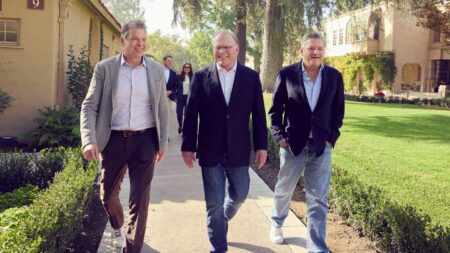
On Dec. 17, Zaslav hosted Sarandos and Peters on the historic Warner Bros. lot in Burbank, where they met with senior leaders at the company, in a show of confidence in the deal.
But the mega-deal deal also begs the question: Why did Netflix pursue Warners anyway?
It is the dominant subscription streaming platform, and has never done a deal anywhere remotely this size. And Warners is in business lines that Netflix simply hasn’t played in, like producing TV shows for other platforms, and of course big theatrical tentpoles.
Of course, the company has a long history of saying it isn’t in the business of X — advertising may be the biggest example — only to later go all-in.
“I think we built this company with a very, very simple proposition. We actually had one SKU for the longest time, one model, and that helped us build a really strong foundation,” Sarandos said at a UBS conference in New York Dec. 8, days after the deal was unveiled, citing Netflix’s push into advertising, games, original series and live events. “The idea was, you build a really strong foundation, and then you can introduce new complexities to the business for future growth. And we have now been doing that pretty successfully I think by doing things that people would argue are pretty complicated.”
Warner Bros., to hear Sarandos and Peters tell it, is meant to bring Netflix to every part of the entertainment industry. The company may have always been a builder, not a buyer, but it is now ready to buy and build.
“We built Netflix through continuous improvement, innovation, consumer focus, and bold ambition – whether it was going from DVDs to streaming; licensing to originals; or Hollywood programming to hits from all around the world,” Sarandos and Peters wrote in a letetr to shareholders Dec. 17. “Over the years, our deeply experienced management team has proven that they can successfully navigate an ever-changing, highly dynamic entertainment marketplace to create incredible value for consumers and the creative industry. And we’ve created over $400 billion in stockholder value.”
Read the full article here