





“In a world without humans, a strange Being finds what we lost – and what we failed to see. Or did we?” The trailer for Hungry has major sci-fi thriller vibes.
It turns out that the Being is searching for clues for mankind’s extinction. In the process, it creates the film Hungry using audio interviews made with scientists and activists before what is referred to as “extinction events.” The experts, who appear with their voices rather than in typical talking-head fashion, had warned about the threat of the destruction of the planet and humans themselves.
Hungry may at first glance seem like a fiction feature, but it is the new documentary from U.S.-born, Austria-based filmmaker Susanne Brandstaetter (This Land Is My Land), world premiering in the Harbour program of the 55th edition of the International Film Festival Rotterdam (IFFR) on Feb. 2.
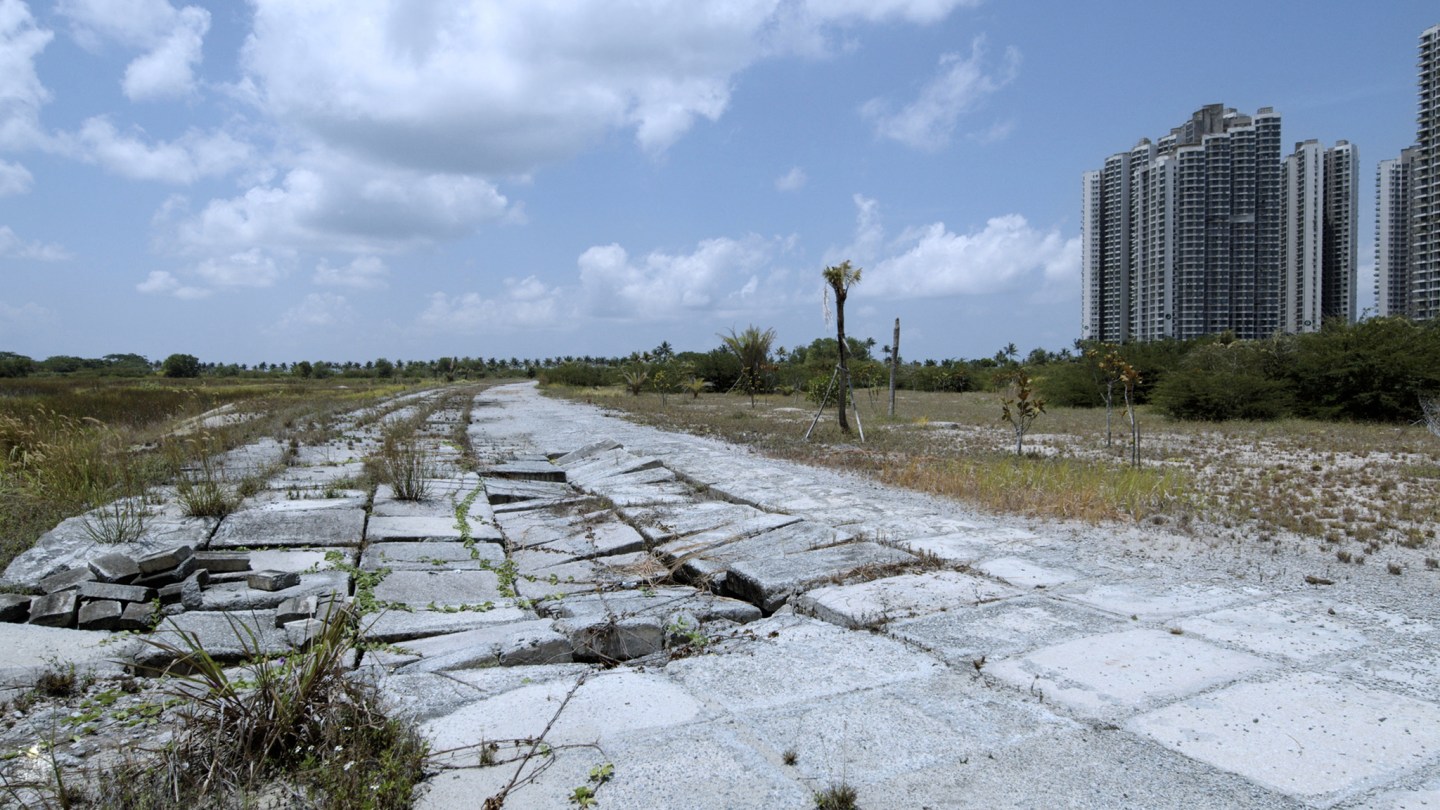
Viewers are not immediately told how near or far in the future the film takes place. And we don’t really know who or what the “creature” arriving on this planet to investigate is. Via a mix of scientific information on and insights from specialists into problematic food, environmental, business, and political trends with haunting imagery of human-less landscapes, the result is “a documentary poem of great urgency as well as overwhelming beauty,” says the IFFR’s website.
The doc embraces complexity by highlighting connections that may not be readily apparent. “What starts off as a film focused on environmental issues expands into a scientific and political inquiry looking to highlight connections that may not be readily obvious. Among them are “the destruction of food security, the deterioration of labor markets, the hijacking of democratic governments, and the global decline of democracy itself,” as background materials for the film highlight.
Produced, via her Susanne Brandstaetter Film Production, written and directed by Brandstaetter and edited by Lisa Zoe Geretschläger and Stephan Bechinger, Hungry features cinematography by Joerg Burger, plus additional camera work by Martin Putz and Lukas Lerperger, who helped add a subjective point of view. Peter Kutin and Rojin Sharafi handled sound design and music.
Hungry was produced with the support of the Austrian Film Institute & ÖFI+, Film Fund Vienna, ORF Film/TV Agreement, and Lower Austria Culture. Check out a trailer for the film here.

Brandstaetter talked to THR about her goal of making Hungry an immersive and memorable experience that points out complex connections and relationships, why she wanted to challenge the idea that extinction is inevitable, how the film’s message is much more positive than it may at first seem, and what’s next for her.
What was the inspiration for Hungry, and when did you come up with that title?
I started researching the film in 2016, starting with food supplements. Then I started to get interested in the whole industry behind that and how it was unregulated, and then I went to see how this whole industry was impacting our environment. So, I started to research, and it got bigger and bigger and bigger. It got so huge that I made a mind map with all these different dots and looking at what was affecting what other parts – in our environment, our health and the economy. I started to look for this cause and effect. For example, many of these huge transnational companies have succeeded with their lobbying and making policymakers and the public believe that the onus is on us and that we are the ones responsible for bad health outcomes or obesity.
So I hit upon this idea of calling it Hungry, because I wanted it to have more than one meaning. You know, “hungry” has to do with our food, but it also has this meaning from the point of view of greed. I love double meanings in my titles. You may not get it right away when you’re watching the film, but then, as the film progresses, you start to understand what it’s getting at.
With news of politicians shutting down efforts to protect the environment and the more visible connections between politics and business, do you think key themes of Hungry will look familiar or recognizable to audiences?
I’m hoping so, because it’s very timely. And I think it’s essential to provoke audiences to think more about this. Some of these topics have been handled in different films, but what I really set out to do was to connect the dots and show the complexity. Hungry shows how we are impacting not just the quality of our food, but also evolution, plant life, animal life, etc.
When did you decide to add this unusual sci-fi lens?
As I was trying to figure out how to make all these complex links understandable and what it all means, I was looking for different ways to tell the story. And that’s when I hit upon the idea of making it a sci-fi documentary. I think one of the reasons why I got that idea was that during project development and then during the pandemic, I was in a farmhouse that was very remote in the mountains in the South of Austria. There was basically no civilization around. So that was conducive to thinking about what it would be like if there were no other people around.
All of a sudden, this idea just popped into my head to put the film in the future, with no human beings left, and hardly any animal life, basically only insects. That’s how I chanced upon this idea. Plus, since it was during the pandemic when none of us really knew what was going to happen in the future, I was wondering how I was going to be able to make a film. And I thought interviewing people remotely made sense. And then I was [using] them as these voices from the past, which fit in with my story.
Overall, I wanted to create a really immersive [cinematic] experience.
How did you think about the time the film is set in and the visual mix of derelict buildings and barren landscapes we see in Hungry?
I did play with the idea of actually saying a year, but then I abandoned that because I realized it would be better to leave that open for audiences. We have this progression in the film where some of the locations where we shot are more devastated than others. It was quite hard to find the locations that fit what we needed so that you would see a kind of progression within the film.
We filmed in Austria and in Germany, in Spain, in the United States and in Malaysia. And it did a lot of research to find [suitable] locations. I was researching really, really extensively online for quite a long time, using Google Street View and things like that. But, of course, those images are not really recent, so I had to have people who looked to see if the locations still actually looked like that. For certain locations that I was interested in, we couldn’t get filming permission.
So it was a lot of work. And, as always with documentaries, some of it comes down to looking around and researching once you’re on location. If you talk to the right people, they will all of a sudden say, ‘I know this place,’ or you notice this abandoned school or other places you had not planned on.
And in post-production, we removed any remaining traces of human and animal life.
What can you share about how you developed “the Being” coming to Earth?
I didn’t want to define the Being too much, because that was also something that I wanted to play with, and I wanted the viewer to be able to think about that: Who is this Being? But I actually ended up defining the Being more than I originally planned on.
In the very beginning, I thought it would be interesting not to let the viewer know at all who the Being is. But I ended up feeling that defining it a bit at the beginning of the film would be helpful and make the film really function. The whole film Hungry is actually being made by the Being. This was a whole Odyssey in the development of the film, deciding how the Being was going to move through the world, and what the Being does and feels like for the viewer.
Tell me a bit about the choice of images in Hungry. Since we hear the experts discussing complex issues, the visuals used for illustration obviously usually can’t directly show the topics being discussed.
Yes, sometimes it’s just very associative. I wanted to allow the viewers to also expand their ideas and what they’re thinking, not just so narrowly focus on what they are hearing.
Do you at all worry that someone could be put off by the dystopian feel of Hungry? Or what would you tell people wondering if this is a pessimistic film?
When you watch the whole film, I think, you understand that it is actually very positive. I’m really an optimist at heart, and the film has a positive message. There’s a dramatic twist, which I don’t want to give away, but it’s definitely not doom-mongering. I want it to be thought-provoking. I want people to be emotionally touched and think about what they’re hearing and seeing.
Basically, the film is empowering and should be inspiring for people to know that we can still be doing something to make a difference. That is something I really deeply believe in, and I want this film to have an impact. I think films, in general, can have a tremendous impact, and I hope this film will have an impact, which is why I was fighting for so many years to develop and make it. The film is really an immersive call to action. Our future is not dismal. We could still turn things around.
What’s next for you after Hungry?
I’m just finishing another film. It’s a documentary about something completely different. You wouldn’t believe it was by the same filmmaker as Hungry. It’s about youths with a migration background in Vienna [Austria]. The working title is What About Me?, but I haven’t yet decided on a title.
Read the full article here