




It’s a good time to be a fan of somewhat zany, deceptively emotional, heavily accented, female-forward mystery-comedies on the small screen.
Audiences who responded to Apple’s perpetually awards-miscategorized Bad Sisters and Amazon’s more overtly wacky Deadloch, returning for its second season next month, will find a lot to enjoy in Netflix’s How to Get to Heaven from Belfast, an eight-episode mystery-comedy from Derry Girls creator Lisa McGee.
How to Get to Heaven from Belfast
The Bottom Line
Effective as both comedy and whodunit.
Airdate: Thursday, February 12 (Netflix)
Cast: Sinead Keenan, Caoilfhionn Dunne, Roisin Gallagher, Emmett J. Scanlan, Saoirse-Monica Jackson, Bonagh Gallagher
Creator: Lisa McGee
It’s simple enough to sum up the appeal of How to Get to Heaven from Belfast as Derry Girls + Murder. But that may not fully capture the somewhat sluggish stretch in the middle of the season when How to Get to Heaven from Belfast is too busy tying itself in mysterious knots to be funny at all — nor the strong conclusion in which the intricately plotted mystery pays off in ways that are far more serious and, if you want to read a little into it, far more thematically expansive than I initially expected.
Some of the richness in How to Get to Heaven from Belfast can get lost in the intentional chaos and misdirection, while some of its tantalizing specificity may be generally lost on American viewers simply looking for a wild whodunit. But when the cast is this exceptional and the dialogue has this much manic crackle, whatever you take from the series ought to be enough.
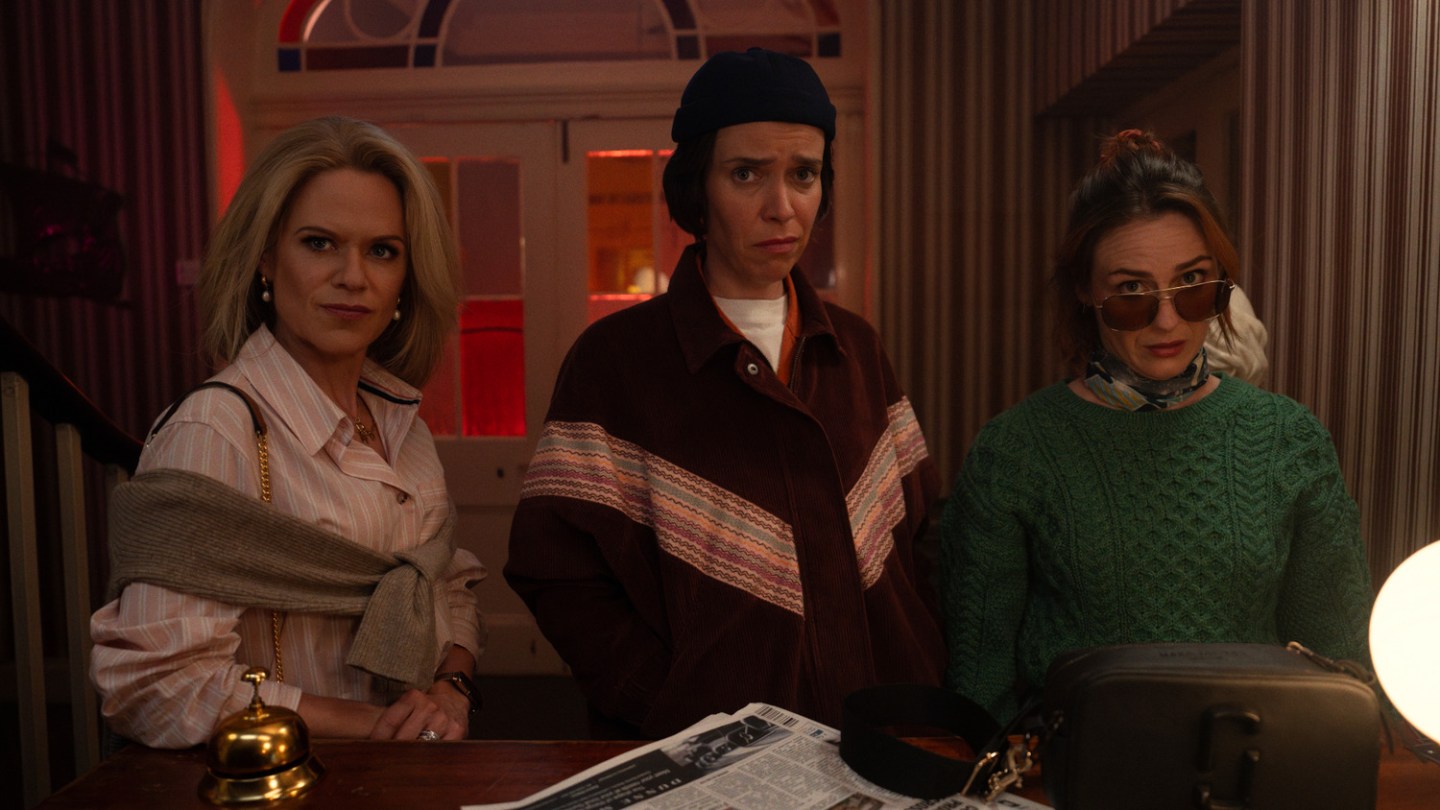
The season begins with a trio of lifelong 30-something friends getting some bad news that leaves them incredulous. Greta (Natasha O’Keeffe), the final member of what was briefly a close quartet, has died.
Saoirse (Roisin Gallagher), the creator of a wildly popular television murder mystery that she’s sick of, Dara (Caoilfhionn Dunne), stuck tending for her mum and still sad about the girlfriend who got away, and Robyn (Sinéad Keenan), on the verge of a breakdown tending to three unruly children, are more shocked than saddened. None of them has seen or spoken to Greta in 20 years, not since a Very Bad Thing That Happened teased in opening flashbacks featuring a remote cabin on fire.
Whatever happened — it starts off seeming like it’s going to be weirdly identical to the inciting event in Netflix’s His & Hers, but it’s not — left all three women slightly traumatized and totally unable to discuss the details. Responding to what they think is an invitation from Greta’s sister-in-law, they leave their Belfast homes for a quick visit to the village of Knockdara, County Donegal, across the border.
Their misadventures begin with innocent confusion over whether Robyn’s new car takes diesel or petrol, which introduces them to Liam (Darragh Hand), a mechanic who doubles as a member of the local Garda (police, doncha know). At what they were told is Greta’s wake, they meet Greta’s stern husband Owen (Emmett J. Scanlan) and her stern-er therapist mother (Michelle Fairley), who are mighty perplexed at the arrival of three friends Greta never mentioned at a wake that isn’t actually public. This is far from the oddest detail surrounding Greta’s death, her life in Knockdara and the ongoing ripples from that Very Bad Thing That Happened 20 years earlier.
The past, especially as it relates to Ireland and Northern Ireland, is never truly past, and unresolved traumas are rarely far from the surface. This, in How to Get to Heaven from Belfast, is both text and subtext.
Especially when it comes to introducing the characters and the situation, the cadences of McGee’s dialogue will be instantly familiar to anybody who loved Derry Girls. Characters talk fast, swear colorfully, fluster easily and verbally charge passionately into any circumstance, especially when they’re wrong. Both the conversations and soundtrack are packed with British pop hits from the ’90s and early ’00s, especially the girl power anthems that fuel the series’ brand of feminism.
A lot of the characters themselves feel familiar as well. Robyn looks and frequently sounds like Saoirse-Monica Jackson, youthful ambitions sharpened into frustrated self-delusion. Dara has traces of Louisa Harland’s Orla, a little bit spacey and insulated, though more by way of her Catholicism and loneliness than dreamy naïveté. Saoirse, then, is more like McGee herself, a vehicle for inside-baseball entertainment-industry satire in the series’ darker moments, but more frequently offering a chance for meditations on how storytelling and narrativizing can be a lucrative but imperfect coping mechanism.
All three actresses are superb, with Keenan nailing Robyn’s scathing shield of self-defense, Dunne accentuating Dara’s core sadness and Gallagher relishing all of the cracks in Saoirse’s professionally and personally successful facade. Much credit to the series’ casting department for impeccable selections for Young Saoirse (Emily Flain), Young Dara (Chara Aitken) and Young Robyn (Maria Laird), whose similarities to the grown-up cast help emphasize the proximity between the flashbacks and the present day. And especially credit for Chara Aitken as teenage Greta, who provides a palpable sense of their young friend that runs through the series into the present day.
The cast’s excellence goes deeper than its leads. There are aspects of Liam’s backstory that made me wish Hand had just a bit more edge, but he’s a fine romantic foil and believably expresses frustration at the three friends and their antics. Scanlan, who starred in the McGee-co-created (with husband Tobias Beer, a writer here) drama The Deceived, broods enigmatically and develops icy tension alongside Fairley and Bronagh Gallagher as a dark-eyed stranger wreaking havoc across the Irish countryside. Best of all is Derry Girls veteran Jackson, who steals every second she’s onscreen as a woman whose state of arrested development has her wearing an escalating series of hilarious costumes.
One of McGee’s great gifts, exhibited so often in Derry Girls, is populating her world with seemingly one-off characters and performances so instantly indelible that you instantly hope they’ll return, generating sparks of happiness if and when they do. Here, I’d specifically salute Niamh Finlay as a spectacularly grouchy waitress named Lucy, and James Martin as a perpetually skeptical convenience store manager obsessed with Sherlock Holmes. Neither is likely to get mentioned in many reviews, but every time either popped up, I let out a little cheer.
The mystery itself is exactly complex and involving enough to work on its own merits, which is all I ask of shows like this. Actually, I ask even less. The mystery in Deadloch was perhaps too twisty, while the second season of Bad Sisters bore the convolutions of a show that probably could have ended after the first, but I enjoyed both shows anyway.
Around the middle of the season, as the action takes the main characters to a resort in Portugal, my attention began to waver a little, but the cast carried me through the bumpy spots and I really was invested in seeing how the pieces would come together and what the big-picture reveals would be. At different points, there are suggestions of supernatural and spiritual elements, while the jokes related to the Troubles, traditional Irish language, Catholic-run schools (where the title gets its comic-tragic mention) and even one corker of a punchline about Gerry “In the Name of the Father” Conlon had me wondering how political the resolution was going to be.
The answer is that the resolution is as political and culturally specific as your reference points allow it to be. Some audiences will, I’m quite certain, enjoy the fast-talking, unfiltered characters, be curious about the time-spanning structure, and won’t even notice that the action is going back and forth between two countries with a very detailed history. I suppose one could have taken a similarly blinkered view of Derry Girls (a beloved show that gets at least one big nod that made me very happy).
One quick concluding note: Like Bad Sisters, How to Get to Heaven from Belfast has what feels to me like a pretty resolved (and effective) ending, especially given the amount of time Saoirse spends in the finale talking about the difficulties of writing endings for TV. I don’t think Netflix is treating it as a limited series, though. It probably should be, but I won’t quibble if McGee wants to spend more time with these characters and it reduces our wait for her next season of TV.
Read the full article here