



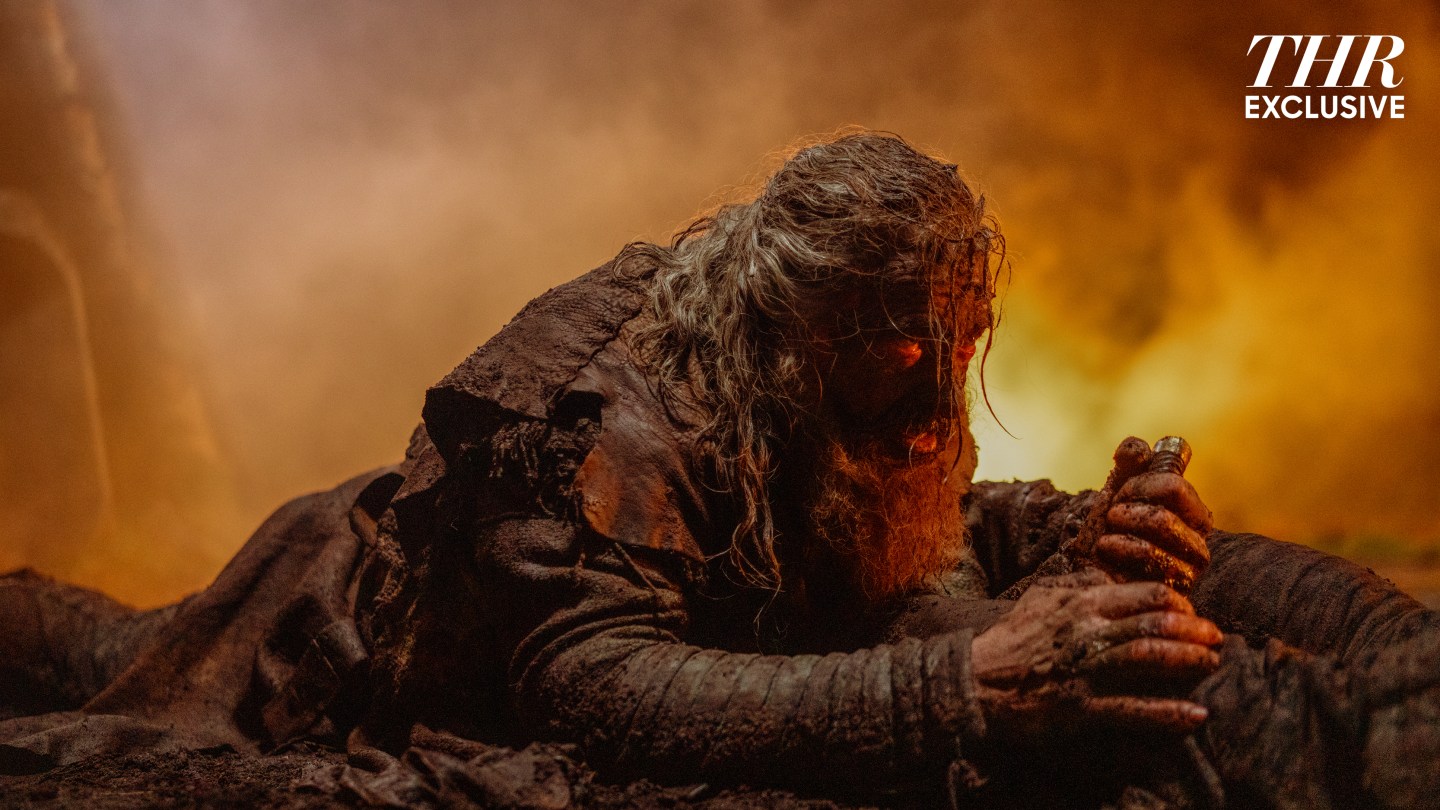


As part of the research for his new film The Death of Robin Hood, writer-director Michael Sarnoski delved into a series of Medieval-English history lectures. These courses provided an immersive window into the world that Sarnoski was about to bring to the screen, with one particular challenge to the conventional wisdom proving especially resonant.
“You think of medieval battles as knights in shining armor, riding in on horses, but most of the time it was just peasants beating each other to death with shovels in the mud,” Sarnoski says now. That insight inspired his vision for how he wanted to capture action in his movie: “Just a couple of old men, desperately trying to kill each other in the mud — that was the core idea. How do we strip this down to its essentials?”
That motivating question speaks to The Death of Robin Hood as a whole. The stark film may seem to offer a departure from the eponymous outlaw’s typical, bloody role across movies and TV, but for Sarnoski, it reflects his honest relationship to the material from childhood. He loved the 1973 Disney version as a kid; he was still young when his father died, after which he encountered the ballad Robin Hood’s Death, which dates back to the 17th century. Reconciling the dramatically different tales led to his interpretation.
“I remember as a kid going through the loss of a male role model, trying to come to terms with, ‘Wait a minute, there’s this immortal folklore character that is the animated Robin Hood, and then at the same time, there’s this story of him dying very much in a quiet human way,’” Sarnoski says. “That was very confusing to me as a kid, and it was something that I was fascinated by and wanted to explore more deeply.”
The Death of Robin Hood, shot almost entirely on location in the stunning wilderness of Northern Ireland, opens in vast wide-screen, with our antihero (played by Hugh Jackman) a wanted, aging marauder who kills and kills in order to survive. The film’s first act is unrelenting in its brutality, bracingly realistic in its portrait of life on the Celtic fringe circa 1247 A.D. “That was our way of saying, ‘Here’s the legend that you think you’re seeing, this is the thing that you expect from a movie like this,’” Sarnoski says. “I needed that action to be unpleasant. After you watch the action in the first third of the movie, I want you to be a little disturbed by it.”
After being dragged into a near-fatal encounter with his former companion, Little John (Bill Skarsgård), Robin Hood finds his story making a surprising turn: He’s taken to heal at an idyllic faraway priory, and cared for by the warm Sister Brigid (Jodie Comer). The bloody thrills of the film’s introduction give way to meditative psychological drama, with Robin Hood carrying a lifetime of guilt and betrayals and secrets — the latter of which threaten to disturb his peaceful final days. Sarnoski’s script zeroes in on the cycles of violence that have defined the character’s life, and, in turn, what he can leave behind.
“A lot of it is Robin grappling with that legacy,” the filmmaker says. “What makes Robin Hood tick? I really wanted to humanize these characters and understand them on a deeper level. The subversions, or the things that people see as subversions, came from being like, ‘Okay, what could a medieval bandit’s life have been like? People were getting beaten to death all the time. I want to imagine what it would’ve been like to actually be a person back then.’”
**
A Milwaukee native who went on to study at Yale, Sarnoski has experienced a swift rise in Hollywood. His 2021 debut, Pig, celebrated as a comeback showcase for Nicolas Cage as a mournful truffle-hunter, won him the Spirit Award for best first screenplay (alongside co-writer Vanessa Block) and a slew of critics’ prizes. In the aftermath, he started taking general meetings with studios and talent — including Comer, who’d go on to star in Robin Hood — and began negotiations to helm the prequel spinoff A Quiet Place: Day One. He ultimately signed onto that franchise movie — but in the months before inking that contract, wrote a quick Robin Hood draft purely for himself.
“I was like, ‘It’s now or never to try and crank out this Robin Hood script to see if it’s something that I can believe in,’” Sarnoski says. “I kept working on it throughout the Quiet Place process, and then by the time Quiet Place was done, we were ready to go out with it. I didn’t think of it as the sort of ‘one for me, one for them’ thing, but I wanted to make sure that I had this thing that I knew I was passionate about in the background as I was working on this big studio thing.”
In May 2024, A24 landed the rights to The Death of Robin Hood. The next month, Day One opened to critical acclaim and box-office success.
“I was going from this big studio movie, and before that I had done a tiny indie movie,” Sarnoski says. “I wanted to use what I learned from both of those worlds in something that was right in between.” He did not intend to make a conventional Robin Hood and thus approached the scale of the project with discipline. He calls the budget “reasonable” and cheekily describes the final product as “a weird take on Robin Hood,” adding, “It’s a thoughtful, heartfelt, dark movie that is kind of challenging, but that’s the movie that we all wanted to make — and so we found a way to do that. People are going to assume this was some big epic, but this was an indie film. We financed this internationally and I wrote it on spec. This was a real labor of love.”
Still, the movie boasts significant visual scope, shifting to a boxier aspect ratio after arriving at the priory while maintaining a commitment to real, striking locations, from castles to mountaintops to mudpits. The opening act’s battles are intense and elaborate in their naturalistic choreography. The actors were “put through their paces,” Sarnoski says — especially since the shoot took 30 days in total, very little time given the scale of the project.
Jackman told Sarnoski he had not shot a movie in such a short timeframe since the first indie he ever shot back in his native Australia, nearly 30 years ago.
“I know it was rough for Hugh. It was muddy. He tweaked his neck. But he was enjoying it — he liked how fast we were shooting,” Sarnoski says. “He was like, ‘We’re on fire, we’re moving.’ One day we’d be shooting some crazy action scene and then this really intense dramatic scene the next day. It was just nonstop.”
We meet Jackman’s Robin Hood as a kind of “ogre lion,” a cave-dwelling monster that the humans around him are trying to slay. That animalistic layer wears down, though, as he reconsiders his humanity. “Hugh has done Wolverine, he’s done action — I knew he could do the aggressive, violent side of this,” Sarnoski says. “But he’s such a warm, kind person that no matter what, we can have him do all the horrible things we want in the movie — and those moments when you see kindness in him feel really real.”
That nuance was equally important in Sister Brigid, embodied by Comer with steely warmth. The character in past iterations of the tale tended to appear more as an “evil nun,” Sarnoski says, and he wanted nothing to do with that.
“She’s created this incredible world of love and caring using some of the same tools that Robin created a world of pain and violence,” Sarnoski says. “The two of them grappling with that dynamic becomes a big part of the story.” Of Comer’s portrayal, the director raves: “She’s very childish and sweet at times, but then she has this real gravitas and poise and wisdom that feels kind of beyond her years, and she can play all of those things at the same time. She’s very observant, but she also plays a lot of it close to the chest.”
In just three movies, Sarnoski has already presented consistent themes and motifs. Pig and Day One both present loner protagonists at a certain impasse, feeling used up and worn out, only for life around them to start opening up again — and Robin Hood follows that trajectory. It’s clear even in the design of the new film, which gradually discards an initial color palette of bleak browns and grays for an array of blues illuminated in natural light.
None of this is to say that it’s all sunshine and rainbows by the end. Sarnoski never works that way, either. “People describe my movies as sad, and they are somber and sad in certain ways, but I think they all have fairly optimistic or hopeful endings,” he says. “I try to find those hopeful endings — while still doing full justice to the dark side of what’s going on.”
**
The Death of Robin Hood hits theaters on June 19.
Read the full article here