





Like many others, my New Year’s resolution is to start eating healthier — a big part of my plan involves tracking how many calories I’m consuming in a day.
But as I started logging my calorie intake with an AI calorie tracker, I realised that it may not be as accurate in tracking the nutritional value of local foods, as most trackers cater to Western markets.
Just as I was about to give up my favourite cai fan and char kway teow altogether, I came across HawkerSense — an AI calorie tracking tool that claims to accurately read local cuisine, even detecting details such as the amount of oil used in ban mian or curry gravy poured over rice.
Wong Qi Han, product lead at Google and the developer of HawkerSense, told AsiaOne the reason for developing the tool is to help Singaporeans solve the problem of not being able to accurately track the nutritional content in their hawker meals.
“When I looked at a plate of cai fan, I thought it was an interesting problem for computer vision. Captcha squares would fail at labelling a plate correctly — too many overlapping items, ambiguous ingredients. So I took it as an engineering challenge,” he said.
The tool also helps Singaporeans to make healthier choices without having to give up their beloved hawker fare.
“I want to help people order smarter without giving up what they love. It’s about awareness, not restriction,” Qi Han added.
According to him, HawkerSense’s core prototype took two weeks to build and saw close to 3,000 meals scanned. 20 days after the tool was launched, it tracked a total of 1.8 million calories.
In addition to identifying local dishes accurately, Qi Han also designed the tool to be more engaging for users — using the relatable “Nutri-Grade” labels and Singlish.
“A clinical ‘high fat content’ warning is easy to ignore. A localised tip like, ‘Wah, a bit oily lah. Ask for less gravy next time!’ hits different. It turns the AI from a judge into a helpful buddy, making the advice more palatable and certainly more memorable than a standard nutrition label,” he explained.
Sensing hawker fare
Determined to stick to my New Year’s resolution, I decided to give the tool a go to see if it’s accurate.
For my experiment, I compared the readings of three hawker meals from a regular AI calorie tracker and HawkerSense.
Besides calories, both tools tracked nutritional information including protein, carbohydrates and fat, as well as the percentage each nutritional value takes up with reference to the daily recommended intake.
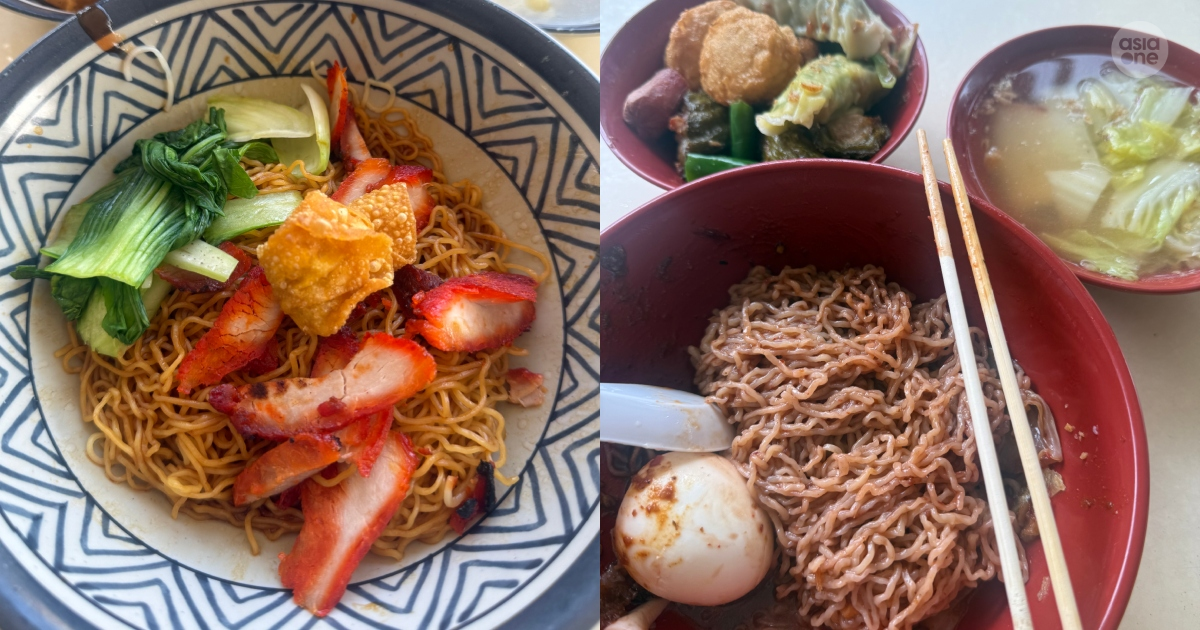
The first meal is a local favourite — wonton mee with soup and a side of fried wontons.
After uploading a photo of the meal to HawkerSense, the tool not only calculated the calories in the meal, but also provided insights into “blindspots” — such as how the noodles are likely cooked in lard, which adds significant hidden saturated fat.
It also correctly identified most of the meal, down to the bok choy and clear soup.
The entire meal came up to 950 kcals, labelled as “Nutri-Grade C” according to HawkerSense.
While most may recognise Nutri-Grade as Singapore’s labelling system that identifies levels of sugar (with sodium and saturated fats coming in 2027) in beverages, the tool uses it as a relatable frame of reference for users.
When I uploaded the same picture to a generic AI calorie tracker, the meal registered as having a mere 592 kcals.
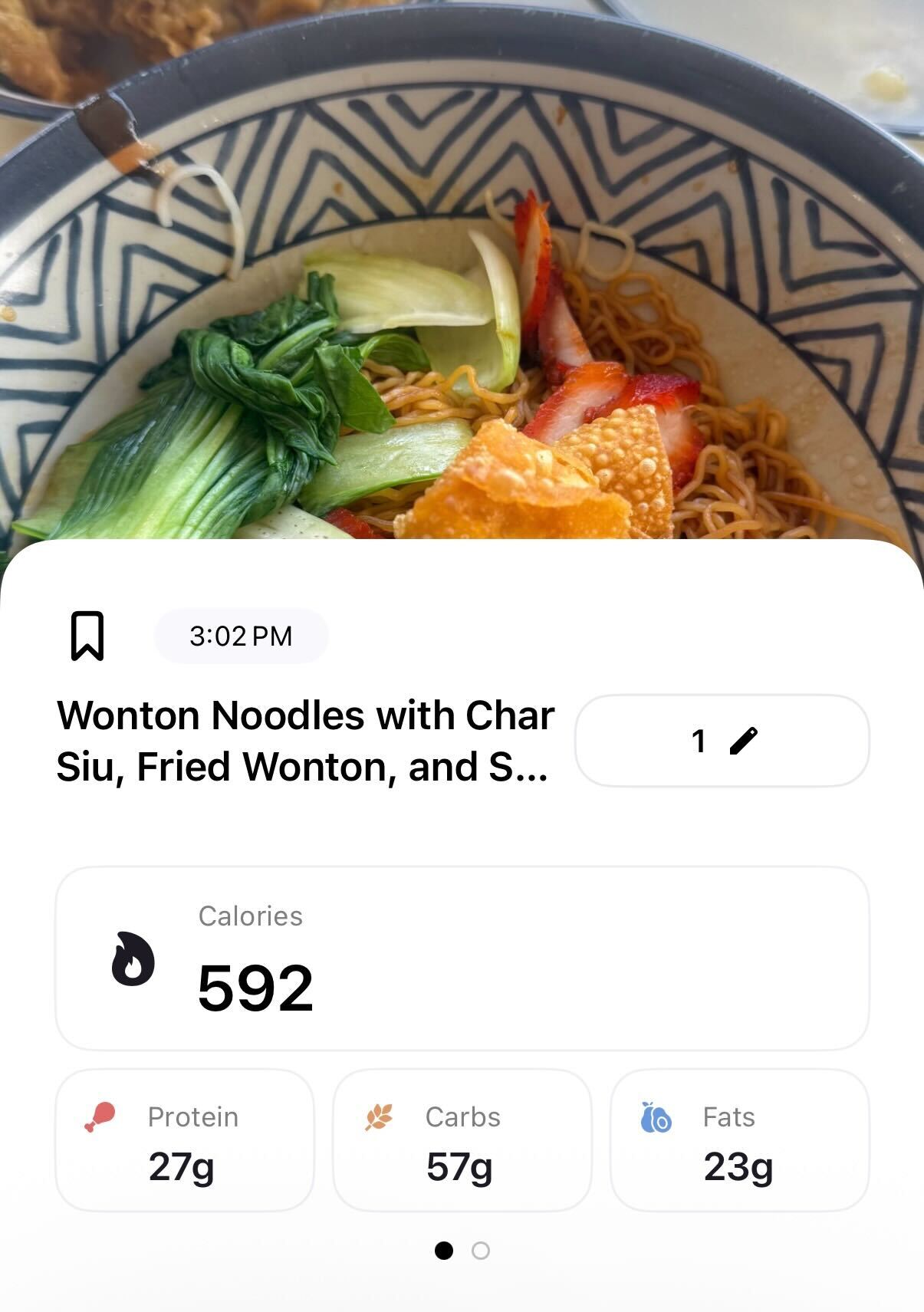

That’s a difference of over 300 kcals. But how do such discrepancies matter?
One key benefit of calorie tracking is that it increases awareness of how many calories you are consuming, Melissa Tay, senior dietitian at National University Hospital’s Department of Dietetics, told AsiaOne.
“It teaches you the proper portion sizes so that you avoid overeating and exceed your calorie requirements,” she said.
According to HealthHub, the average recommended daily calorie intake is 2,200kcals for males, and 1,800kcals for females.
“Based on the self-regulation theory, by monitoring one’s own behaviour and seeing positive results, it motivates one to keep making better choices,” she explained.
“This creates a virtuous cycle where tracking leads to better decisions and therefore improved health outcomes, which further motivates one to keep tracking.”
Studies show that when a person’s body weight is in an unhealthy range, he or she is at a higher risk of health problems such as high blood pressure and Type 2 diabetes among other chronic diseases. The main reason for weight gain is consuming too many calories.
The second meal I logged was something trickier for AI calorie trackers — yong tau foo with assorted ingredients.
While it was unable to distinguish each ingredient and registered them as “yong tau foo assortment”, HawkserSense managed to pick up other “blind spots” such as the sweet sauce, which it warned could contain hidden sugar and oil.


This meal came up as 700 kcals, with a B “Nutri-Grade” rating.
The same dish was logged as 490 kcals on a generic AI calorie tracker, which detected cheese tofu as “fish cake” and chive dumplings as “stuffed tofu”.
For the third meal, I decided to log the dish that inspired it all — a plate of economy rice.
HawkerSense didn’t manage to register the cereal fish correctly, instead identifying it as fried chicken cutlet. But it got the other two items right: braised tau kee and braised egg.

It also identified the sauce on the white rice and oil absorbed by tau kee.
The calories came up as 835 kcals, with a “Nutri-Grade” C rating.
Lapses like these are no surprise to Qi Han, who described hidden ingredients, such as salt in soup, or submerged ingredients in yong tau foo, as the “toughest challenge”.
“One user also sent me a photo of his yellow sweet potato and showed me how my AI said it was a potato. Tough one!” he admitted.


On a generic AI calorie tracker, the economy rice was logged as a 1,050 kcal “Fried Chicken Rice Box with Braised Egg”, without a clear breakdown of where the calories came from. It also missed out on the gravy and tau kee.
Balanced diet
After using the AI calorie tracking tools, I realised that each of my meals potentially took up over half of the calories I needed for the day.
Factoring in other beverages, snacks and meals, it was likely that my daily calorie intake exceeded the recommendation of 1,800kcals.
The tools also showed that there was too much fat and sodium in my meals.
I’m now aware of hidden calories in hawker food, which makes it easier for me to plan more balanced meals.
But what constitutes a balanced meal?
While consuming the right number of calories is a good first step towards a healthier diet, not all calories are equal.
“Keeping to the calorie count on a diet consisting of only sugary cakes, meat dishes, or a glass of wine is far from ideal. This is because your body needs a variety of vitamins and minerals, as well as fibre to function properly,” an article on HealthHub explained.
According to the Health Promotion Board’s My Healthy Plate guidelines, a simple way to achieve a balanced meal is to fill your plate with half a plate of fruits and vegetables, a quarter with wholegrains, and a quarter with lean meat and others.
https://www.instagram.com/hpbsg/p/DJBCtTetKIN/
Not a standalone solution
According to Melissa, the mismatches in calories tracked are one of the main cons of using such AI tools.
“There is a risk that the app may incorrectly identify foods or provide wrong nutritional information due to database errors, leading to misleading calorie counts,” she said.
In my opinion, there are improvements to be made regarding the accuracy of both calorie-tracking tools, but HawkerSense appears to be more helpful to the average Singaporean.
Having a tool that understood local food also helped me feel more confident that I was on the right track in my health journey.
On the benefits of localised AI calorie-trackers like HawkerSense, Melissa thinks that it helps people become more aware of their food choices and learn which foods are better for their health.
“Over time, this builds up knowledge about healthy eating, so individuals may more naturally make better food decisions, building a solid foundation for healthier eating habits in the long run,” she said.
However, it’s important to note that AI calorie tracking tools — no matter how tailored to the needs of an individual or group — isn’t a silver bullet to eating and staying healthy.
While calorie-tracking offers numerous advantages, it achieves maximum effectiveness when integrated with other healthy lifestyle practices such as regular exercise rather than being used as a standalone approach to health improvement, Melissa advised.
“Calorie-tracking serves as a valuable component in the journey towards a healthier lifestyle.
“It’s essential to remember that developing healthy habits is a gradual process that requires patience and daily commitment, rather than expecting immediate transformation overnight,” the dietitian said.
[[nid:716514]]
carol.ong@asiaone.com
Read the full article here