






[This story contains MAJOR spoilers from the season five premiere of Power Book III: Raising Kanan.]
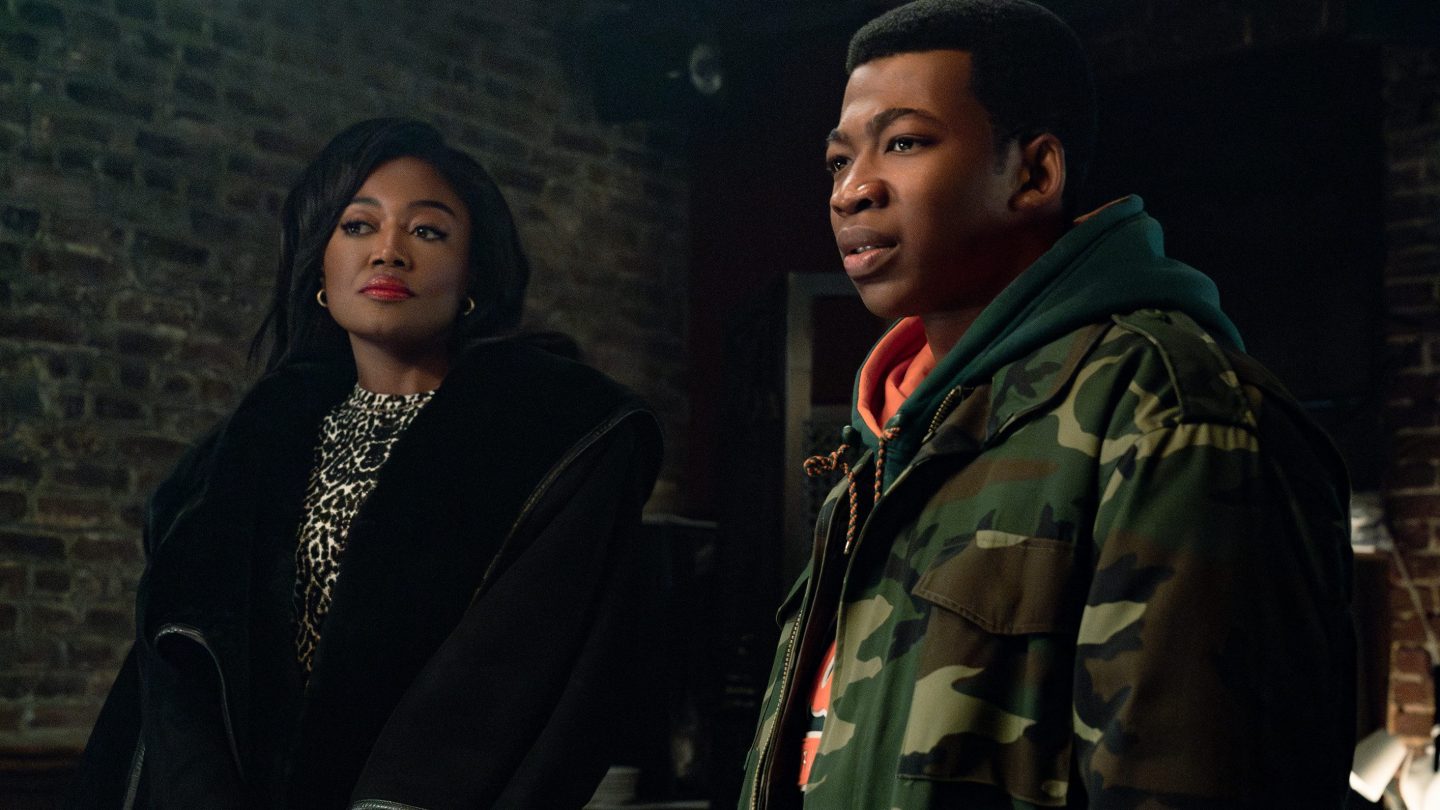
Power Book III: Raising Kanan shocked viewers with an explosive start to the premiere episode of the fifth and final season of the hit Starz series. Kanan (Mekai Curtis) had ended last season with a bang when the gun he was holding on his mother Raq (Patina Miller) went off just as the screen went black. He was there to confront her on misinformation that she killed his best friend Famous (Antonio Ortiz) and girlfriend Krystal (Aliyah Turner).
As he ran down the list of those close to him that he believed she had killed — including two murders she actually had a major hand in with D-Wiz (Nile Bullock) and his father, Detective Malcolm Howard (Omar Epps) — things got irreversibly out of control to kick off the show’s return with season five.
Trying to prevent Ruben, Raq’s henchman, from shooting Kanan as he played peacemaker, Lou-Lou (Malcolm Mays), Raq’s baby brother and loyal soldier, caught the bullet instead, dying in dramatic fashion with eyes locked in on Raq. Though there were many times throughout the series where Lou could have died, how it happened is hitting fans super hard. That reaction what showrunner Sascha Penn and his team were banking on.
“It introduces an interesting, compelling and frankly tragic dynamic shift that helps propel us through the final season. It hangs over everything,” Penn tells The Hollywood Reporter. “There’s a reason why we did it in the first 20 seconds of the show, because we want it to cast a pall over the entire final season.”
As fans know, the kid version of Kanan that Curtis plays is far from the ruthless adult version Curtis “50 Cent” Jackson portrayed in flagship series Power. “The whole reason the series exists is to deconstruct Kanan as you met him in Power and explain how he became who he became. Certainly, this is a huge piece of that — a foundational piece of his identity and a sense of himself and a sense of the world around him,” expounds Penn.
“I didn’t know,” Mays tells THR of Lou’s shocking death. “That’s how the Power Universe works. You just expect yourself not to make it [beyond] season one, much less [to] season five. I was just really appreciative to make it to this fifth season.”
“It’s not a personal slight; it’s about the story,” he adds.
Marvin’s reaction to his brother’s shocking death solidifies that. London Brown, who portrays Marvin, sells how devastating this loss is. His profound sadness and rage give the audience permission to feel similarly. When Marvin is called to the morgue, he has no idea he will be identifying Lou’s body. Despite being startled by seeing his brother under that sheet, he holds it together until he gets back to the car and sinks into tears in the loving embrace of his daughter Juke, or Jukebox (Hailey Kilgore). It’s an intensely emotional scene from Brown and Hailey Kilgore that drives home just how life-altering Lou’s death is for the family and, as Penn stated, this entire final season.
“I don’t think he even knew where he was going until he pulled up and parked,” Brown says of that moment for Marvin. “When they pulled that sheet back, he can’t even talk. He had to just digest that and keep his face together until he felt he was in a safe space, which was in Jukebox’s arms. Nobody was around. It was just him and her, and he had to get that out.”
As Marvin’s emotions quickly shift, so does his mood, notes Brown. “Even then, within that pain, the anger is already a brewing; he’s getting antsy and [later] he’s like, ‘Raq I need some answers’ …. He has to make a move. I don’t think he’s able to rest until he does. But I’m glad people connected with that, because even though the brothers were at odds throughout [the series], we all know that the Thomas family loves each other.”
Mays spoke with THR extensively about his exit below, reflecting on his time playing Lou, where he shined alongside Tony winner Miller, who plays Kanan’s mother Raq, and bonded with the whole crew in front and behind the camera. Fans of Mays’ recall that his character on the FX gritty urban drama Snowfall, Kevin Hamilton, also suffered an accidental demise. This isn’t foreign territory for the actor, but, of course, his time as Lou-Lou hits differently. Penn describes Lou as “being somewhat of a moral compass for everybody.”
Though an enforcer and loyal soldier to sister Raq who helped raise him, Lou showed his unease with the Thomas family business throughout the series. For a minute, the music business, where he recorded Kanan’s best friend and budding rapper Famous or Fame (Antonio Ortiz), and his niece Jukebox represented an out for him. When that didn’t pan out, he spiraled, ending up in rehab for alcoholism and attempting suicide, which is how their father, a musician, died. Lou also suffered the loss of his mother, with Raq being the one to follow her wishes to take her out of her pain.
Unlike Marvin and Raq, fans saw how deeply those key deaths, mainly those of D-Wiz and Scrap, affected Lou. And it’s the lack of remorse over Lou’s death on Kanan’s part, and the coverup by Raq, that greatly sets the tone for how Kanan (50 Cent) in the original Power came to be.
***
Man, Lou-Lou is an audience favorite. Having him leave, especially so unexpectedly and accidentally, really hurts.
That kind of happened with Kevin [on Snowfall], too. I don’t think I was supposed to make it as long for either series. I think people respond to the characters I’ve been blessed enough to create and play, and that causes the writers to give me more runway than I was supposed to get in the first place. I think the audience then just assumes I was supposed to be there the whole time, which is once again a testament to their support of the work I’m doing, and I take that as a blessing.
Take us back. Who was Lou when we first met him?
Lou was the cleaner. He was the guy stuck in a dead-end job, one he hated but was really good at. I think at some point once his soul and spirit started to awaken, he started to then not be as good at that job, because once you start questioning why you do something and how something affects your soul while doing it, sometimes that affects the actual performance. But unfortunately, the consequences for his particular job are fatal.
That’s the tragedy of it all. As a person watching a human have an experience, we’re really happy that Lou is finding himself and discovering things and finally maybe doesn’t want to do this, and wants to do music, wants to participate in the arts and the humanities, and explore the pieces of his soul that have never really been present to him. But the moment he starts to [do that], all of that is taken [away] because of the primary occupation that he’s been born into. It’s hard to quit a regular job, but much harder to quit a job that you work that’s a family business.
What did Lou’s brief bit of early music success with Fame.Famous do for him?
When Famous was getting a little buzz, there was a realistic pathway. And that’s the test. I think that speaks to coming from [certain] environments. It’s not that people aren’t talented or that we don’t have interests that are unique and counter to what our environment says, or to what is normal or prescribed for us. It’s the lack of a pathway; lack of resources and access. Once Lou found access, because that’s what hip hop did — it provided access for people to have the arts — it democratized artistic expression; you didn’t have to be able to own a piano or spend lessons for classical training. You didn’t have to go learn the violin, you could just start talking into a mic, and, if you wanted to participate, you could fund it [yourself]. If you wanted to make beats, you didn’t have to own a studio, you could make it on an MPC at your crib. Once Famous got popularity, once there was a pathway to accessing that expression, [Lou] wanted more because it tasted like freedom.
What did killing D-Wiz, one of the family’s loyal soldiers in the drug game, do to Lou?
I think that started the fracture because D-Wiz was so young. But I [also] think that the fracture already existed. [Killing D-Wiz] increased whatever crack was in his spirit to the point of where it became a chasm. Eventually, that’s the problem. He had already done everything he does, but he had hyper-compartmentalized. He couldn’t hyper compartmentalize that one because it was unnecessary; it didn’t have to happen, and I think that is the one that really broke [Lou].
And what about his role in Scrap’s [another loyal soldier] death?
Yeah, once Scrap went, it was over. For the first one [with D-Wiz] it was like, “Okay, we made a mistake, right? Really, Kanan made a mistake, and we’re covering up for your boy’s mistake, but that’s family.” And [Lou’s attitude to Raq is], “Even though I don’t agree, I chose your leadership. I got to go with it when it’s great, when it’s bad.” But with Scrap, she was wrong, blatantly wrong, then lied about it. And then expected us to hold it anyway, and then insulted [Lou] and everybody else at that point. That’s when he was like “my soul has been screaming for something else, thirsting for something else already. Now it’s time to get away as much as I can,” and she wouldn’t let up.
It was the same relationship between Tasha and Ghost. A lot of fans, not all, but a lot, were like, “What’s wrong with Ghost?” But the reality is that before he started fully dating Valdez, he told Tasha, “Hey, I don’t want to sell drugs no more. We don’t have to sell drugs no more.” And [like Raq], Tasha was like, “Man, shut up, we sell drugs.”
They had a whole penthouse worth $30, $40 million with a bunch of money in the bank, and the kids go to private schools, and they still trying to figure out how to keep selling drugs? The businesses alone could have generated enough interest to take care of whatever their bills were at that point, but they didn’t want to let him out. I feel like that’s what Lou was experiencing with Raq. Raq was telling him, “This is what we do.”
Lou going to rehab for alcoholism was very powerful and a different side than we’ve seen on a lot of so-called gangster shows, especially since this world is so married to liquor. What was that experience like for you as an actor? Where did you have to dig to portray that real-life struggle?
I looked at it as an opportunity to anthropologically explore blights in my own family, in my own community with my aunties and uncles. Addiction is rampant in most families, regardless of color, but pervasive, specifically, where I come from [in Los Angeles]. So for me, it was an opportunity to really explore and speak to what that experience may look like, and, hopefully, I added some nuance and complexity that it’s not just entertaining to watch. There’s a reality that in this country, and in our culture, [this kind of] escapism is okay. It’s commodified. Like your pain, you ain’t got to deal with it, your trauma, you ain’t got to deal with it. Come get this liquor, come get these drugs, come get this whatever. So I just looked at it like he was trying to escape, and [asked], “What does it look like when you spend all your time trying to escape instead of trying to deal [with your trauma]?”
When Lou tried to kill himself, it opened the door to learn more about their family history.
Addiction has been proven to be technically familial. His father also was an addict, right, [and] addiction is pervasive in family genealogical trees.
What was Lou and Raq’s relationship after Lou went to rehab?
I think before rehab, it was shaky because he was discovering a life outside of their world, and that was negatively impacting her operations and her goals. So anybody who gets in the way of Raq and her goals, with the exception of her son, you already know how it’s going [to go] for them. It wasn’t positive at all. Then I think after, they were in a better space. She accepted [Lou and was like], “That’s okay. I got Marvin still, and maybe, maybe I can start to let go,” but then all the shit she had done before kept Lou from believing that she was actually going to let him go.
The relationship Lou has or had with Marvin is much different than the one he has with Raq.
I think the relationship [Lou has] with Marvin is probably one of the most [or highest forms of] unconditional love. Despite the favoritism [Lou] received from Raq, Marvin’s the only one who never [questioned] Lou-Lou [when he] wanted to do something different. He was like, “Alright, that’s what you want to do, that’s cool.” He never really judges nobody. He lets people do what they do, and that’s kind of in the Bible, how they speak of love. Whether you believe in God or not, there’s a pretty good manuscript in there about how love is kind, love is understanding, love doesn’t judge. I think, ironically, the most dangerous man on the show, outside of Lou, is Marvin [because] he loves the most purely, which is why I think everybody loves his character, to be honest.
The interaction between Omar Epps’ Detective Malcolm Howard, who is actually Kanan’s father, and a drunken Lou when Lou realizes that Howard was the one who told Raq that Scrap was a snitch towards the end of season three is especially memorable. Howard gets so upset about Lou’s realization that he puts a gun to his head and says, “One more word and you dead” and Lou responds, leaning into Howard’s gun, by saying, “I’m already dead, n***a.” Take us into that scene, that moment.
First of all, working with the legendary Omar Epps was bar none, tier one, and him being so gracious in that scene. There were a lot of tips he gave like, “Hey, look, man, you already got it, you already have mastered this character, feel free to play and to explore beyond what you’ve already built, because I’m gonna go right there with you.” And that’s what happened, we went somewhere else. A lot of it was scripted, especially that line, but in between moments [like] the leaning up against the gun.
To the trained eye, Lou leaning his forehead into Howard’s gun basically welcoming him to kill him seemed like it was a choice made by the actor and not scripted.
Yeah, definitely, but it’s a dance. You don’t do no tango by yourself. I wouldn’t have been able to make that step had Omar Epps not been so Howard, invested, and gave me his back step so I could take that front step. A lot of that was just us flowing.
Just before Lou’s death, he kidnaps Unique’s (Kadeem Mathis) woman and their child. What state of mind is Lou in by then?
He’s accepted that he’d rather have his sister’s love. He’s accepted that he’s not a good guy who’s forced to do bad things because he’s gone too far, even in his own mind. He’s been manipulated to believe that this is what’s necessary by his sister. Lou’s highly impressionable and highly weak-minded, in my opinion, so he’s accepted that he isn’t shit. It’s like what happens when somebody tells you “you ain’t shit” your whole life; you start to believe it. He finally started to believe it. He had his transformation, and then it didn’t matter.
He tried to do right, and things still went to shit. His girlfriend got killed, His other girl moved away. He still had to kill somebody’s son, then had to kill the mother of the dude that he killed because his sister told him to, and then Marvin drove him.
Curiously, were you surprised that Lou got taken out by Kanan, even if was by accident?
Yeah, that was a little strange for me, because I didn’t get to act with [Mekai Curtis] as much as I wanted to, and that’s really my boy in real life. I’m like, “Oh yeah, we got scenes together [then] wait, wait, this ain’t what I thought it was.” I always say that Raquel’s first son is not Kanan, it’s Lou. So her first son killing the second son is also kind of poetic in that way.
Like Cain and Abel?
Exactly.
Of course, some people will argue that Lou didn’t go out like a G, that he should have died in a shoot out or something more glorious than catching a stray from Kanan. What are your thoughts?
Selfishly, I would have wanted that, too. But the reality is my storyteller had an agenda of the tragedy of what it was, and I don’t fault him for that. Sometimes the thing that’s more impactful for me than an individual to look cool as an artist is not necessarily what’s best for the story or for the impact of the story. And I’m a team player. I’m just glad to be on the board and be on the team to get us to the championship.
What do you hope that Raising Kanan fans take away from their time with Lou?
The pitfalls and danger of change. Change doesn’t look like a straight line. Just because you wake up and you finally become self aware, the work isn’t done. Even if you put one foot in front of the other to go to the other end to become a different person, you are not guaranteed a happy ending.
***
The fifth and final season of Power Book III: Raising Kanan is now streaming on Starz.
Read the full article here