






As the clock crossed midnight on Labor Day, the tide at this year’s Telluride Film Festival started to turn against Frankenstein. After Guillermo del Toro’s lavish adaptation of the Mary Shelley novel had launched in Venice days earlier to strong if not effusive reviews, star Oscar Isaac hopped on a plane to introduce the film’s secret, ultimately unfortunate North American debut at a late-night screening in the Colorado Rockies. I’ve been to screenings in Telluride like this before, where you can hear the restlessness in the room, feel the sense that it’s not playing as the filmmakers surely hope. My colleague Scott Feinberg wrote that the U.S. premiere “engendered a more muted response,” questioning its viability as an awards contender. Most coming out of that screening felt the same way.
Three months later, Frankenstein has re-emerged as a heavyweight, consistently racking up nominations totals in the same league as front-runners One Battle After Another, Sinners and Hamnet. (It’s up for best picture, directing, and acting at the Golden Globes and Critics Choice Awards.) A best picture nomination suddenly seems assured, and Jacob Elordi is a strong supporting actor contender. While Kathryn Bigelow’s A House of Dynamite played better in Venice, and Noah Baumbach’s Jay Kelly surged in Telluride, there’s no denying that del Toro’s film has secured the top spot among Netflix’s typically busy slate.
The robust response from audiences continues to fuel the momentum. Immediately after Telluride, Frankenstein was the runner-up for the Toronto International Film Festival’s crucial People’s Choice Award; it now has a 94 percent verified audience score on Rotten Tomatoes, among the best of any player in the field. Del Toro has been reposting fan art and testimonials of folks who’ve seen the movie over and over. “Because I’m Mexican, I have what I call the immigration test. When I go through immigration, if they say, ‘What are you working on?’ I say, ‘Oh, the movie’s not going to land,’” del Toro tells me. “But if they say, ‘Oh, I can’t wait to see Frankenstein’ — which is what started to happen — I go, ‘Oh, it’s happening!’”
The film ranks within the Netflix platform’s top five most-viewed films of the year (within their first five weeks of release) and has been a quiet theatrical success. That latter point is key, since Netflix’s contenders rarely drum up much box-office noise in their qualifying runs — a point that’s been magnified in the conversation around Warner Bros.’ potential sale to the company (which is pending regulatory approval and the fending off of Paramount’s hostile-takeover bid). Indeed, while Netflix does not release box-office data — hence the “quiet” descriptor — Frankenstein has sold out just under 1,000 theaters globally, per sources familiar.
Two months out from its October release, it continues to play in theaters in Los Angeles, New York, Miami, Philadelphia, and more cities around the country. “What is insane for me is the way the audience has reacted. I’ve never in 30 years had this reaction. It’s a massive tidal wave of affection,” del Toro says. “I’ve been getting public and private communications from filmmakers I absolutely adore and worship, that talk about the movie with admiration or with great pride.”
In conversations with voters and peers, speaking anecdotally, few filmmakers are brought up as often as del Toro. They’ve felt his support for their own careers. His chants of “fuck AI” at major industry screenings elicit regular cheers, and have become a refrain for like-minded filmmakers such as Rian Johnson. And it’s widely known that Frankenstein is the film that del Toro has long been working towards.
“Since I’ve known you — and that has been awhile — you’ve always talked about, at some point, doing a Frankenstein,” del Toro’s longtime buddy Alfonso Cuarón told him at a recent industry screening. “Your awareness of Frankenstein and cinema go hand in hand.” Meanwhile, Margot Robbie said at a separate event, “I feel like, Guillermo, this is your magnum opus — this is the movie you were born to make.”

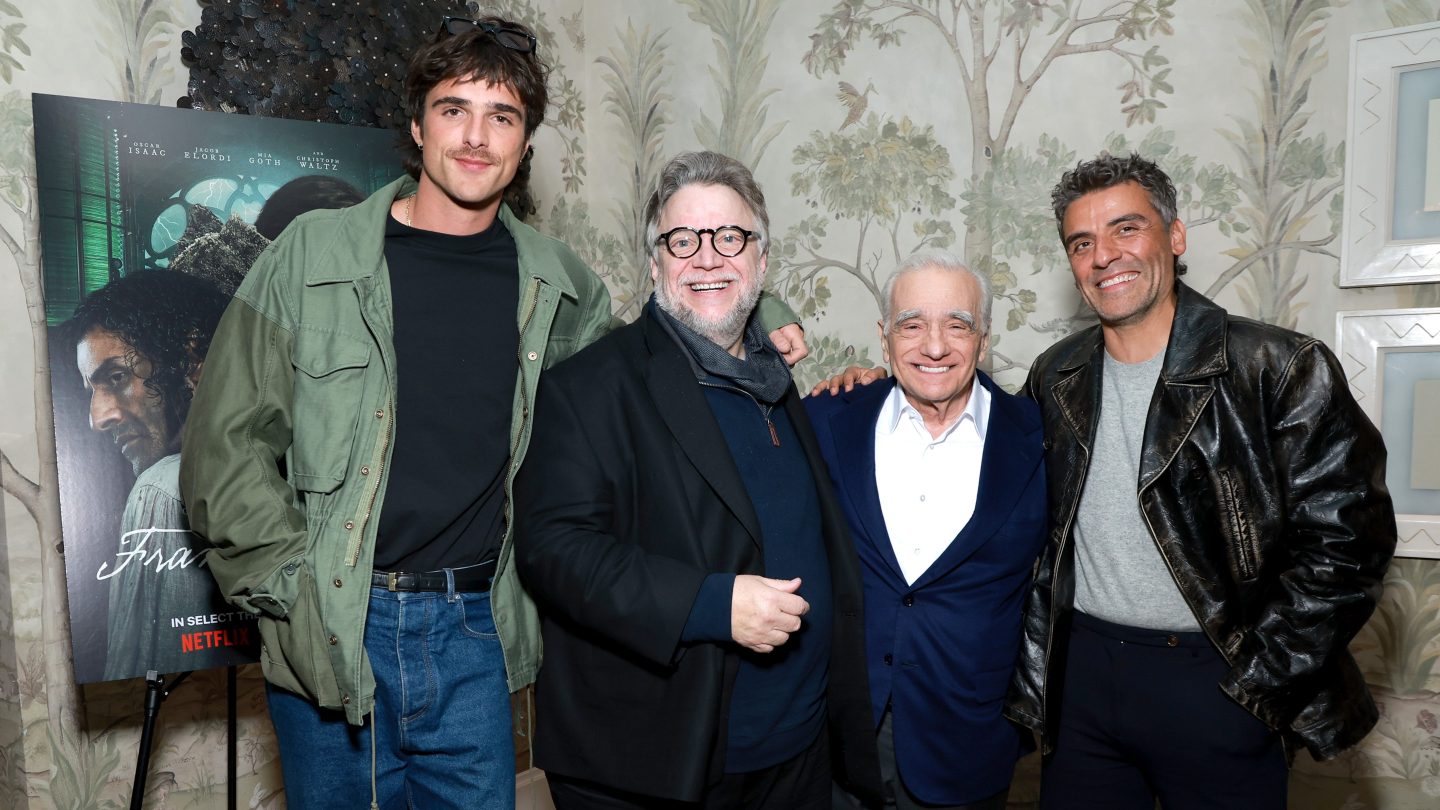
Celebrity moderators of post-screening panels for guilds and Academy members are now a staple of any all-out Oscar campaign, but this season, there’s no equivalent for who’s come out for del Toro. Among them, in addition to Robbie and Cuarón: Bill Hader, Jon Favreau, Jason Reitman, Ava DuVernay, Bradley Cooper, Celine Song, Emerald Fennell and Hideo Kojima. Above, you can watch Martin Scorsese emceeing a larger discussion for the film. “It’s a remarkable work, and it stays with you,” he said to the audience. “I dreamed of it.”
Del Toro has already won an Oscar for a Netflix film, with his dark stop-motion take on Pinocchio from 2022 taking home the best animated feature trophy. He’s also a recent best picture and best director winner for 2017’s The Shape of Water. But the Academy’s growing affection for the Guadalajara native arguably became most obvious a few years back, when his divisive and less-seen noir remake Nightmare Alley still eked out a best-picture nod.
Just how far del Toro can run with Frankenstein remains to be seen — the film remains on the bubble for both writing and directing nominations — but his genuine enthusiasm for simply promoting and speaking about it continues to work wonders for the campaign. Even if it’s simply del Toro’s way of coping with having completed his life’s work. “In the middle of the shoot, and then in releasing the movie, I realized that I was entering the most massive postpartum depression,” del Toro admits. “It feels overwhelming, and it leaves you without a horizon.” Fortunately, this creature isn’t just alive, but growing by the day.
Read the full article here