






In the spring of 2022 Emily St. John Mandel found herself in Los Angeles with a lot of time on her hands. The Brooklyn-based author, who first found literary fame after her 2014 pandemic novel Station Eleven became a bestseller and a National Book Award finalist and then again when the book became a cult-favorite HBO limited series, had come to town to work on an adaptation of her 2020 tome The Glass Hotel. The series, which ultimately didn’t go forward due to the upheaval at HBO and parent company Warner Brothers, was starting to see setbacks. “Nobody’s deal closed in time, so they pushed our writer’s room back by two months,” Mandel explains to The Hollywood Reporter. “But I’d booked an Airbnb, and I’d set up a complicated schedule of childcare for my daughter, so I knew I had to stay.”
Mandel started hammering out the pilot with showrunner Patrick Somerville (the two currently have permission to sell the scripts should another network show interest) but spent most of her days thinking about what her next novel might be. At the time, she had two fascinations: The current political environment, with the threat of another Trump presidency looming, and the character Ari, who was the villain of her second novel The Singer’s Gun. “She was in prison, and I’d never had a narrative way to get her out,” says the author, who is known for repeated use of characters throughout different books. “But at this point I figured so much time has passed and I could set this book a bit into the future. So I took this person, who’s been dropped out of time for 18 years, and put her into a fractured, chaotic, hopeful world.”
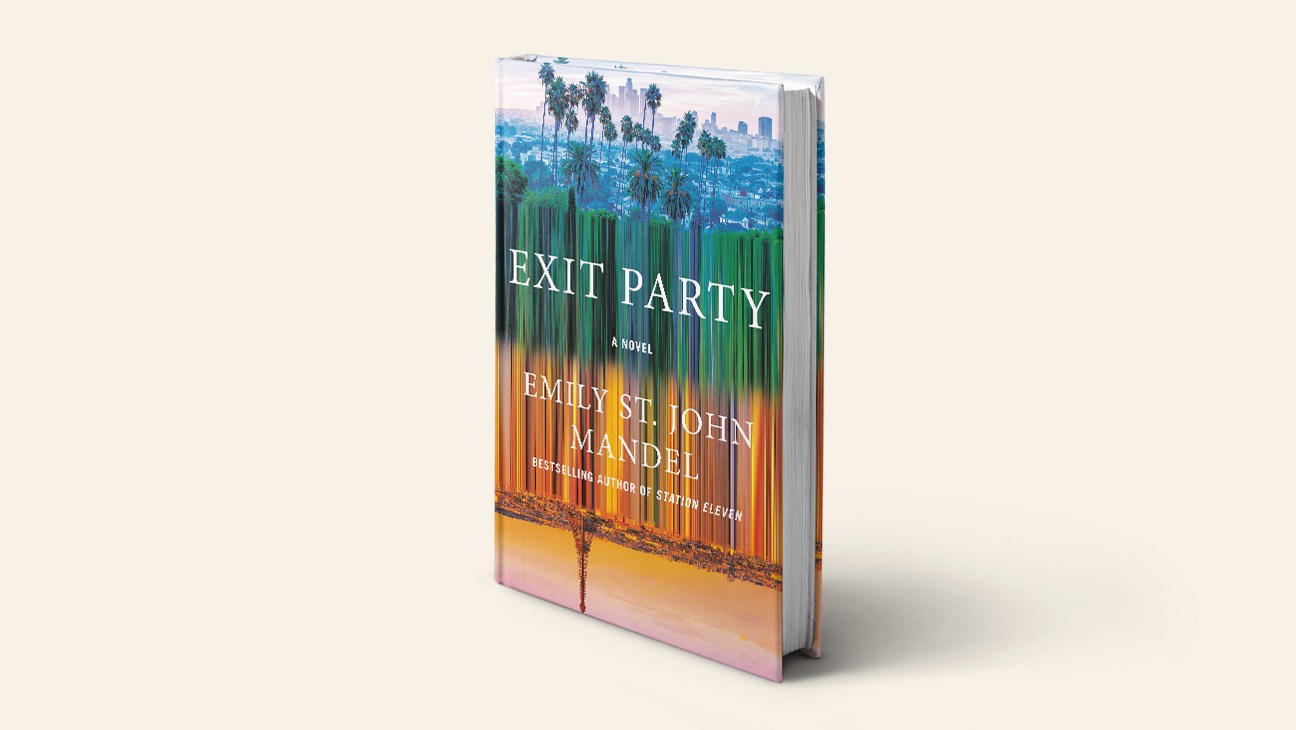
That ultimately became Exit Party, a speculative story about a dystopian not-so-distant future in which the government of the United States has collapsed and Los Angeles has become something of a refugee camp from the latent civil war. The novel opens as Ari attends a party celebrating the recent lifting of a citywide curfew and discovers a portal to an alternate world where L.A. has become a surveillance state.
In a conversation with THR, the author and screenwriter discusses what to make of her latest work, and gives an update on her latest adaptations.
I’m not sure if you’ve seen Civil War, but when that movie came out audiences had a lot of questions about how he imagined the events and military actions that preceded the version of the country we see in the film. I imagine there will be similar discourse with Exit Party.
I did, and I do think it’s very easy to imagine the scenarios. For example, suppose that Mike Johnson were to refuse to seat the Democrats after the midterms. But for me, I almost didn’t care [what happened] because I was more interested in the aftermath than I was in how the breakup of the country happened. My editors are mixed on that, which is why there’s a paragraph on the first page that’s like, ‘the United States had come apart following a coup d’etat‘. I put that in under slight duress.
When you write a very topical novel like this, do you think about what the inevitable press tour will be like, and what sorts of questions you’ll be answering for the next year of your life?
I dreaded that a little bit. I published Station Eleven in 2014, and at the time it was like wow, what a crazy fantastical scenario. Then the book took on a much greater weight after the pandemic, and I went on the road again doing paid conversations and lectures as a side gig, and people wanted to talk to me about what happened to them during Covid. It can feel like something I’m not qualified to take on. I listen and I absorb. My wife made the point about this book that I’m going to be absorbing everybody’s political anxieties for the next year. But look, I’m here for it, and I feel fortunate that the book is finding enough audience to do that.
What have you observed about the way book publishing is changing, especially as you get more successful?
What feels different with this book is how fractured the media environment is. I’m talking to a lot of mainstream journalists but also people with Substacks who have huge followings. There’s an incredible marketing team at Knopf, but I’m also on Instagram working very hard. I’m constantly taking screenshots of accounts with a lot of followers and asking the team to get them a galley. I saw that Justin Tranter said something lovely about my work, so I DM’ed him asking if he wanted a book, and now he’s saying nice things about Exit Party. The hustle has never let up.
You had a big success with the Station Eleven series, does that get you any more clout or power in the publishing world?
I don’t know that it did. I think it increased the size of my audience, and it helped with the TV writing side of my career and trying to adapt my own work. I wasn’t involved in the adaptation, but it did serve as proof of concept that my weird books can work on TV.
At the time, did you have a desire to be involved in the adaptation?
I had a phone call with Patrick Somerville in 2017, I think he was on the set of Maniac. He’d just been able to bring Station Eleven over to Paramount and he offered me a place in the writer’s room. At the time I was like, “Go do your thing, I’m going to write The Glass Hotel.“ But then the pandemic was such an isolating experience and I wanted to collaborate with people instead of working alone in a room. I got into television for the collaboration and the health insurance.
Are you still trying to adapt any of your other work?
Well, I was on Assassin’s Creed all of last year, and it was really fun. I’m writing a script for Last Night in Montreal with Semi Chellas [Mad Men], so I’m hoping that’ll happen. I was paired with Semi for a different iteration of The Glass Hotel, which obviously didn’t sell, but she’s so fun to work and hang out with, so writing this was just how I hung out with my friend on Zoom. Natalie Leite, who was on The Handmaid’s Tale, just came on board as a director. And we have an actor attached, but I’m not sure if I’m supposed to say that.
What is the experience of casting like when it’s for one of your own books?
Well, sometimes you do bump into the dehumanizing side of Hollywood and of being an actor. Or, I should say, of being an actress. I’ve been in those casting meetings where we’ll be talking about someone and they’ll ask, “Is she too old?“ And she’s 27. So I’m often the person in the room arguing for the actress to be older than I had her in the book.
Will we be getting an Exit Party adaptation?
I’m working on the pilot script. I sold it to Laika Studios. I’m into second round studio notes. I also wrote a pilot script for The Lola Quartet, my third novel, which is kind of a Florida noir thing.
Read the full article here