





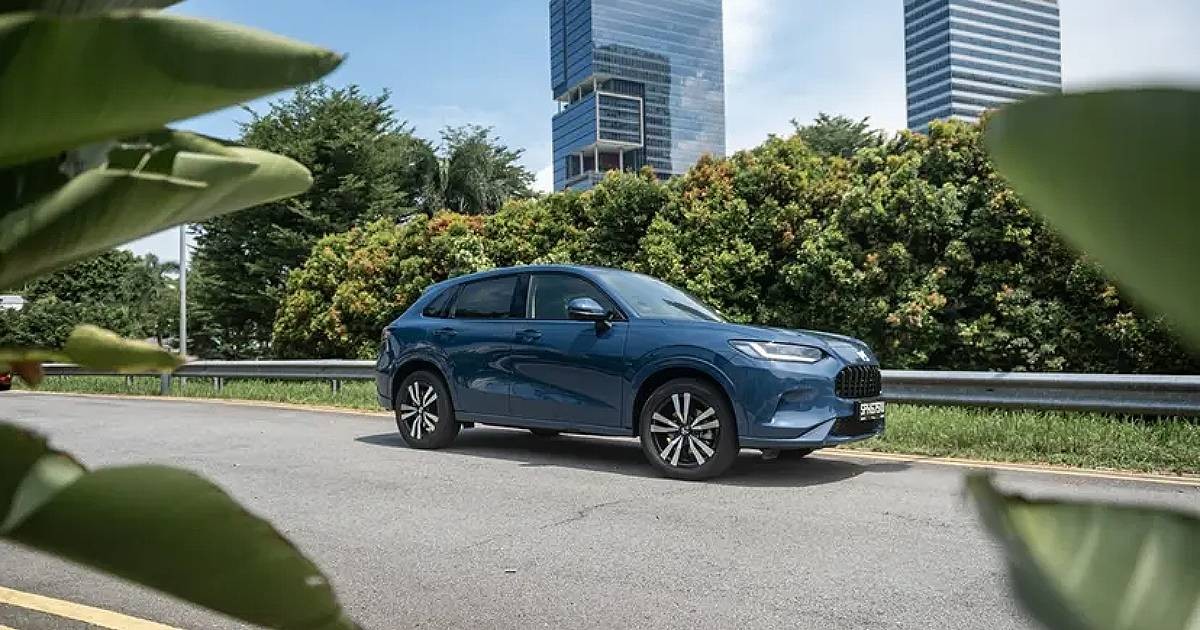


For some time now, Honda’s crossover offerings in Singapore consisted of the HR-V (better known as the parallel-imported Vezel) and the more established CR-V.
Apparently, there is a gap in this line-up, so Honda introduced the ZR-V. It’s larger and quicker than the HR-V Hybrid, but smaller and less powerful than the CR-V.
And, unlike the HR-V which shares its platform with the Jazz, the HR-V has the same underpinnings as the Civic Hybrid.
On paper, the ZR-V has a purpose. But does it fill an existing gap, or will it be a niche model that’s cool, but one that few buyers will go for?

Look book
The ZR-V’s exterior design can be described as ‘unusual’ because it doesn’t resemble any other Honda model.
There are no honeycomb grilles or sleek lines. Instead, you’re greeted by a robot-like mien with a gaping grille.
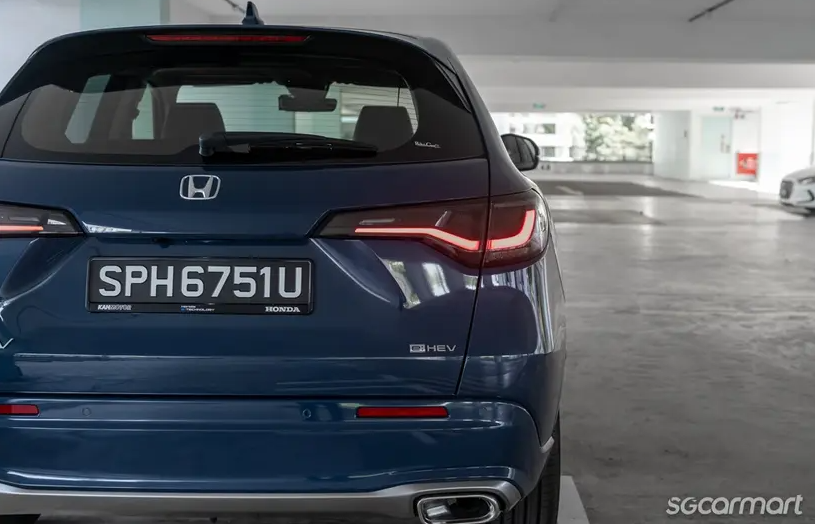
The rear end, though, looks a lot friendlier. Gentle curves, slim taillights with a unique light signature, and sporty exhaust finishers are a lot easier on the eyes.
One wonders why the front end couldn’t be more like the rear. Even if the ZR-V doesn’t look striking, at least the overall styling would be holistic.


Fortunately, things look a lot more familiar once you’re in the cockpit. The driving position is spot on and needs few adjustments — it’s a trait only found in Hondas and Mazdas.
A relatively flat dashboard improves forward visibility, and the instrument panel and infotainment display are both sharp and easy to read — even in glaring sunlight.
More importantly, the space is user-friendly, thanks to the plentiful physical controls.
There are no haptic buttons here (woot) and the digital menus are kept to a minimum.


While this might feel archaic compared to other cars that dump all their functions into the infotainment system, it’s refreshing to be able to adjust your climate controls without tapping on a screen.
However, this is also what makes the gear selector odd.
If we’re going with mainly conventional controls, why do away with the regular gear selector? Also, why does the button for Reverse feel like a toggle?
Just as puzzling is the presence of a single USB-A port when the other three are USB-C ports.
During a road trip, someone will have to bring a USB-A cable or adapter. Without it, someone will have to wait their turn to charge their phone.


Rear passengers, of course, won’t have to worry about this. Instead, they’ll be enjoying the cushy seats, plentiful legroom and flat floor.
There are also air vents to help ensure that the heat and stuffiness are kept at bay, which should be easy for the wintry air-conditioning system.
Less impressive, on the other hand, is the 370-litre boot — you’d expect at least 400 litres in a crossover this size.
Thankfully, folding the rear seats expands this to around 1,300 litres.


Buttery smooth
The best part about the ZR-V is its hybrid powertrain, which delivers sterling performance.
It consists of a naturally aspirated 2.0-litre engine and two electric motors, which are fed by a lithium-ion battery.
Instead of combined figures, Honda only provides the numbers for the combustion engine (141bhp and 186Nm of torque) and electric motors (135kW or 181bhp, and 315Nm of torque).
However, you cannot add everything together and declare that as the total output, as the engine and electric motors make peak power at different points.


As for efficiency, I averaged between 15.5km/L and 16.8km/L, which isn’t too far from Honda’s claimed 17.5km/L.
The other key thing to note is that the e:HEV switches between combustion and electric power seamlessly, and depending on the driver’s demands, can activate both simultaneously.
The result is smooth and punchy delivery that makes the ZR-V feel very driveable indeed.


It’s responsive enough to ensure you’re the first to zip away when the traffic lights turn green, while still retaining plenty of midrange for expressway runs.
But before you can think of the ZR-V as a ‘warm’ crossover, its pliant ride will clearly indicate otherwise.
Indeed, the suspension is adept at ironing out surface imperfections, helping to create a stress-free drive.
The only crease, however, is that there’s more road noise than expected, which is strange considering that the ZR-V test unit is equipped with comfort-biased tyres.


A gap-filler and a niche model
Though costlier, the ZR-V is roomier and more enjoyable to drive than the HR-V.
In terms of price, the $236,999 ZR-V is far enough from both the HR-V Hybrid ($213,999) and CR-V ($264,999 for the five-seater), allowing it to occupy its own space within Honda’s line-up.
However, the ZR-V is a niche model in the Cat B hybrid crossover segment.
It is bookended by two larger and more powerful options: The Subaru Forester e-Boxer, which costs $199,800, and the Toyota Rav4 Hybrid, which starts from $248,888.
The ZR-V makes sense in the Honda context, but in this reality, justifying it is a tough proposition indeed.
[[nid:738910]]
This article was first published in sgCarMart.
Read the full article here