




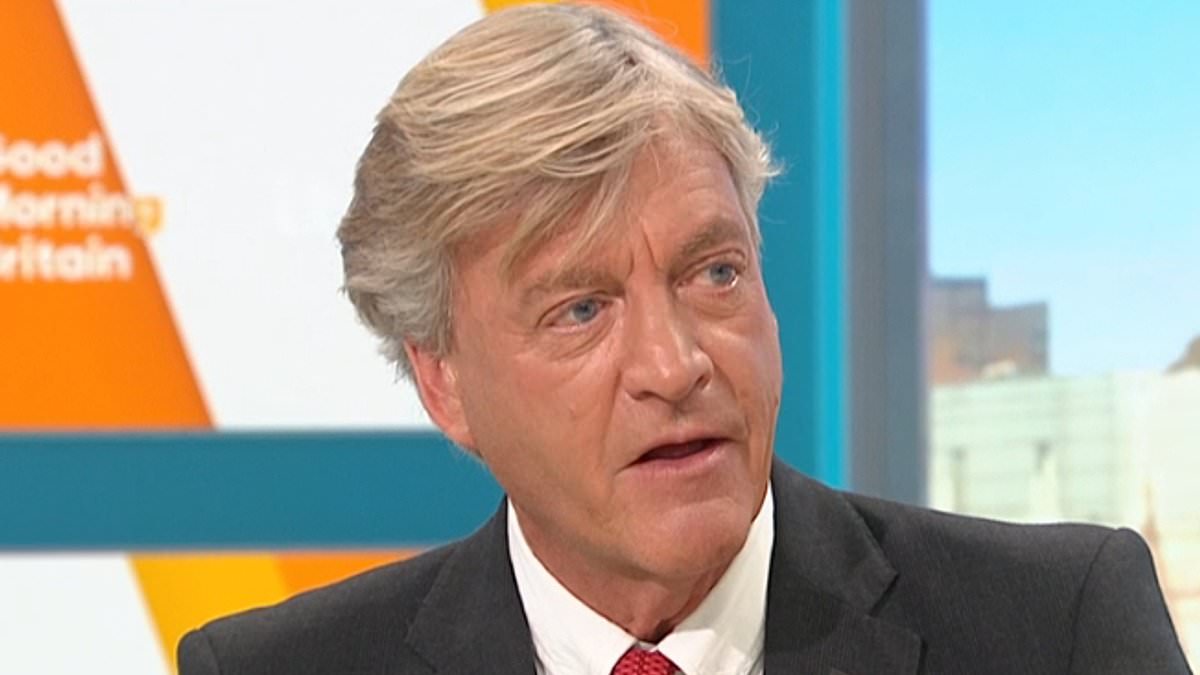


Richard Madeley claimed the prisoners he met in El Salvador’s mega jail while filming a documentary are ‘completely beyond redemption’.
The presenter, 70, spoke on Thursday’s Good Morning Britain about his experiences fronting Inside The World’s Mega Prison on Channel 5.
The documentary aired on Wednesday and saw Richard visit El Salvador’s Terrorism Confinement Center, known as Cecot, widely renowned as the toughest prison in the world.
Richard’s show, which briefly saw him kicked out of the prison after he challenged guards over the brutal conditions, earned a mixed reaction online, with some comparing him to a ‘real-life Alan Partridge.’
Opening up about entering the prison for the first time, Richard told Charlotte Hawkins and Richard Arnold: ‘It is a harrowing moment. Even a big screen TV can’t really convey the impact.
‘Seeing what basically looked like human battery chickens and knowing this isn’t just their reality for the next four or five hours.
Richard Madeley claimed the prisoners he met in El Salvador’s mega jail while filming a documentary are ‘completely beyond redemption’
The programme sees Richard, 70, visit El Salvador’s Terrorism Confinement Center, known as Cecot, widely renowned as the toughest prison in the world
‘This is how they spend 23-and-a-half hours of every single day – they have half an hour to do a little bit of exercise under armed guard in the atrium.
‘And then it’s back in behind the bars.’
This prompted Charlotte to ask: ‘There’s no sense of rehabilitation in this prison? That’s it, you’re locked up for life?’
Richard responded: ‘They are seen as being completely beyond redemption.
‘And, I think to some extent, many of them are. I mean, these are all serial killers.
‘In order to be a member of the gangs that used to terrorise El Salvador, that’s why these guys have been locked up, you had to kill 10 people.
‘That was the entry bar for getting into the gang.’
He went on: ‘They are pretty, pretty beyond redemption I have to say.’
Elsewhere in the conversation, Charlotte and Richard Arnold queried how the star divided his time while in El Salvador.
He explained: ‘I spent two days in the prison and the rest of the week – about eight days – in El Salvador, talking to regular, ordinary people.
‘I couldn’t find a single person at any level of society who wasn’t on their knees with gratitude for Cecot.
‘It’s delivered them from a living hell. Including a township that used to be run by the gangs, there are executions there every day.
‘There was a murder there every hour, at some point.
‘And all that’s gone – it’s now El Salvador has gone from being one of the most dangerous countries in the world and certainly one of the most dangerous in central South America, is one of the safest.’
He also joined prisoners eating rice, beans and tortillas for dinner at El Salvador’s mega jail – before pointing out the lack of cutlery and green vegetables.
The broadcaster watched inmates hurriedly take boxes of food through the bars of their concrete cells where they spend 23 and a half hours a day with nothing to do.
He asked prison director Belarmino: ‘So they never eat outside the cell, they only ever have their meals in the cell. What’s the food, what’s dinner tonight?’
Garcia said it is ‘beans and rice’, and a chef is seen wheeling in a trolley packed with boxes containing the meals. Madeley added: ‘That’s the same every night?’
Describing some of the heinous crimes, Richard said: ‘In order to be a member of the gangs that used terrorise El Salvador, that’s why these guys have been locked up, you had to kill 10 people’
Richard described entering the prison for the first time as ‘harrowing’ as he outlined the facility’s conditions
The director told him: ‘That’s dinner and breakfast, it’s always repeated. Different at lunch which is rice and pasta.’ Madeley then says the meal is not a ‘balanced diet’.
The boxes were placed outside each cell before a command was given and the prisoners then hurriedly took them through the bars and handed them out to fellow inmates.
Mr Garcia then opened the box for Madeley and told him: ‘This is the food that is being served to them.’ The presenter replied: ‘But they have to eat with their fingers?’
He is told: ‘With your hands. Cutlery doesn’t exist here.’ Madeley then started eating the beans with his hands – before the governor said: ‘No, con la tortilla.’
The presenter replied: ‘Oh you dip it in with the tortilla. I’m not gonna lie, the beans are quite tasty, but this isn’t what you’d call a nutritious meal, is it? I mean, there’s no green vegetables.’ He is told: ‘You have the protein and you have the rice, but yes.’
Some viewers praised Madeley’s journalism but some said his attempt to be the ‘new Louis Theroux’ came across more as a ‘real life Alan Partridge’.
Viewers wrote on X: ‘Richard Madeley looks to be the new Louis Theroux, he should’ve brought Judy along for good measure’;
‘Only Richard Madeley could be booted out of a mega jail after 15 minutes’
‘Only took the Governor of El Salvadors toughest prison to be in Richard Madeley company for 5 minutes before kicking him out’;
‘Watching Inside The Mega Prison on Channel 5 with Richard Madeley but wishing it was Louis Theroux;
‘We’ve gone from Ross Kemp on gangs to Richard Madeley doing World’s Most Dangerous Prisons’;
‘Poor bleeders. Imagine doing a life sentence in one of the most dangerous prisons in the world and having Richard Madeley in the same enclosed space’;
‘He’s the real life Alan Partridge. I can’t watch/ listen to him. He makes me cringe.’
Prisoners – mostly gangsters – are stacked in four-storey bunk beds that they share with several other cellmates, sleeping in permanently illuminated cells inside giant hangars. Almost all are never expected to be released.
Good Morning Britain host Richard has said the harsh regime inside the £85million facility in Tecoluca could help authorities in Britain fix what he described as the ‘broken’ prison system.
He said: ‘I think Cecot is probably a unique, brutally bespoke solution to the horrors that plagued ordinary El Salvadorians for so long. But I do believe there are lessons we can learn and apply to repair our own broken prison system.
‘Namely, that once you’ve agreed on the level of security and punishment and deterrence you want from it, you can achieve consistent results. You just need the application and determination to do it.’
Among the chilling encounters the presenter had was a face to face conversation with one of El Salvador’s killer gangsters – a serial murderer known as ‘Psycho’ who spoke to him from behind the bars of a secure holding cell.
The criminal grinned as he admitted to ’30 homicides’ and being a gang leader, after becoming embroiled in violence as a youth.
‘You killed 30 people?’ Madeley asks, as Psycho replies cooly: ‘Yeah, si.’
Asked how it felt to be locked up in one of the most secure jails in the world the killer said: ‘This is the end of everything.’
He added: ‘We’re not getting out because of the crimes we committed. So that’s it. You don’t think much in that life – you have to do what you have to do. You have to kill and you have to do everything to control.
‘I’ve always had this concept that once I go into that life I’m going to die in that life. From the moment I watched my rivals shoot my mum and kill my friends, I was going to get revenge.’
Since 2022, tens of thousands of people accused of having gang links have been arrested and held in pre-trial detention at prisons such as Cecot – where after mass ‘trials’ they are typically found guilty and told they will never be released.
The initiative has, according to the Salvadoran government, slashed homicide rates by more than 50 per cent.
The documentary saw Madeley experience the prison’s tough restrictions for himself – after being told he could not speak to Psycho in English despite the gangster’s grasp of the language.
‘I’m told he speaks good English,’ Madeley said to those watching on – as prison staff said: ‘No, not in English,’ and ‘It can’t be in English’, so they could understand every word.
Despite being locked up for life, Psycho said he and his cellmates would only ever talk about ‘the old days’ to pass the time. Inmates spend 23 and a half hours a day in their cells, with no recreational facilities.
And he admitted that he would return to his old life were he ever to be released.
‘Maybe we cry at night because we regret our decisions but in truth there is no change in us. All of us know that one day even if this did stop we will return to do the same things outside,’ he said.
And in a message to young people watching, he said they should ‘take advantage of what they have right now’.
‘How much I miss riding in cars, seeing my family, seeing my children, I’d like to see them one day, but sadly I’m in the game and a day like this isn’t possible. I will always be inside.’
It is unlikely that Psycho will ever be released, or see his family again. The El Salvador government has been explicit in its intention to hold suspected gangsters for life, and Cecot bans family visits.
Madeley looked solemn in the moments after the interview as he reflected on Psycho’s situation. ‘There’s that old cliche, isn’t there, [of a] dead man walking? That’s how he came across to me – dead man walking.’
The start of the documentary saw Madeley searched as he entered the prison, where he asked if any mobile phones or drugs had ever been smuggled inside.
‘No, no-one,’ says prison director Belarmino Garcia, who breaks into a wide smile as Madeley asks of him: ‘Can he come to England, please?’
But his time in the prison was almost cut short after Garcia ejected Madeley and his crew, evidently unimpressed by his questions about living conditions.
The documentary nearly came to an abrupt end when an official stepped in to stop filming within minutes after Madeley asked whether the regime was too cruel.
At the prison, prisoners wear only boxer shorts with their heads shaved, lights are never switched off and there are no family visits, recreational spaces or rehabilitation programmes.
The presenter asked the prison director whether it was ‘remotely cruel’ that the men have ‘absolutely nothing whatsoever to do’ while sat in their cells, given they are not allowed books, magazines, newspapers or screens.
But Richard soon found himself being taken into a side room where he was told to stop. He said: ‘The pace suddenly quickens so perhaps asking about conditions here is pushing too far. I think I may have overstepped the mark.’
The guard shrugged and added: ‘It’s necessary to be in control. But I imagine the culture where you come from is different’, before Richard and the crew were swiftly asked to stop filming and ushered out of the compound.
They were able to return early the next morning – under much tighter security.
The jail has become the cornerstone of Salvadoran president Nayib Bukele’s war on drug cartels and key to deportations from the US under President Donald Trump.
There are no workshops, libraries, opportunities to learn kitchen skills and no visitors.
He added: ‘All meals must be taken in their cells, inside which they spend 23 and a half hours every day, with just 30 minutes outside for brief, heavily-guarded exercise.
‘They just sit on their bunks, day in, day out, and the prison lights stay on 24/7, never dimmed. All will die in this prison. It’s a living death.’
The 57-acre facility was built to hold up to 40,000 prisoners – equivalent to almost half the UK’s prison population – and currently houses an estimated 15,000 inmates.
Many are suspected members of rival gangs that terrorised the country for decades, alongside convicted murderers and rapists.
Cecot was built three years ago amid a huge crackdown on the gangs destroying the fabric of Salvadoran society.
For 23-and-a-half hours of the day, the men are obliged to squat on mattress-less metal bunks, stacked four-storeys high, like shelves in a B&Q store.
They are permitted to speak only in whispers and may only scuttle out of their cages, shackled hand and foot with heads bowed low, for a small number of reasons.
They are evacuated when the guards charge into the module brandishing machine guns to stage a ‘forced intervention’ and search their bunks.
While this clean sweep takes place they must crouch on the floor in perfect rows, with their legs wrapped tightly around the man in front of them and their head pressed against his bare back, forming a human jigsaw puzzle.
Anyone who spoils the pattern by fidgeting receives a sharp baton jab to the ribs.
They also sit cross-legged on the spotless module floor for a daily 30-minute Bible reading and calisthenics session.
And when their turn comes, they are removed to one of the small rooms used as courts, for remotely conducted ‘trials’ which, in almost every case, end with a guilty verdict.
Madeley said: ‘Nothing, absolutely nothing, can prepare you for the sight of 3,000 shaven-headed men crammed behind floor-to-ceiling bars. No doors. No screening.
‘They sit there in permanently open view through the bars, on tiers of metal bunks four-high – no mattresses, just thin cotton sheets – staring out. It’s one hell of a sight’
Mr Bukele ordered the mega-prison to be built in March 2022 as part of his campaign against El Salvador´s gangs, and it opened a year later.
There are no programmes preparing prisoners to return to society after their sentences and no workshops or educational programs – as it unlikely they will ever leave. They are never allowed outside.
The exceptions are occasional motivational talks from prisoners who have gained a level of trust from prison officials.
Prisoners sit in rows in the corridor outside their cells for the talks or are led through exercise regimens under the supervision of guards. The prison’s dining halls, break rooms, gym and board games are for guards.
Until recently, El Salvador had the highest murder rate in the world, with 106 homicides per 100,000 people.
The country was plagued by brutal gang violence which regularly featured extortion, kidnapping, murder, human trafficking and drug smuggling.
The government of El Salvador – where two per cent of the population is now in prison – says gang violence has been responsible for 200,000 deaths over the past three decades.
But following Bukele’s election in 2019, a major security crackdown saw tens of thousands of suspected gang members detained – and a claimed huge reduction in the murder rate.
This has attracted praise from Trump – whose government struck a deal with Mr Bukele to accept what they described as transfer and imprisonment of foreign criminals to El Salvador.
Last week, official figures revealed the number of people deported to El Salvador from the US nearly doubled in the first months of 2026.
The US deported 5,033 Salvadorans back to their country in the first three months of 2026 compared with 2,547 deportees in the same period in 2025.
Cecot’s apparent success has inspired other Central American countries such as Ecuador, Guatemala and Honduras to build similar prisons in order to combat their own issues with gang violence.
But human rights groups have accused the El Salvador government of deliberately putting the prisoners in cramped conditions and subjecting them to psychological torture – claims the prison’s governors have denied.
Read the full article here