



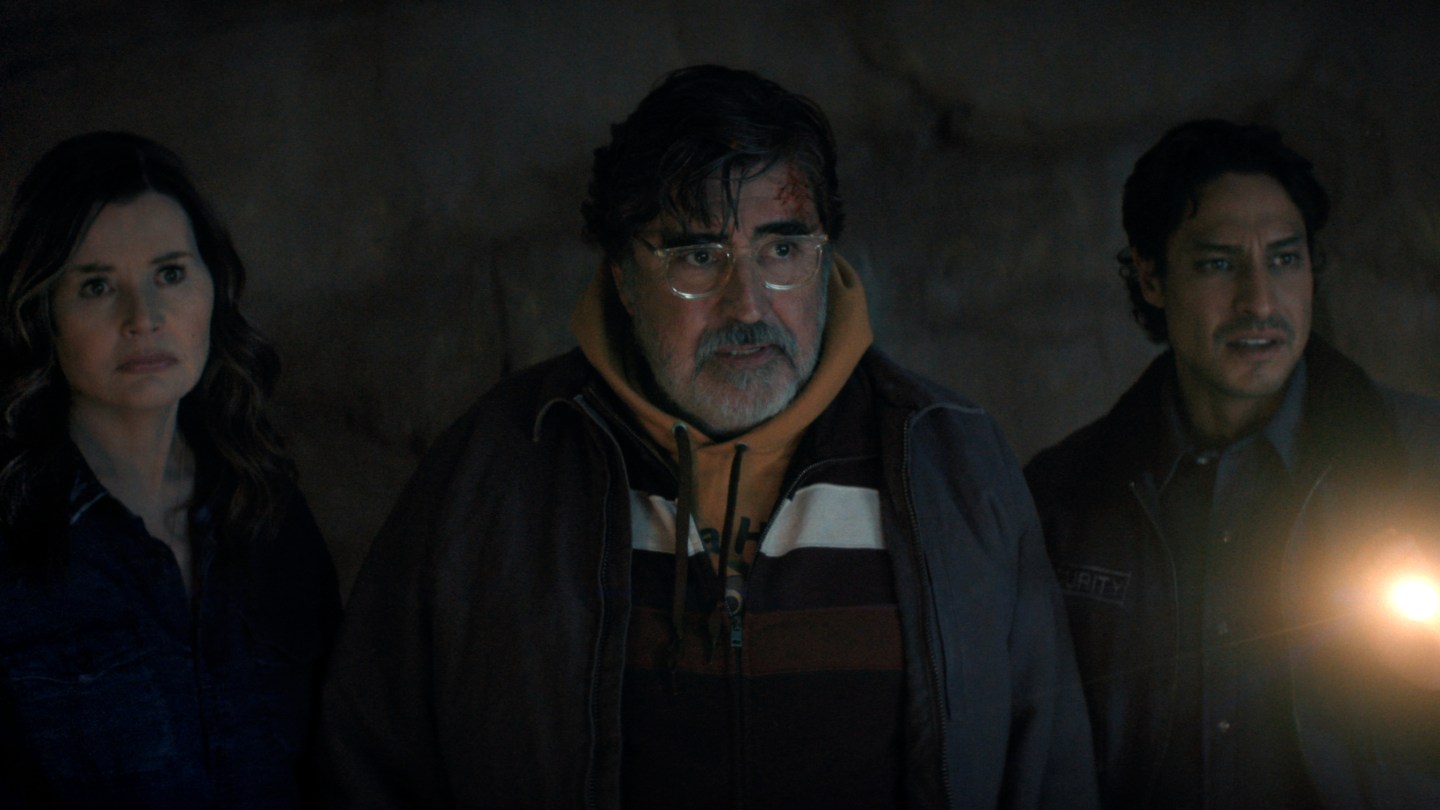


When Jeffrey Addiss and Will Matthews sent Geena Davis the script for the first episode of what would become their Netflix sci-fi drama The Buroughs, the actress was all in on the show and her character, Renee, especially, a vibrant, confident former music manager who resides in the titular retirement village.
“I was like, ‘This is crazy how perfect this is for me,’ Davis tells The Hollywood Reporter. “And then when I met with them, and I said that, they said, ‘Well, we wrote it with you in mind, hoping you would say yes.’”
That she did, along with co-stars Alfred Molina, Alfre Woodard, Bill Pullman, Denis O’Hare and Clarke Peters, the retirees at the center of the series who go against the owners of their community when they find out they’re using it as a front to drain residents of their brain fluid and feed it to a creature that allows them to stay young.
In the final episode, “Triple Audible,” the gang succeeds in their quest to take down the youth-obsessed CEO and his wife. And it’s a good thing they did, as Netflix just announced the Matt and Ross Duffer-produced series won’t be renewed for a second season.
Davis says the cast wasn’t given an explanation for the cancellation. “Fortunately, the creators, who became our dear, dear friends, were able to tell us before the news came out, and we’re all terribly disappointed. Honestly, I don’t know what happened. I think it’s probably rare for a show to not get picked up and to have it announced that it’s not being picked up while it’s still in the top 10.
“We didn’t expect that,” she continues. “But the creators told us from the beginning that the series was not going to have a cliffhanger ending to the first season, that someone had advised them, ‘Make it its own thing. And if you come back to do another year, make that its own thing.’ And we really did. There’s a tiny hint at the end that maybe everything isn’t fixed, but it is a complete story. And if we had made it as a limited series, then it would’ve been a big hit and everybody would be happy.”
Cancellation aside, the show, which premiered on May 21, is still available for streaming — and still in contention for this season’s Emmy race in the drama series categories. Below, Davis talks about her character’s steamy love scenes with co-star Carlos Miranda and why she’s, unfortunately, under no illusion that the series will spark an offshoot of stories centered around older characters.
How would you describe Renee, and why did you say she was the perfect role for you?
Well, I would describe her as a badass, which implies that I think I’m all that and I think I’m a badass, but I aspire to be. I’ve been really lucky in my career that I had the opportunity to play characters that were much further along in their badassery and their development and becoming their authentic selves than I am. It’s uncanny the level of people that I get to play — the president of the United States [in Commander in Chief]. I’m like, “People believe me? I’m the president. All right, then I do too,” Thelma & Louise, so many incredible roles. I happened to have written a memoir a couple of years ago called Dying of Politeness, which I had spent my life doing, and talk about how it’s kind of the story of my life in a way that I have gotten to play characters who are much bolder than I was at that time, and it rubs off on you. There’s fake it till you make it, and then there’s act it till you become it. So playing characters who were so ferocious and bold and confident and determined and all that helped me profoundly in my personal life.
And now you’re actually in your badass stage.
Right.
Renee’s relationship with Paz (Miranda) is such a big part of the conversation around her. You said these were the steamiest scenes you’ve ever done …
No, I misspoke because whoever was interviewing me said, “Wait a minute, what about Thema & Louise?” I’m like, “Oh my God. Wait, wait. OK. It doesn’t get steamier than that scene.” So this was also a nice steamy scene; definitely a really cool scene. As an actor, I’ve gotten to have some pretty remarkable romances onscreen. Very happy about that.
When you got to the part about their sexual relationship in the script, did you have any hesitations? Were you excited?
I was really excited. It didn’t spell out exactly what happened, but the meeting and the flirting and everything was so delightful. And Carlos Miranda is the sweetest, best guy in the world. We had so much fun together. And we got to have some really great scenes together that were romance and adventure and action. I say to [Paz] at one point, “No, come on, I want to stack bodies.” And he’s like, “Stack bodies? Who are you?” But he’s there to help me stack bodies. He is.
Obviously, the age dynamic is part of what makes Renee and Paz’s relationship so interesting. Did you worry at all about how audiences might receive it or if it would open a can of worms about, say, what if this were an older man with a much younger woman?
No, I didn’t worry about it one iota, and nobody else did when it came out. I’ve seen comments like, “Hey, awesome.” Nobody has said, “Well, wait a minute.” There really isn’t anything inappropriate about our relationship. It was a delight to work with Carlos. He’s a dream.
I was reading another interview where you said, “I don’t have faith in things onscreen starting a trend,” which was in response to the May-December romance piece, but I’m curious if you feel the same way about the prospect of seeing more stories about older characters in general as a result of the show.
Well, we always do here and there, and then momentum doesn’t happen. I came up with my theory about how difficult it is to [continue] momentum after Thema & Louise, because it had a huge — it was 35 years ago — reaction, both in people recognizing Susan [Sarandon] and me on the street, and also in the press. We were on the cover of Time magazine, and I think a week later, it had two editorials in there because two people felt strongly enough about what a horrible, horrible thing it was. And there was a lot of reaction like that. “Now the world is ruined.” “Women have guns.” “This is a horrible message to be sending,” but they also all said across the board, “This will change everything. Now we are going to see so many movies with female leads, female stars, female action movies, female buddy pictures.” And so we’re like, “Hot dog. We’re going to usher in a whole new era.” And I’m [still] waiting for that to happen.
My very next movie, a year later, was A League of Their Own, which miraculously and wonderfully became a giant hit. And all the press said, “This will change everything. Now we’re going to see so many female sports movies, and it’s going to change everything. It’s going to just open the floodgates.” Let’s name all the female sports movies that have come out in 34 years. And when First Wives Club came out, they were all, I think, in their early 50s, the press was like, “Oh my God, this will change everything because of these women, it’s a giant hit.” And not only did it not change everything, it didn’t change everything for the actual women in the movie. I have no faith in the momentum thing. I think it’s going to take creators deciding. My institute [the Geena Davis Institute on Gender in Media] is all about show it and it will happen. If they can see it, they can be it, is our motto.
That brings me to the news of The Boroughs cancellation. How did you find out? Were you given an explanation?
No, not necessarily. Fortunately, the creators, who became our dear, dear friends, were able to tell us before the news came out, and we’re all terribly disappointed. Honestly, I don’t know what happened. I think it’s probably rare for a show to not get picked up and to have it announced that it’s not being picked up while it’s still in the top 10. We didn’t expect that. But the creators told us from the beginning that the series was not going to have a cliffhanger ending to the first season, that someone had advised them, “Make it its own thing. And if you come back to do another year, make that its own thing.” And we really did. There’s a tiny hint at the end that maybe everything isn’t fixed, but it is a complete story. And if we had made it as a limited series, then it would’ve been a big hit, and everybody would be happy. We so fell in love with each other that we just wanted to keep working together. I suggested that the creators write another series, a completely different story with the exact same actors and writers and crew, and we just do it again like an anthology series, right?
Have you heard of any possibility that Paramount could pick it up with The Duffer Brothers move to the network?
No. I haven’t heard anything about that.
But you’d be open to returning if somehow the series is revived?
Oh, hell yeah. Or spinoffs, for Renee and Carlos.
You’ve said that The Buroughs redefines retirement. Is retirement in your vocabulary at all?
So not. You think, “When I get to that age, I’ll be so different.” I remember when I was a kid, I endlessly fantasized about New Year’s 1999, and that’s going to be such a big deal. I think I would be 44 or something. And I pictured every detail, the dress I would have on at this chic party with a martini and my hair in a French twist. And then New Year’s Eve came, and I’m like, “Oh, I’m still me.” It was the same with high school when I was a freshman. I was like, “Those seniors, oh my God, at some point I’ll be a senior and the freshmen will look at me like, ‘Wow.’” Nothing happened. So on the topic of retirement, I don’t feel any different. There’s nothing different about me. My age makes me laugh because I thought it would be so different to be my age. It’s totally not.
Before The Boroughs, we hadn’t seen you on a TV show since Glow. Was that because you were more focused on film at the time, or had nothing interesting come to you in that period?
Yeah, nothing interesting enough had come along. I just go by what’s good. I read it and I go, “Yes, I want to do this.” Even if they don’t necessarily want me, I say, “I want to do this.” I had to talk Ridley Scott into hiring me for Thelma & Louise.
How’d you convince him?
Originally, he was the producer. He was not the director, and he had a director, and that director picked Thelma and Louise, and then that fell apart, and now there was a new director, and he already picked his Thelma and Louise. It happened three times. After that, Ridley decided he was going to direct it himself. So during this year, my agent at the time called Ridley’s office once a week to say, “If anything happens, Geena is still really interested.” So when he became the director, he said, “Yes, yes, I will meet her with her. Yes.” And I just pitched the shit out of it and got cast.
How do you feel about the roles that are offered to you now?
I’m still getting cool stuff. I’m in Budapest now, shooting a movie with Arnold Schwarzenegger.
The Kellys?
Yeah. And again, I get to be a little bit of a badass. I’ve got lots of irons in the fire. I feel good.
Earlier this week, you were serving as chair of the Bentonville Film Festival, which is centered around inclusion and is very much an extension of your founding of the Geena Davis Institute more than 20 years ago, with a focus on gender equality. How do you feel about the fact that we’re still having these conversations?
We started out as an institute on gender and media, and soon expanded to race and ethnicity, disabilities, age, body size, LGBTQ, all different things. We have made a lot of progress, particularly in children’s entertainment. Children’s movies and TV are now at gender parity, which is profoundly different from how it was when we started out. So we’re thrilled about that. And the whole reason I started the Institute was because I realized we were teaching kids from minute one to have unconscious gender bias because the shows that we’re watching were wildly imbalanced. So it’s a huge, fulfilling goal to me to really help improve kids’ TV.
Read the full article here