




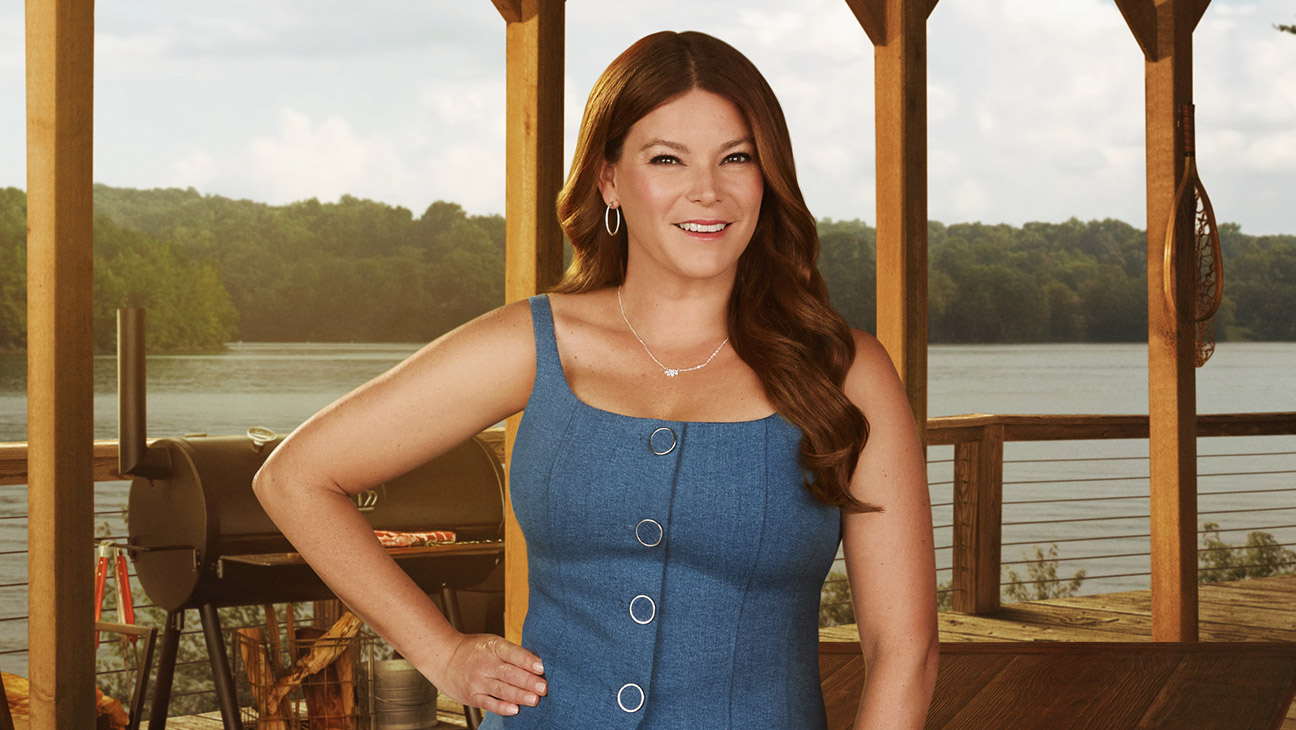


As longtime viewers of Top Chef can corroborate, Gail Simmons is unflappable — unless, as seen during a recent episode of the Bravo competition, a live snake finds its way under the Judges’ Table.
Simmons’ mettle, as well as that of fellow judges Tom Colicchio and Kirsten Kish, was tested again that episode after the reptile in question was removed and the eliminated chef (slightly stale spoiler here), Sieger, took issue with his eviction over a texturally unpleasant mousse. He later asked that producers show him the Top Chef rulebook for judging, a rare moment of personality-driven drama for a franchise that has intentionally avoided the reality tropes typically platformed on other competitions. “We don’t do things for reaction’s sake,” says Simmons. “That has been a constant for many, many years.”
Top Chef judge since day one and an executive producer for many years, Simmons’ day job is at the Emmy-winning series. But the former Food & Wine executive and longtime writer always has other things on her plate. Come November, she releases her third book: Guesting: How to Show Up, Win Over Your Host and Make the Most of Any Occasion. During a recent episode of The Hollywood Reporter podcast I’m Having an Episode (Spotify, Amazon Music, Apple), Simmons pondered the timeline for another All-Stars season of Top Chef, talked through some of the lessons her book can teach — what should you do when seated next to an asshole at a dinner party? — and, naturally, shared her thoughts on being challenged at the Judges’ Table.
First, can I get a copy of the rules right now?
Yes. We will provide the rules, as you’ve seen, to anyone who requires the rules. It’s complicated. Top Chef this season has been amazing. I think our chefs have cooked beautifully; they’re so interesting and we’re getting down to the wire. As that happens, tensions run high. Sometimes it’s hard to make sure that everyone is clear on the reasons that we make decisions. Our Asheville hurricane relief episode was great for a lot of reasons, but it also was a check for us as judges and producers on how we communicate clearly to our chefs and to our audience.
I’m sure he had his reasons, but it did remind me of the first two seasons when the show was much more about the personality and hotheadness of reality. Was it odd for you to experience after operating with such a different tone for so long?
It is always a bit of a check when a contestant fights back on a decision we make, but I appreciate it. I was gonna say I like it, but that’s not the right word. It’s not that I like it. I don’t thrill in their frustration or in getting into conflicts with them. That’s not my role — certainly not anymore, nor was it ever — but as a show, to your point, have come so far in the judging process. Our criticism is meant to be critical, constructive, helpful and, also, it has to support the decision that we’re making. Sometimes that can be unclear, and I appreciate when our contestants question us if they aren’t clear.
Fair.
You don’t want them to just blindly accept all our decisions, because sometimes, we’re not right. It’s possible that we aren’t seeing things clearly or that we don’t understand an intention or that we are misinterpreting information. So we always want to make sure we have that conversation and think, “Wait a second, are we playing by the rules here?” But in this case with Sieger, I think he didn’t understand how the game is played.
It did appear as if he got it after the producers handed him the rules and he read them aloud. But who can tell?
They’re the rules. The proof is in the pudding, so to speak. He was frustrated. I’ve seen this a lot with chefs because I understand that they don’t know what else we’re tasting, right? They don’t know what they are up against.
We’re also ignoring the fact that you were essentially attacked by a snake during this episode.
We were also attacked by a snake. Side note: The morning that the chefs all moved from Greenville to Asheville to do their little day trip, Kristen [Kish] and I went for a bike ride on Swamp Rabbit Trail. About halfway through, we had to stop very abruptly because there was a giant black snake in the trail. I don’t see many snakes. I’m from Canada and I live in New York City. It’s very rare that I have seen snakes in my lifetime. Then, 24 hours later, we’re at this judge’s table in the middle of the forest. And Tom [Colicchio] casually mentions that there’s a giant black snake that’s about to wrap itself around our contestants and then slither right under the judges’ table towards us.
You have been working in various parts of the food world for your entire career. How has your definition of good food changed?
Enormously. Think back to the beginning of just the show — it has been two decades, right? — my personal definition of great food and really fine dining has changed so much. As a population, we’ve become so much more educated. Our vocabularies are stronger about what we value and don’t value about food. I also think we have all learned so much about perspective on great foods of the world. Even 20 years ago, certainly 30 years ago, the idea of sort of fine dining and fancy food was all very Western. Now I think we realize just how many cuisines of the world not only shaped the way we eat here in America, but need to be valued at the same level.
What is an immediate turnoff for you at a new restaurant?
Servers reading the table is important. That and assuming that diners know more than they do. I want servers to assume we know more than we do. Yes, it’s a new restaurant, I’ve never eaten here before and I’m excited for you to tell me what the best thing is. I’m excited to experience it. But assume and know that I’ve eaten at restaurants before. I don’t necessarily need every single thing explained to me.
I’m glad you bring up hospitality because you have a new book about being a good guest coming out in November.
It’s called Guesting and it is a lot about hospitality, but taking a look at it flipped upside down. Very little has ever written about what it’s like to be a guest and how we can do it better too — how being a guest is a reciprocal relationship. I think that being a guest is something that has fallen to the wayside. We don’t think about it that much. And I think that’s why there’s a lot of loneliness in our world right now. And it’s very easy to kind of say “no” and doom scroll on your couch and your sweatpants. But if we all got up and cared for our communities a little better, I think it would just benefit all of us. It’s just about the reciprocal relationship of a guest and a host.
To your point, I don’t feel vulnerable when I’m hosting a dinner party. I feel vulnerable when I’m in someone else’s space and want to be helpful but not annoying.
There’s a lot of social anxiety around it! What do I bring? What do I wear? What if I don’t know anybody? What if they seat me beside an asshole? What if I have an allergy? What if I am running late? All these things that are rightfully anxiety-provoking and awkward. Let’s talk about them and give a bit of a roadmap so that everybody can do it better.
Is there a passage about what to do if you’re seated next to an asshole?
Yes! We’ve all been seated next to an asshole. It’s more about the fact that it’s finite. You can do it, because you’re an adult. It’s just a meal, even if it’s feeling like forever. My advice in those scenarios is to change the subject or turn to the other person on your other side, make some small talk, and then make an excuse to get up and check on your host or say hi to a friend across the room. Maybe you load the dishwasher — after you’ve asked first, because people are very specific about their dishwashers. Never load anyone’s dishwasher without asking.
Never load my dishwasher. Period.
Right? If they say no, maybe you can just clear the glasses if you really need to get away from the asshole. There’s always things you can do.
Back to Top Chef, so much has been written about how GLP-1 usage is impacting the restaurant industry and food in America. I went into this season of the show half-expecting a GLP-1 challenge.
We are not there yet. I mean, everybody’s got a price. (Laughs.) So if someone wants to make us an offer, I’m sure we can accommodate one. But, as of yet, it’s really not our MO. It is a conversation that restaurants are absolutely having. People are eating less. Portions are going down, which, in some ways, is a good thing. Portions in this country have usually been huge. It’s a conversation because it also does affect [the] bottom line. If they’re smaller, you can’t charge the same amount for them and the cost of food is so, so high right now. Restaurants are struggling with the margins because there are none. Lowering prices is not gonna get the rent paid. It’s not gonna get the staff paid. It’s a complicated conversation, and I think we’re still in the early phases of seeing how it really affects the world and the economy of restaurants. It scares me a little bit. Well, it scares me for a lot of reasons. But on Top Chef, we’re still just thinking about the quality of the food, not the quantity. Thank goodness.
Do you watch any other food television?
A little, not a ton. I don’t watch a lot of other competition shows. There’s like a couple travel shows I’ve been really interested in seeing lately. I’m interested in the ones that explore and feel like they’re a new take on something that we really haven’t done before. It’s getting harder and harder to do that.
How often do you think the show can do an All-Stars season?
I have asked that question. I think, at this stage, more often than not. I could be wrong on the exact number, but more than 300 [have been on Top Chef] at this stage. So many of them are household names, who are beloved, who’ve gone on to extraordinary things. Look at the Food Network. They do lots of shows over and over again with the same talent. I think we can do it a lot. As long as we change our all-star seasons to be fueled by different formulas and the structure remains the same on our show always. I feel like we could probably do one again pretty soon.
I’m glad you brought up the Food Network. I’ve been saying this for years, but I firmly believe that the channel has become the Top Chef Senior Tour.
It is. We’re a casting agency, very proudly. We all acknowledge it. We all laugh. I follow a lot of them on Instagram, of course. And when they announce the cast of a new cooking competition show — like eight out of 10 chefs are our former Top Chef contestants, winners, fan favorites. But for reason. Bravo doesn’t necessarily have a path for them afterwards. We give them tons of opportunity, we give them this platform and then we send them off into the wild. Unless we are gonna offer an entire network of shows for them to work on afterwards, good for them. The best ones are finding their way to really great opportunities. I love that they’re all cooking. They’re cooking so hard.
Read the full article here