


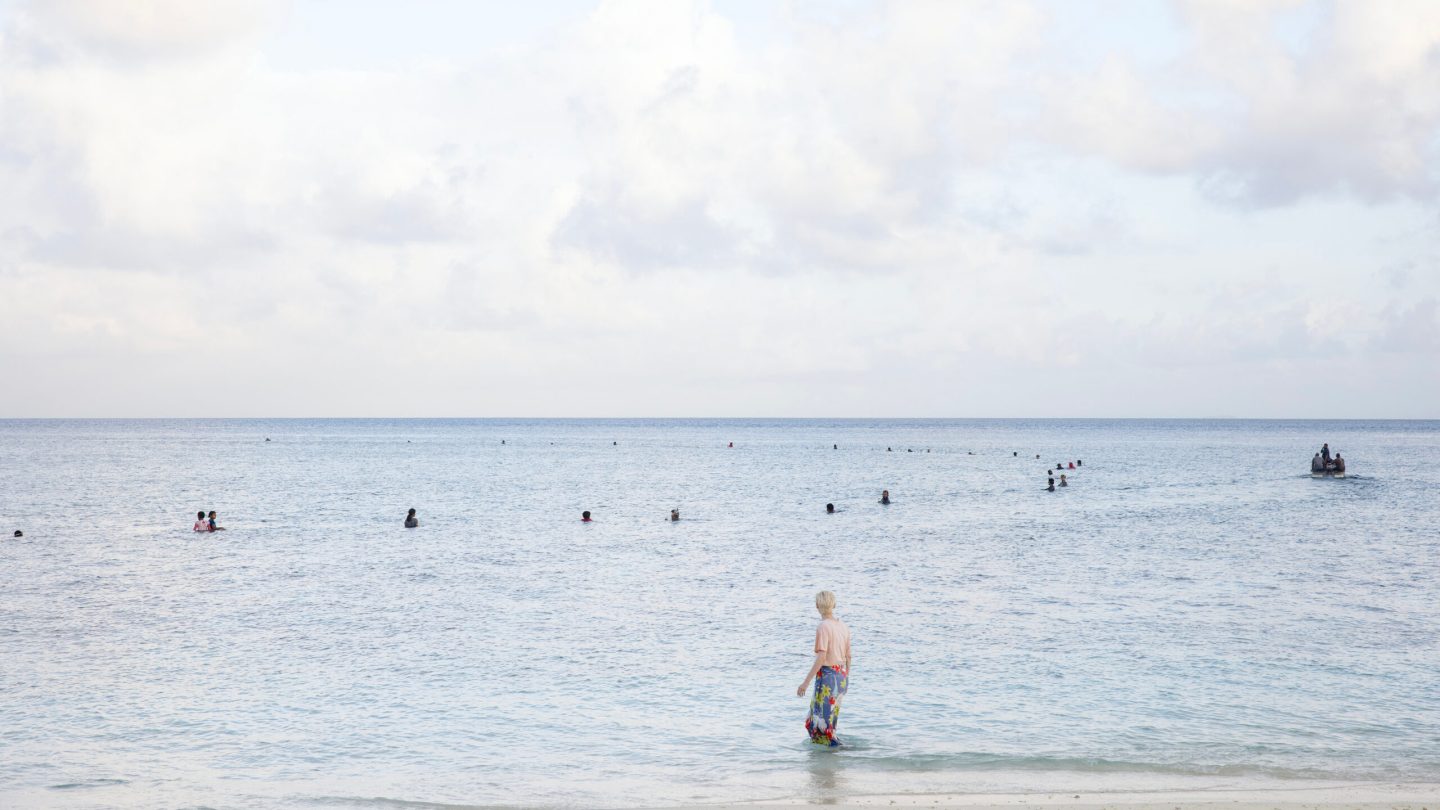

Fiji, its people, its heart and spirit, and Tilda Swinton star in Heart of Light – eleven songs for Fiji, the new film from Cynthia Beatt, which world premiered this weekend in the Harbour program of the 55th edition of the International Film Festival Rotterdam (IFFR). The film and its creation reflect the auteur’s personal story of being raised partly in Fiji.
“After decades abroad, Iona (Swinton) returns to her childhood home on Fiji, sensing that there she might find the answers to many questions she has about civilisation and its discontent,” explains a note about the film on the IFFR website, which describes it as “a speculative autobiography realized as an enchanting hybrid of ethnographic study and essayistic fiction” and “a monumental work of pure cinema!” It may also inspire remedies for the world’s trials, tribulations, and ills.
Written and directed by Beatt, who produced the film with Philippe Avril and edited it with Till Beckmann, features cinematography by Jenny Lou Ziegel, sound design by Marlon Beatt, and music by Talei Draunibaka, Nemia Vanua, Simione Sevudredre, Simon Fisher Turner, Mia Kami, Dakui Gau, and Polotu Tokalau Village. Heartbeatt Pictures and La Cinéfiliale are handling sales.
In addition to Swinton, Talei Draunibaka, Sereima Divavani, Simon Fisher Turner, Peter Knaack, Lasarusa Moce, and Esekaia Tukai Sovea also feature in the film. But the island nation itself is the main star. The opening moments of the film, for example, show the text of a famous line from T.S. Eliot’s 1922 poem The Waste Land: “Looking into the heart of light, the silence.” Shortly thereafter, the screen tells us that we are watching a film by Beatt, followed by the words: “with Fiji” and then “and Tilda Swinton.”
You can check out a trailer, which will give you a first tiny glimpse of the natural beauty and the serenity that awaits you in Heart of Light – eleven songs for Fiji, here.
Born in Jamaica and raised partly in Fiji, yet over the past decades based in Berlin, Beatt headed back to the South Sea archipelago for the production of the film. The cinematic form of her latest feature reminds Rotterdam programmers of her first movie, Description of an Island (1979), co-directed by Rudolf Thome, which they describe this way: “as much an ethnographic study of a Vanuatuan island and its inhabitants as it is an essayistic fiction about documentary filmmaking, featuring Beatt in the main role.” Highlights the Rotterdam team: “This time, it’s Beatt’s by-now alter ego Tilda Swinton as Iona who keeps all the different strands and levels of the film’s story of homecoming, loss and life lessons together, often shot at places remembered and too often found changed from what they once were.”
Beatt, in a director’s statement, calls Heart of Light – eleven songs for Fiji “a cinematic essay in the sense that you follow an idea, accepting the detours and unforeseen events that shape the journey.” However, she highlights, “I’m not crazy about labels like ‘hybrid.’ For me, it’s a film that documents, but with setups and fictional elements. If anything, it is an essay film.”
And she writes: “Heart of Light – eleven songs for Fiji is a window onto moments of everyday life in Fiji that few people get to experience. It’s an homage, and the sum of a lifetime process of constant reevaluation or self-examination of what it means to grow up in a culture that is not that of one’s parents.”
The filmmaker calls Swinton “a soul mate, lauding “her quickness, sensitivity, discipline, and flexibility.” In Rotterdam, Swinton and Beatt talked to THR about Heart of Light – eleven songs for Fiji, their cinematic collaboration, and what the world could learn from Fiji.
The film, just like its creators, doesn’t need genre labels. Its poetic sensibility left several people who watched it at Rotterdam feeling deeply touched and affected. “Derek Jarman is so important for all of us,” Beatt tells THR. “I never actually worked on his films, but I knew him very early on. … It’s like an era of cinema, which is, for me, perfectly natural for us.”
And Swinton shares that “I have this very bemused reaction” when people ask her to categorize a film, especially a film like Heart of Light – eleven songs for Fiji. “Imagine making a film, and setting out from the outset, ‘we’re going to make a box, [it] is going to be this shape, the box is going to be this shape.’ That, to me, is harder to imagine. But the material and the whole experience that Cynthia was approaching needed to be formless for the length it was.”
The two creatives met at the Berlin Film Festival in 1986. “I went there with Derek Jarman with the first film that I made with him, [Caravaggio],” recalls Swinton. Beatt and German filmmaker Klaus Wyborny were preparing the film The Open Universe back then, in which Swinton featured. One part of the movie was set in Fiji.
“So we went to Fiji, and I remember very distinctly, by a pool, Cynthia telling me about this project that she already [had],” Swinton explains, turning to Beatt. “I mean, for years, probably you’d already had it growing in your mind.” Continues the star: “And then she spoke to me about it, and we said, let’s do it together.” That was back in 1986, “and I don’t feel remotely mystified by the fact that it took 40 years,” Swinton says. “I really don’t. I felt it was resonant enough, burning in you, sometimes hotter than at other times, and sometimes…”
“Sometimes I had to put it aside,” Beatt completes the thought. The two made three other films in the meantime, namely Cycling the Frame (1988), in which Swinton cycles along the Berlin Wall and explores the divided city, the short The Party: Nature Morte (1991), and The Invisible Frame (2009), in which Swinton retraces the same Berlin path and reflects on the fallen Berlin Wall.
But the idea for the Fiji film continued to pop up. “It was always there,” Swinton shares. “Whenever we had conversations, which was thousands of times, there was always a section of the conversation about Heart of Light.”
The journey of getting to make the film took another detour a few years ago. “I just got money, and then there were two years of COVID,” recalls Beatt.
The writer of these lines’ love of rugby leads us to talk about scenes of Fijians playing rugby in the film, and discuss their widely appreciated rugby skills, and Beatt shares something that provides further insight into the culture of Fiji. “When they play rugby, they never call out their names to one another. They don’t say, ‘Georg, give me the ball.’ It’s ‘cousin,’ ‘uncle,’ ‘brother.’ It’s kinship. That’s why
they play so well.”
With a sense of this kinship and connection to nature and each other seeping through throughout Heart of Light – eleven songs for Fiji, I wonder if the film can be a very timely reminder of what today’s conflict-ridden world may need more of. Swinton has something to share in this context. Being Scottish, the whole clan system of Fiji is “completely familiar” to her, she mentions. But it may be this deeper spirit of Fiji that explains “the fact that you witnessed somebody who was not brought up in Fiji … responding to Fiji in the way that I did,” she suggests.
“There’s this scene in the film when I’m talking to the elders, and I’m asking them all sorts of questions, and then I’m apologizing to them: ‘Am I being insensitive, or am I being too curious, am I too invasive?’ And they say this very interesting thing,” Swinton highlights. “They say: ‘We like your questions. They’re good questions, but also they’re very welcome because you made your sevusevu, you made your ritual presentation, and you are in. That means you are welcome.’ The patina of foreignness is dissolved. ‘You are part of us.’ And that’s truly what it’s like.”
And she adds: “It is extraordinary how you can go into a community like that for several weeks and be completely accepted – in the most generous way. In the most relaxed and trusting way and safe.”
Swinton then addresses me directly: “That’s what you’re talking about, this old feeling of safety that you had as a child.” And turning to Beatt, she shares: “You might have thought, going into the film, ‘oh, well, that’s to do with childhood.’ No, it’s not just to do with childhood. And maybe that’s something you discover during the course of the film, particularly through someone like me or Simon [Fisher Turner], who’d never been there before. … We’re adults, and we experience it as well. And I think that’s really special, really particular, and something that the West in particular can learn from.”
If one accepts that spirit as being a key element of Fijian culture, British colonization feels even more brutal. “The idea of colonialism coming into and coming onto that social structure is so painful because it’s such an abuse,” Swinton offers. “It’s not just a sort of material abuse, but it’s such societal abuse, such spiritual abuse, because the trust will have been … completely desecrated.”
And “the terrible thing is, when all these colonial governments leave, that structure remains, but it’s not the way of the people,” emphasizes Beatt. “People still try to … function within that foreign, strange structure.”
In this context, Heart of Light – eleven songs for Fiji can be understood as Beatt’s confronting ghosts of the past and her own history. “I was a colonial child, and how do I feel about that?” Swinton explains a question Beatt is confronting with the film. “And looking at what messages she got as a colonial child, or rather, the child of colonial parents. And yet, at the same time, [there is] sometimes the confusion of feeling as a Fijian with Fijian friends, living like Fijian children.”
Swinton lauds her friends for “just the way in which she’s been so scrupulous about examining, interrogating all of that over 40 years,” calling that “absolutely massive” and “not always comfortable.” And she tells her soul mate: “You were ready to go back with all that reflection, not looking away and taking responsibility, and also not taking responsibility. I think it’s very impressive.”
Beatt felt vulnerable at times. “There are times where I thought I’d made a mistake, where I actually cried for like an hour, but that was years and years and years ago,” she shares. “But that was part of the learning process.”
As Heart of Light – eleven songs for Fiji conveys, the spirit of a respectful and supportive community lives on in Fiji, which may inspire hope not only within Beatt and her co-creators but around the world. “It means that, not just for audiences who see the film, but … it is possible for us, in general, to aspire [to] and to actually, practically, make steps to change and inculcate this kind of living,” Swinton says. “It is possible. I’m endlessly hopeful.”
Read the full article here