



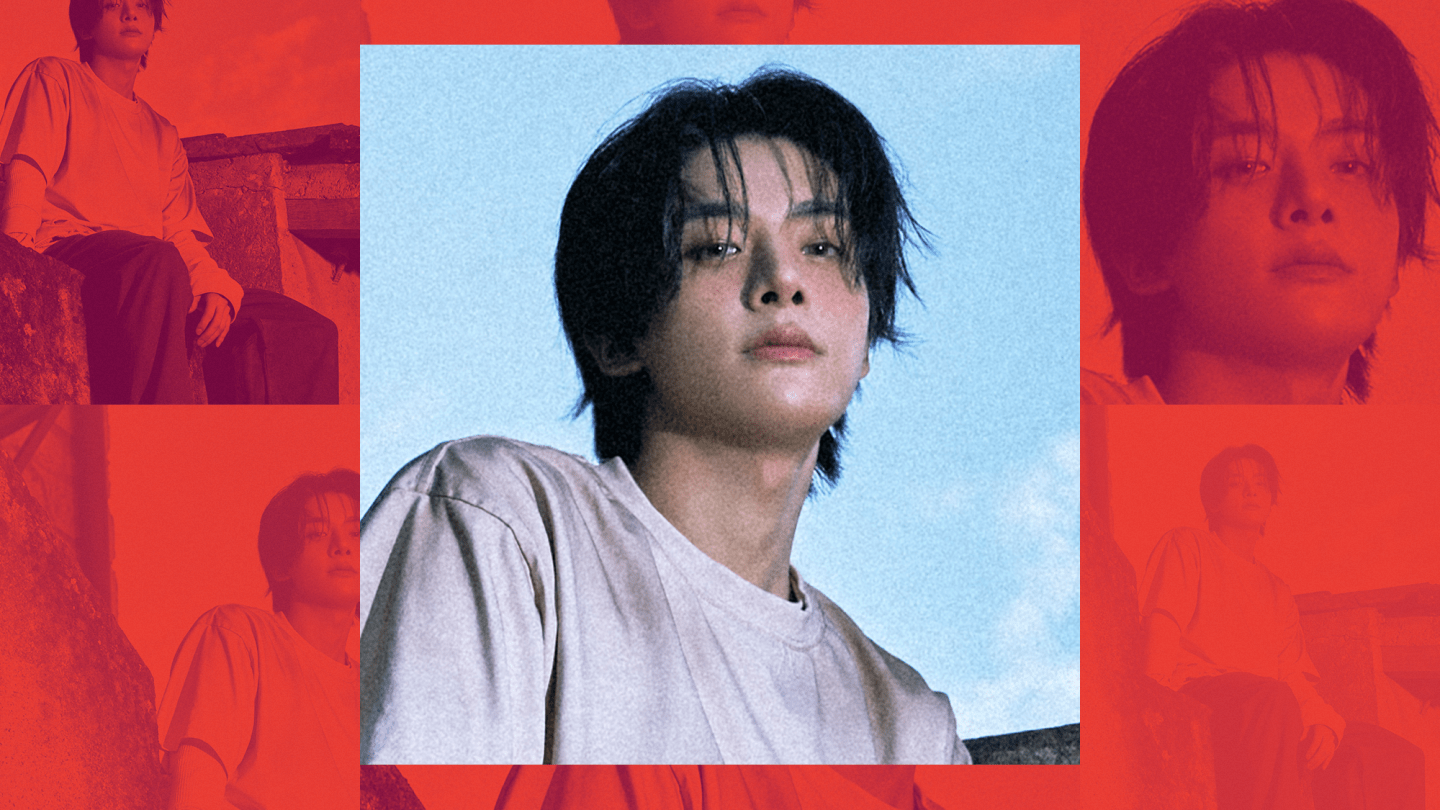


Enhypen, the powerhouse boy group hailing from Hybe sub-label Belift Lab, is finding a new stride, according to member Jake.
The 23-year-old Korean-Australian singer is exuding passion about the seven-member group’s latest album, The Sin : Vanish, when he speaks to The Hollywood Reporter shortly before its release. I’ve found Jake on a rare off day, joining the Zoom call himself instead of at his company.
Enhypen is as solid as ever, and Jake’s found himself finding joy in producing for the group for the first time. The singer produced a narration track and a song on The Sin : Vanish. “Producing a song sparked something inside me that I didn’t really know that I had because being a K-pop idol, sometimes, it gets very repetitive,” he explains.
“We wake up, we have a very tight and set schedule down to the minute. We have to wake up at this hour, this minute. We end our schedule at this [time]. I used to enjoy that,” he continues. “I’m a person that really likes that because I’m just wired that way. I don’t know. But sometimes, without even me knowing, that gets very tiring, but producing and making music makes you think different and makes you think creatively.”
Jake not only says he learned something new about himself, but he’s just had plain fun doing it as well. “I feel something different when I’m in the studio. It’s just a different kind of adrenaline when you’re working on a song,” he says. The singer is quick to add that he plans to do more of it in the future.
Below, Jake breaks down how he came to produce songs on Enhypen’s latest album, the thing he thinks K-pop artists know but are wary to speak about and how the global audience, including Korea, helped build Enhypen into the group it is today.
Can you tell me a bit about Enhypen’s recent album, The Sin : Vanish? I listened to it yesterday with you and the group, obviously, but how are you feeling about it? Where do you think it’s going to take you guys?
First of all, it’s a concept album. What we mean by concept album is that it’s not just a regular album with music — it has a concept and a story to it. The music, the production and the storyboard, the films and everything is involved in the concept or that story, which is continuing from our last album.
Our last album was about the desire to be with their loved ones, but on this album, we’re talking about how we’re on the run, away from society almost or… It’s up to interpretation, but we’re running away with our loved ones. Our title song, “The Knife,” is talking about what we feel and how we’re feeling when we’re on the run.
What about it being a concept album makes the experience different?
You have to listen to this album from the start, in order. We planned it, and we put the songs in that particular order because it tells a story. From the beginning, the first track, which is called “The Beginning,” and it’s a narration track. It’s talking about the beginning of this journey right until the very end, which is the last narration track [“The Beyond”].
We couldn’t really talk about the Korean version [in the group’s media listening session] yesterday, but the Korean version narration is done by a very famous actor called Park Jeong-min. Also, we have a very famous voice actor from Japan for the [Japanese] version, and also the Chinese version. We put a lot of work into this album, and I hope all the people that listen to it really feel and acknowledge all the little details that we have on this album.
You produced on this album for the first time. How did that come to be? Was it something you went to the label and asked about, or was it just something that organically happened?
Right at the start of 2025, my personal goal was to be more active or work on my producing skills. My goal was to put [put] or make two or more songs this year — that was kind of my personal goal for 2025. I’m so happy that the two songs that I made got to be on this album.
Can you tell me about the narration track?
The first track, the narration track, I started working on it almost a day after our promotions ended for our last album. [When] the promotion for our last album ended, I just went to the studio [and] talked about how it went. I was talking about what things could have been better, and started talking about how I wanted to maybe [produce on] the next album. There was nothing really planned at that stage because we still had a tour left [to do]. But I was just thinking about it.
I was thinking about how our concept film was based on the movie called Late Night with the Devil. I think I was rewatching it. It’s not an old movie, but the film style and the concept is sort of a really ’90s kind of film. It looks like a really old film, but it’s not. It was very interesting and the story was very interesting. On the demo, there’s bits of the actual movie that I decided to put in, but it’s not on the final version. But on the demo, you could hear the clips of the movie inside the narration track. I just thought, why not continue this sort of theme of this interview, and how we are being interviewed as a vampire. The society or the people might not understand everything about us, but we still want to live this way and tell people about how we are or how we feel. That was sort of the main idea behind this album.
How was it different this time?
It’s the first time I really worked on the track. I would usually just work on the melodies or the topline on a song, but it’s the first time that I really just started working on it from scratch. It was a very new experience. I found out that I might be better at the producing of the track. A very close producer that I always worked with, he told me that I might be better at doing the track instead of the top melody. It just all came along together very smoothly, which is kind of surprising because it’s the first time for me to really work on a song on an album. I was very lucky and very surprised. That’s how it went for the narration track.
The song that I put out, “Sleep Tight,” I started working on that song on the same day. It was the last 30 minutes, I had finished the narration track, and just decided to work on something else, see what I was feeling. It just layered into each other, and kind of just kept building, and it came out with this final product, which I’m very happy about.
Is production anything you ever dealt with when you were a trainee? And if it isn’t, do you think it should be down the line for others?
I think it is at the moment, or it was when you’re a trainee at maybe Big Hit Labels, which is Hybe now, but it was called Big Hit Labels. Jungwon, Jay, Sunghoon and Heeseung, they were all training at Big Hit for a long time. I was only at this current label for about eight months, so I don’t think I was… Maybe I wasn’t at that level of being a trainee to practice producing a song, or I was just busy trying to dance and sing a little bit, but I feel like it’s very good to start as soon as possible. Start as young as possible, just interact with as much music as possible. Even if you’re not doing the actual production, I feel like it’s a good learning step to just be in the room and just see what people are doing. I think that’s how I started.
K-pop as an industry moves at a rapid pace. It’s very trend-heavy and things change really quickly. Companies are now debuting more groups than they ever have in shorter amounts of time. Is there a pressure to then find [a unique concept]?
I feel like the fact about K-pop that every K-pop artist knows but does’t want to talk about is that [the] K-pop industry is very competitive, right? We all say we don’t want it to be, or we want everyone to do their own thing… Every K-pop artist is different.
Exactly.
I feel like everyone knows in the back of their mind that it is very competitive, and there’s a lot of groups that come out with so many different concepts, and it’s always changing. It’s very fast-paced. I feel like, compared to any other music industry, it’s very up-to-date, like you said, and it’s always changing a lot. You have to be on top of everything.
We would be lying if we said we didn’t feel any pressure. We are very confident in our abilities to always put out something different or a different concept. I feel like we’re confident in that way. The members and our team, or people at HYBE, everyone that we work with, focus on doing something different. That’s the core that we have as Enhypen and as also the crew behind Enhypen. We all try to be the first to do something and be the first to do something different, and I think we definitely did that for this album.
Can you tell me more about that?
Like I said [in] yesterday’s [session], no one really puts out the songs before the concept as we did with the concept films. I think that’s very rare in this K-pop industry. We always tend to wait until the last minute, almost. We don’t do it now, but we used to hide our hair colors until the very last day. I think that’s very K-pop culture, almost. Everyone wants to wait until the last minute and surprise everyone with this new thing. We used to always do that, but we decided every single song in this album is too good to hide.
When we put out an album, it’s always the title song or the B-side track that gets the main spotlight or the focus, but we were always almost not happy about that because our songs are all good equally, I feel like, and they all have different styles. It’s all attractive in a different way, and we wanted to showcase that, so we decided to have a short film for each song. We don’t have the time to make a music video for each song, so we decided to do a short film with the concept and the storyline. I really, really like how we did the pre-comeback promotion for this album. I think the fans are very excited, and I think I’m very excited if you can’t tell. (Laughs.)
These narration tracks are different than a lot of albums, too, because you’re doing them in four languages. I know you grew up in Korea and Australia and maybe have an interesting opinion on the fact that K-pop as a whole now is very confronted with the fact that you have to have this global appeal. You’re trying to hit all these different markets. I’m wondering why you feel it’s important?
I think if I’m being 100 percent honest, the base of Enhypen… I feel like the reason Enhypen was able to come to this world was because of our global fans, and that includes Korea, as well, when I say global. I’m saying that it wasn’t just in Korea that we were able to start almost because we had I-Land, which was a global program and the voting was global, as well. Right off the bat, we knew in our heart that there were people outside of Korea that were very interested in us or in K-pop. But at the time, because of COVID, we couldn’t really see with our own eyes. As time went on — and we were able to go overseas and perform and interact with fans all over the world — we realized that K-pop is not Korean pop. It’s this whole genre that is loved globally.
We don’t really put an album or make an album or make a song that is liked by this region or this group of people or this group of people. We might have different styles… Like on this album, we have a Latin-style song that we know that Latin Engenes would enjoy more. There’s things like that, but we never plan to target a certain group of people. We just put out albums or songs that we know are good quality, first of all. I think that’s what I really like about Enhypen or this company is that we don’t put stuff out to almost… we don’t put out albums just because of our fans. I want to elaborate on that because it’s very important to make an album that the fans like, but also, I feel like a very thin line to keep is that you need to know what you want to do or you need to keep grounded and have a meaning behind the album.
You need to create a vision for yourself more than just that.
Exactly. More than just to please people or just make a song or make an album that just people would just like to hear. I think it’s a very thin line. You can’t really tilt towards one side. The people that work with us or this company are very good at staying on that really thin line. This album is very strong with the concept and the meaning and the details and everything is very detailed. Everything is there for a reason. But also, I know that the people would love to listen to it. Even if they don’t know much about Enhypen or this concept or this storyline that we have, they would still listen to it because it’s such a good song. I don’t know, this album is the most confident that I’ve been throughout the five years. I feel like the songs and everything around it is the best that we’ve done so far.
You have this crazy schedule that you’ve described as structured. It seems to have been helpful, but what do you do then to take care of yourself in this situation? I assume you’re finding your own way that’s more than just doing a face mask. What does taking care of yourself look like?
The first thing that comes to mind is you have to talk to people about it. I feel like K-pop idols are very different to normal people — you can’t really expect to have a normal life, so I feel like it’s important to talk to other K-pop artists or other K-pop seniors that have been doing this for longer than me. They know what I’ve gone through. They all went through the same thing. I feel like it’s important to share what you’re feeling because if you want to ask advice for anything related to your life or my life as a K-pop artist, there’s no one that can relate to it other than the same people that are doing it. I don’t really know a lot of people, to be honest. (Laughs.)
Really?
There’s people like Felix, who I’m close to, and Chris from Stray Kids. They’ve been doing this for longer, and they know exactly what I’m going through. Because they’re also very busy and I’m busy, we don’t really get time to link up, but when we do, we talk about all this. They can relate to it very easily and give me advice. I feel like that helps me cope with everything.
Internally, I feel like this goes for every job, but you’ve got to enjoy what you do. I certainly enjoy what I do, and everyone in the group enjoys what they do. We enjoy performing in front of our fans, and I think that’s what motivates us during the hard times, which is before we come back, before we put out an album, the few months or the half a year that we have to put in doing the music videos, recordings, making the album, that’s the hard bit. Just the thought of putting this album out and singing this song in front of our fans is what helps us get through the few months.
Do you find it a bit harder to deal with the fact that most of the K-pop industry is structured in a way that most groups are putting out two albums a year? Do you come to cherish that downtime more or is it just something you get used to?
I don’t know how K-pop artists put out so many albums. [The other members and I], but also our company, sometimes talk about how the other groups do it. How they put out so many albums, because we know how long it takes to make an album. It takes a long time [and] takes a lot of work to put out one album. But I feel like every single K-pop artist usually don’t have downtime. If you’re doing a promotion for an album, you’re doing that. If you’re not, you’re working on the next album. It’s almost like you don’t ever stop, or you’re on tour. So it’s pretty hectic, but you definitely get used to it. You find little bits of rest in between, and you get to cherish that rest or the days off that you have rarely; you really cherish those. I’m used to it. It’s fun. You have to work hard because a lot of people, a lot of fans, are really expecting a lot from us, which is a good pressure. It’s a positive pressure, if you know what I mean. It helps us [stay] motivated.
Read the full article here