



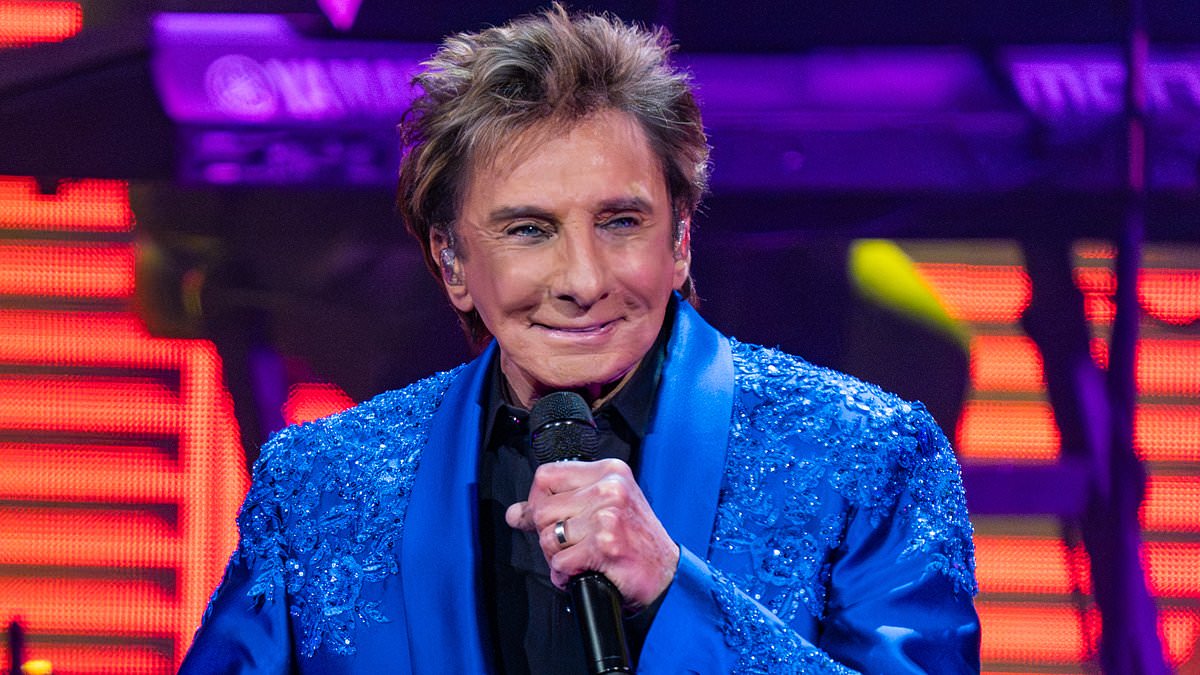


Barry Manilow is battling lung cancer he revealed on Monday morning with an Instagram note.
The 82-year-old Copacabana singer shared with his fans that he has a cancerous spot on his left lung that will be removed surgically soon but will not have chemo and radiation.
The crooner said he happened to have an MRI after suffering from weeks of bronchitis and that is when the spot was discovered.
A cancerous spot on the lung, called a lung nodule, is common and often benign, but needs evaluation due to its link with lung cancer, the leading cancer killer, according to the Mayo Clinic.
The star is a longtime smoker who has switched to vaping in recent years. Manilow told the London Evening Standard in 2012 that he’d been smoking since the age of nine.
He was seen vaping last week in Palm Springs in photos obtained by Daily Mail.
Barry Manilowis battling lung cancer he revealed on Monday morning with an Instagram note. The 82-year-old Copacabana singer shared with his fans that he has a spot on his lung that will be removed surgically soon. Seen in 2024
Seen on December 17 with appeared to be a vape pen on a rare outing in Palm Springs
His statement was posted early in the morning with white type on a black background.
‘As many of you know I recently went through six weeks of bronchitis followed by a relapse of another five weeks,’ he wrote.
‘Even though I was over the bronchitis and back on stage at the Westgate Las Vegas, my wonderful doctor ordered an MRI just to make sure that everything was OK.
‘The MRI discovered a cancerous spot on my left lung that needs to be removed. It’s pure luck (and a great doctor) that is was found so early. That’s the good news.’
Then he said he needs to take a break. ‘The bad news is that now that the Christmas Gift Of Love concerts are over I’m going into surgery to have the spit removed. The doctors do not believe it has spread and I’m taking tests to confirm their diagnosis. So that’s it. No chemo. No radiation. Just chicken soup and I Love Lucy reruns.’
The hit-maker was supposed to hit the stage for U.S. tour dates in January 2026. He was going to visit nine major cities including Orlando, Tampa, Charleston, Greensboro and Columbus.
Manilow said that he will be performing again in February.
He has talked about his smoking habit with the London Evening Standard over a decade ago. ‘Well, I smoked for 30 years. I started when I was nine years old. I grew up in Brooklyn,’ he said. ‘Then I stopped about 15, 20 years ago. Then I just started in Las Vegas and the band and I went down to a little club and somebody offered me a cigarette. And I was back.
‘Within a week I was back. Not on a pack a day, ’cause when I was really smoking I was on three packs a day – non filters. Oh yeah. I was a great smoker.’
Pictured performing at The Grammys on February 1 in Los Angeles
Over the years Manilow has experienced multiple health woes including vocal cord issues, bronchial infections and throat cancer, which was successfully treated after its discovery in 2020.
He told the publication that he traded his heavy cigarette smoking habit for vaping over a decade ago.
Manilow added that vaping may not work for everybody, but it works for him. ‘Do they work? They do for me, my band and my crew, all of us who hated smoking but couldn’t stop,’ Manilow told The Evening Standard.
The Copacabana hitmaker has been seen vaping in public and at events before.
Manilow, who is private about his personal life, wed his longtime partner Garry Kief in 2014; pictured with Garry in 2016 in Beverly Hills
The Mandy singer has overcome numerous health issues over the years, including bronchial pneumonia, a mouth tumor, heart problems and hip surgery, and admitted he’s amazed he can still put on a show.
He told the Daily Mirror newspaper in 2019: ‘I’m fine, I’m waiting for the other shoe to drop. I’m very old, I should not be able to do this.
‘You saw me going up those stairs on stage – there’s 14 steps up and 14 down, you would think I should be in a wheelchair or something.’
He’s also said his love of music and performing is what keeps him going.
The singer who ‘writes the songs that make the whole world sing’ has much more music yet to produce, he told Palm Springs Life in 2015.
‘And it’s a good thing I wound up successful in music, because if I didn’t do this, I’d be in trouble,’ he added.
‘Because I don’t know how to do anything else. And it’s really all I’m interested in. You’d think, after all these years, I’d have found all the colors that interest me — I’ve recorded pop, big band, Broadway, jazz … everything — but there’s always something more I haven’t done.’
Read the full article here