





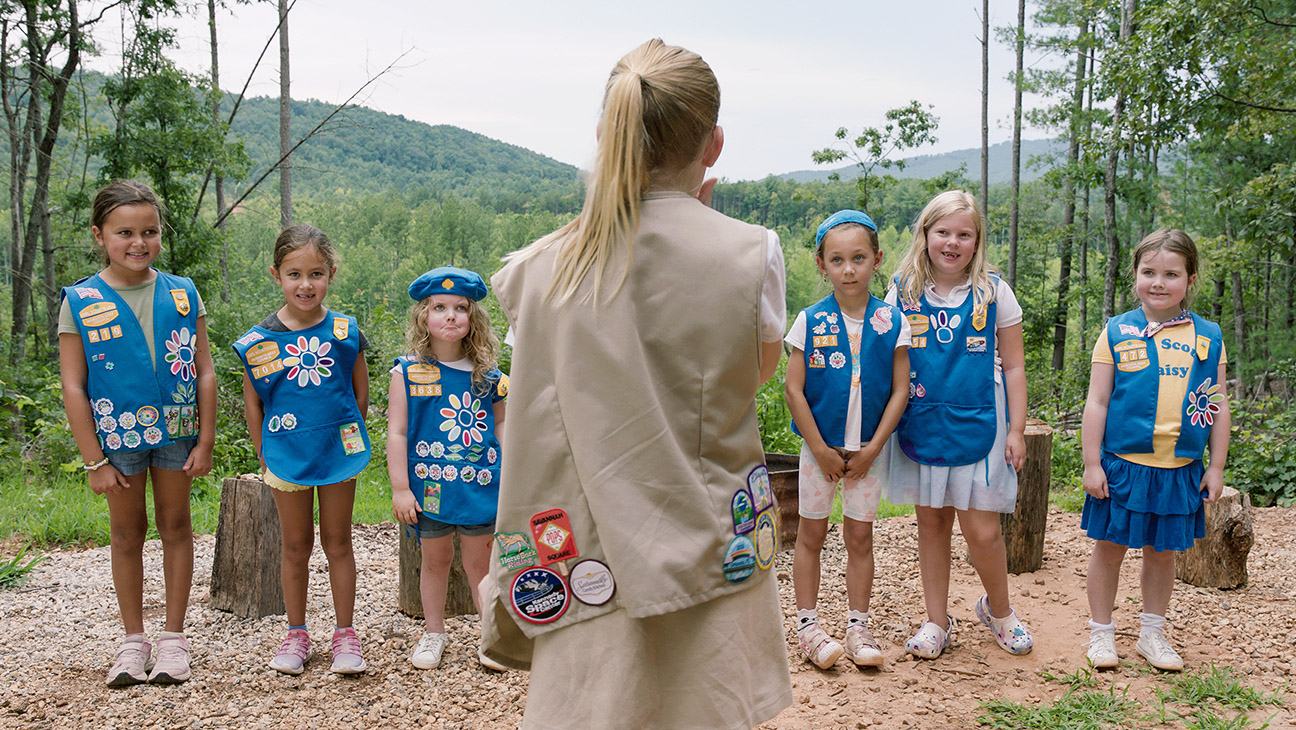


At one point in Cookie Queens, a highly engaging documentary about four Girl Scouts selling cookies, the film’s smallest moppet, five-year-old Ara E., meets a prospective client who — given his diabetes — wonders if he should be buying cookies at all. Ara, who has type-1 diabetes herself, empathizes enthusiastically and later bakes some sugar-free treats for the two of them. (Although she still charges the customer, having clearly learned the capitalist lesson of the cookie-charitable-industrial complex.) It’s an adorable moment, but one that might just draw attention to the fact that if this film were itself a baked good, Ara would need to be careful because one bite could cause hyperglycemia or even diabetic ketoacidosis. It’s just that sweet.
Not that viewers are likely to complain, judging by the reportedly long ovation that greeted the film after its first Sundance screening. Directed by Alysa Nahmias (who won an Emmy for Art & Krimes by Krimes) and executive produced by, among many others, Prince Harry and Meghan Markle, Cookie Queens serves up an eminently accessible and easily meme-able serving of American-girl cuteness, featuring a diverse cast of well-chosen young women.
Cookie Queens
The Bottom Line
Sweet as can be.
Venue: Sundance Film Festival (Family Matinee)
Director/screenwriter: Alysa Nahmias
1 hour 31 minutes
And while it may be a little too saccharine for some palates, in less skilled hands it might have been much worse. Nahmias adroitly adds some more acidic notes along the way that gently, very quietly draw attention to income inequality, tricky parent-child dynamics, and issues around race and beauty. There’s even an implicit questioning of why only a dollar or so from the $6 sticker price on each box goes to the seller’s troop, while the Girl Scouts’ local councils and national organization take the rest of the money to fund administration and activities as they see fit.
That said, even the way blonde 12-year-old Olive G., a Tracy Flick-in-training if ever there was one, scrunches up her face in confusion as she struggles to understand why so much of her earnings are garnished is still cute. Nahmias’ no-interview, straight-up observational doc method keeps the focus on the girls, so we learn almost nothing about Olive’s family except what can be gleaned when they share the frame with the subjects. That means we barely even know Olive’s mother’s name, let alone what she and Olive’s dad — who directs Olive’s appeals videos, and gives tough notes after each take — do for a living.
But Olive’s mom is also one of the troop leaders, so she’s clearly more invested than most parents in cookie campaigning. The lady certainly seems to protest too much when she insists that the push to beat records comes “all from Olive,” who seems pretty over the whole grind in the last act of the film. When she’s finally broken her personal sales record by shilling 9,000 cookies, securing her title as North Carolina state champion, and mom suggests that making a round 10,000 would be so cool, some viewers may feel concerned that everything’s alright in that home.
Thankfully, Olive has the unconditional support of her best friend Celia K., a hyper-articulate, adorably intense scene-stealer whose loyalty to her friend is truly moving. We can but hope there will be a follow-up film that catches up with these girls five or 10 years from now as they launch their political careers or start their first Fortune 500 company together. Also, that spotlight on female friendship is reassuring since two of the other girls in the film seem more isolated and alone.
That’s less the case with eight-year-old Shannon Elizabeth S., a part Latino, part Native American girl living in El Paso, Texas. She has her fellow Brownies to hang with, but clearly she’s most attached to her mother and her mom’s partner Sushi, who help Shannon Elizabeth work every flea market and parking lot so she can sell enough to win a trip to summer camp, a prize far beyond the family’s means.
Little aforementioned Ara, on the other hand, seems like a more solitary spirit, although we do see a precious scene where she tries to teach her younger brother how to hold as many boxes of cookies as his little arms can manage. But when not working the seafront near her San Diego home on cookie-selling duty, Ara seems to be in a beautiful, pastel-colored world of her own. Like Celia, she’s unnervingly well-spoken for her age, but also able to do numeric calculations well beyond her years and an accomplished pianist, tinkling out a Bach minuet with impressive precision.
The kid with the most complicated family dynamics is easily nine-year-old Chino, California, resident Nikki B., the youngest of three who desperately wants to be considered an equal by her older sisters Nala and Nyah. A Black family in a predominantly white community, the girls and their own troop-leader mother seem to have embraced the Girl Scout way and cookie-selling success as a means of building status, along with courting validation with beauty. Both older sisters, now more focused on cheerleading than scouting, have complicated make-up regimens, required to service their devotion to making TikTok videos, a lifestyle Nikki longs to be a part of.
Her dedication to cookie-selling is one way she can prove her worth to the whole family, as her aim is to earn a prize trip to Europe. And, though it might be of less monetary value, to bring home a trophy as big as the one an elder sister once earned. Luckily, Nikki’s youth, sunny disposition and agreeableness are her own superpower, making her the “hook,” as the girls describe her, because other people consider her “still cute” — unlike her older sisters, who have apparently nearly aged out of cookie-selling.
With all four girls, the life lesson that selling Girl Scout cookies offers is irrevocably bound up with late-stage capitalism. Tasty-morsel entrepreneurship stands in here for a modern kind of Protestant work ethic, but gets sprinkled with the sense that cuteness, like beauty for older women, is a commodity in itself that the possessor can exploit to their own advantage. At the same time, all the girls seem to have subconsciously absorbed that guilt-tripping potential customers is part of the game, luring in marks with pity for the vendor’s disadvantages (poverty, not being white, having a disability) in a culture overwhelmingly rigged to favor girls like, well, white middle-class Olive.
As the above may suggest, it’s very easy for viewers to read into Nahmias’ film all kinds of subtexts that the filmmakers might have intended. But there is some subtle direction in what Nahmias and her editing team have chosen to include, and resonances and discordances they draw out between the different families. Meanwhile, Antonio Cisneros’ warmly lit, subtly humorous cinematography adds a softness to proceedings, like powdered sugar on a fresh batch of cookies.
Read the full article here