





Ever wonder what your favorite celebrities are reading — whether it’s a timeless classic or the buzzy bestseller they can’t put down? Welcome to Page-Turners, where stars reveal the books that keep them hooked, inspired and up all night. Warning: your TBR pile is about to get a lot longer.
Comedian Jordan Carlos loves reading the lesser-known works by famous authors.
“A part of me feels like life’s too short for anything but the classics, that I should be reading banger after certified required reading banger, but I find myself drawn to all kinds of stories, fiction and non-fiction alike,” Carlos — whose new book “Choreplay” is out now — tells Page Six.
The “Colbert Report” alum adds that he is particularly drawn to an author’s work he refers to as “the ‘B’ sides.”
“As a comedian, I know that life is full of rejection and not every book is going to be a winner. Point me to the also-rans… ‘Billy Budd’ (Melville), ‘The Last Tycoon’ (Fitzgerald), or ‘Always Outnumbered, Always Outgunned’ (Walter Mosely), one of those books that doesn’t announce itself as important, but stays with you longer than the big, loud ones,” he tells us.
His own new comedy book, which is part memoir and part advice, focuses on divorce and chores.
“It encourages slobs (men) to do the latter to avoid the former,” he says. “I wrote this book to share that even doing the league minimum amount of housework can be a force multiplier for your relationship. Who knew making sure there was enough TP in the house could do more good than out-of-network couples therapy?”
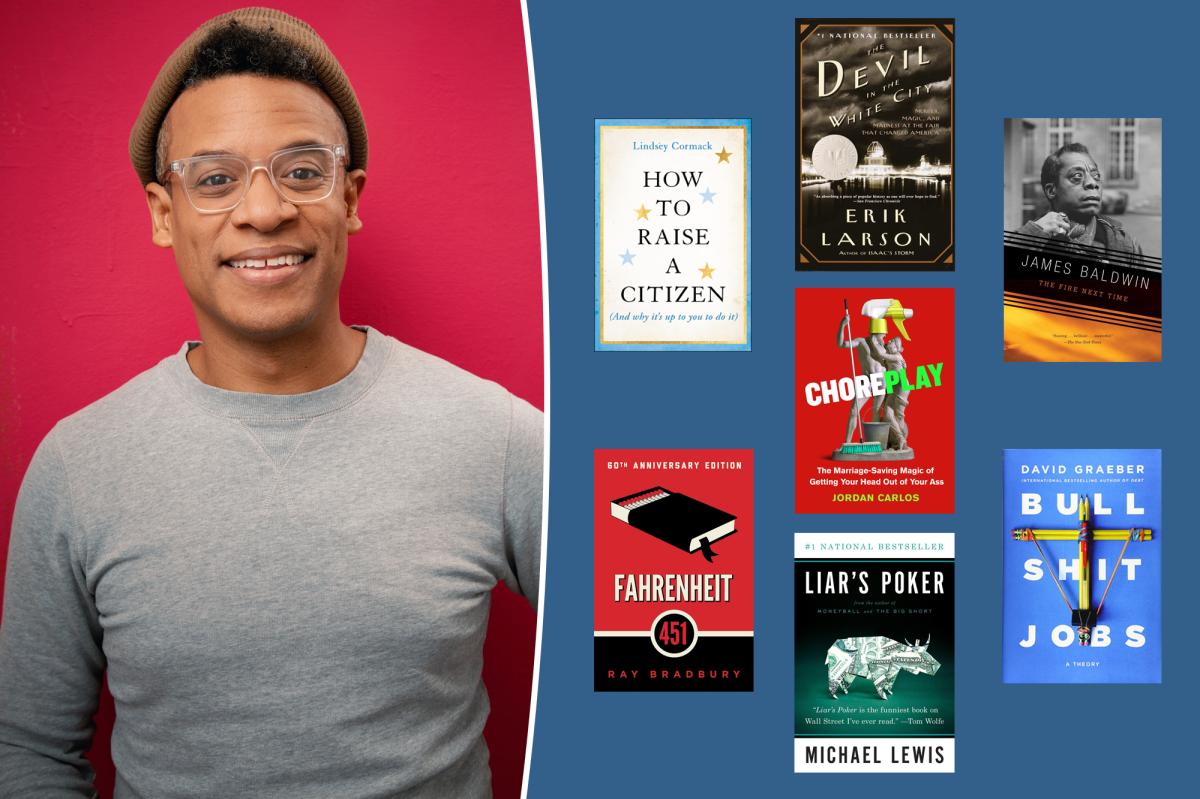
See below for Carlos’ six must-read book recommendations.
“As fiery as the title would suggest, James Baldwin is an iconic writer with a singular wit and a cold eye for glaring inequities and enraging dissonance. For better or worse, his insights on race and class are as true today as they were then, but it’s really the way he crafts his arguments with such power and erudition – that’s what always blows my hair back. I love Baldwin because his ideas challenge the reader’s own ideals and force you to analyze society warts and all.”
“I love this book because it’s written as a how-to for any US citizen raising kids in 2026. It gives such simple but cogent advice on how to bring up a child in this era so that they will be ready to be positive members of our democracy. And it does that in a way that does not take political sides. It’s simple. It’s straightforward and earnest and indefatigably hopeful writing without being over-the-top and Pollyanna – something sincerely missing from the landscape.”
“Erik Larson is the LeBron of narrative nonfiction. Only Larson can take the seemingly unrelated subjects of serial killer H.H. Holmes and Frederick Olmsted designing Central Park and dovetail them so seamlessly. Larson is a master of putting you ten toes into an era with unflinching attention to 4K detail.”
“Somewhere between economist and sociologist lies the late, great David Graeber. Graeber cuts through the titular BS to reveal just how bloated, redundant, and bureaucratic the private sector has become. I love books like this because it makes me thank, ‘God I quit my day job!’”
“This is an absolutely bonkers book, but I’m a sucker for dystopic futurism as a cautionary tale. As a comic, censorship isn’t a joke to me. The First Amendment is sacrosanct. But Bradbury invites us into a world where all books are banned and replaced with brain-rot, low-brow entertainment meant to pacify and infantilize the populace under a brutal authoritarian regime. Totally not a breezy beach read, but definitely a thinker for someone who makes their living as a writer. None of my jokes are edgy enough to get censored, really, but if that day ever comes, books like ‘Fahrenheit 451’ will have warned us.”
“Michael Lewis’s first book is BTS about breaking into Wall Street during the Gordon Gekko’s ’80s. Lewis captures these heady days of the Bull turned loose, when Wall Street went from déclassé to pop-culture fascination. I studied business in college, and as a New Yorker, Wall Street is, and all its dramas and excesses are difficult to avoid. The book is also about finding out what you don’t want to do for a living. For Lewis, that was Wall Street. To me, the temerity to try on different hats and pivot is fundamental to being a New Yorker.”
Read the full article here