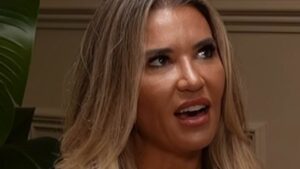


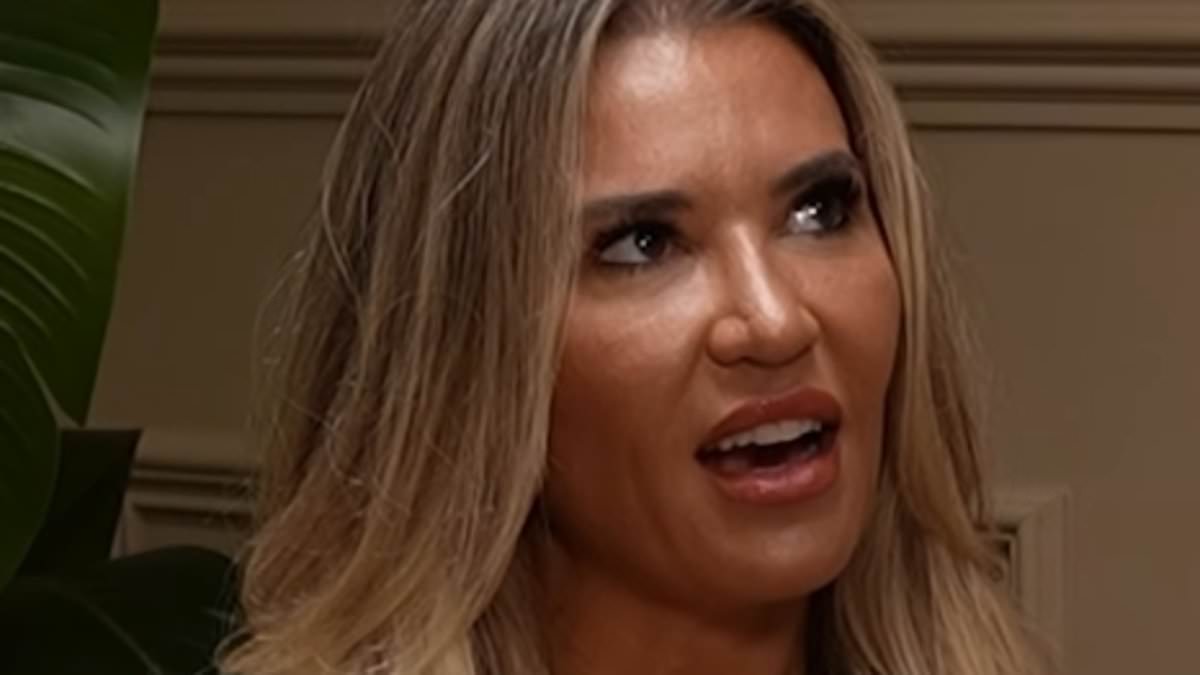


Christine McGuinness was overcome with emotion as she recalled the hardest part of parenting in a recent podcast.
The model, 38, shares three children with her ex-husband, Paddy McGuinness including 11-year-old twins Penelope and Leo and eight-year-old Felicity – all of whom have autism.
Although Christine and Paddy are no longer married, the pair still live together in the family house for the sake of the children.
And speaking on Friday’s episode of Parent Unplugged, Christine confessed the hardest part of being a parent is preparing them to live without her when she can’t live without them.
Fighting back tears she told host Charis Halsall: ‘Oh, this is quite deep to start with. It’s realising that I am preparing my three children to live without me when I can’t live without them.
‘And why do you feel you’re preparing them for that?’ asked Charis.
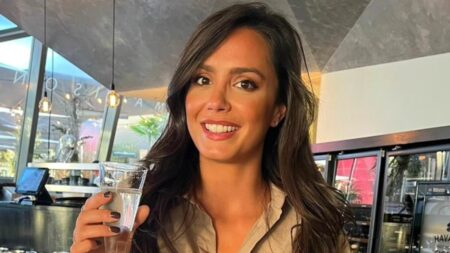
Christine McGuinness fought back tears as she recalled the hardest part of parenting is realising she is preparing her children to live without her in a recent podcast
‘It’s a job as a parent or a carer, anyway. You know, of course we want them to be happy, we want them to be successful and all of that.
‘But really, we want to know that when we do go to sleep properly that they’re going to be able to cope and manage.
‘So I think that was the biggest realisation is that I can’t live without these three kids and one day they have to live without me.
‘So I need to prepare them to be as independent as possible, especially with their additional needs as well.’
Christine has previously spoken about her children’s autism as she discussed the challenges parents of neurodiverse children often face on the BBC radio show Woman’s Hour last year.
During the show, Christine discussed with Krupa Padhy, how the majority of playgrounds in the UK are inaccessible for children with disabilities.
Discussing her children and how their autism presents, she said: ‘It’s different for all three of them like it is for all autistic children.
She continued: ‘I always say if you’ve met one autistic person, you’ve met one, we’re not all the same.
‘And my three are evidence of that. All of their personalities, the way they play, the way they socialise, the way they communicate, it is all completely different.
The model, 38, shares three children with her ex-husband, Paddy McGuinness including 11-year-old twins Penelope and Leo and eight-year-old Felicity – all of whom have autism
She said: ‘So I think that was the biggest realisation is that I can’t live without these three kids and one day they have to live without me. So I need to prepare them to be as independent as possible, especially with their additional needs as well’
‘But the one thing that we have in common with all of them is finding places to play, especially outdoors, that is suitable for them is a real challenge,
‘It’s very limited the places that we can go to, and it’s not really gotten any easier since they’ve gotten older.’
When asked to elaborate further on the specific challenges, Christine explained: ‘Finding places that are tailored for them where it feels like they are included with the other children, there’s not many parks or outdoor play areas that will have sensory equipment.’
She continued: ‘Or that will have a quiet area, or that are gated, you know, to keep them safe. And more so for children with additional needs, especially neurodiverse, when they haven’t got that awareness of danger.’
‘It’s really important to have a park that’s got a fence around it where I can close the gate. Because if they do get overwhelmed, or even if they’re really excited, it might be a positive feeling for them, and they’re running around or they’re overstimulated in a positive way, they can run, and they can climb.
‘And there may not be a gate there that I can close for when they’re not aware of everything else going on outside the car park and everything, and they’ll run, excited, and there’s nowhere to keep them safe.’
‘Like I said with the sensory areas, to try and help them calm down or to give them something that they are actually going to enjoy doing, there isn’t really a lot.
She added: ‘I mean, the research shows there really isn’t enough, and families are travelling up to five miles if not more, to go and try and find somewhere that is suitable for their children, which it’s not okay,
‘Outdoor play should be there for everyone. It is a right for everybody it shouldn’t just be as limited as what it is.’
Christine also discussed her autism and ADHD diagnosis, which came about at the age of 33.
When asked how she came to realise that she might be autistic, she revealed she found out after her children were diagnosed with autism.
She said: ‘It was after my children’s diagnosis, I didn’t understand why they were considered different because they were just like me,
She continued: ‘And so, when they got their diagnosis, then I kind of had to go okay, well we’ve got this in similar, we’re common in that area,
‘I thought it was just because they were my babies. So, of course, they’re going to be like me, but there were areas of quite difficult times and challenges,
‘Like when it came to socialising, sensory food issues, sensory just being out and about, you know in busier places I always struggled with.
‘I just thought that was me and part of my personality. In some ways, I suppose it is, it doesn’t completely define us.
‘Yes, we are autistic, I’m autistic and ADHD, but I’m still me, and it’s just a part of me, and I accepted that, and I accepted that with my children.
‘So when I realised that it was because of autism and ADHD, then it answered a lot of questions, but it also opened up a load more (changed my outlook).
‘It’s helped me massively. I always understood my children anyway, but it’s helped me keep that strong bond that we always had.
She concluded: ‘And it’s helped me reassure them that everything is going to be okay and mummy is capable of doing things and you’re going to be capable of doing things too.’
Read the full article here