
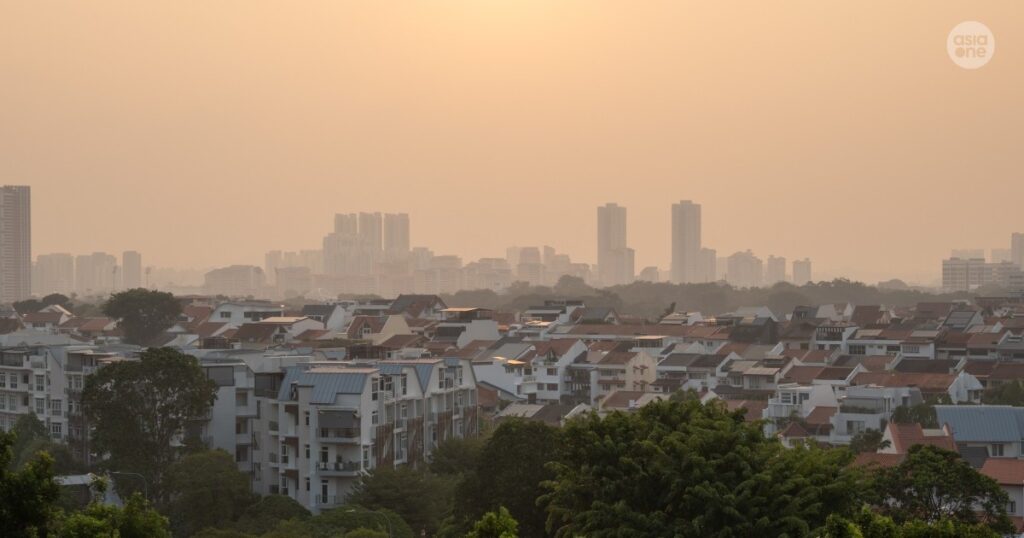
As Singapore continues to see hazy conditions, some groups are stepping up to offer support.
400 N95 marks were distributed during a Meet-the-People session and house visits in Chong Pang on Wednesday (Sept 16) evening.
In a Facebook post on Wednesday, Senior Minister K Shanmugam noted that the “haze situation was not at a critical level”, but said those with existing health conditions “may feel the effects more than others”.
“Hope the situation improves. In the meantime, let’s continue to take the necessary precautions and look out for one another as we protect ourselves against the haze,” he wrote.
National Environment Agency (NEA)’s data show that the 24-hour PSI was in the moderate range at 3pm on Thursday, with readings ranging from 66 to 92 across Singapore.
The one-hour PM2.5 concentrations were in the elevated band for the Central and West regions at 68 and 65 respectively, while the North, South and East remain within the normal range.
Meanwhile, the Singapore Red Cross (SRC) has also ramped up support for vulnerable communities.
Earlier this month, the organisation said that it is stepping up its ground response to “protect seniors and at-risk groups from prolonged exposure to poor air quality and heat”.
Its expanded efforts plans to reach 700 people across Singapore in the first tranche of support.
As part of the initiative, 200 seniors aged above 70 will receive air purifiers and Heat & Haze Support Packs. Where needed, they will also get three months of electricity bill support to facilitate the use of the air purifiers.
https://www.instagram.com/p/Dc-GQECGiIv/
Another 500 beneficiaries from vulnerable groups will also receive care packs containing coconut water, isotonic drinks, ready-to-eat food, basic hygiene items and other practical essentials.
“These supplies will help them remain hydrated, reduce unnecessary outdoor activities, and follow the National Environmental Agency’s health advisories as far as possible,” SRC said.
When temperatures rise and air quality deteriorates, the consequences can be far more serious for those already at risk, noted Benjamin Wiliam, SRC secretary general and CEO.
“For seniors living alone, vulnerable families, person with existing health conditions, and migrant workers who spend long hours outdoors, even everyday activities can expose them to serious health risks,” he said.
[[nid:743469]]
Who needs to wear a N95 mask?
Does this mean you should start stocking up on N95 masks as well?
According to the Ministry of Health (MOH), the health impact of haze is dependent on one’s health status, such as whether there is a pre-existing chronic heart or lung disease, the PSI (Pollutant Standards Index) level, and the duration and intensity of outdoor activity.
https://www.instagram.com/p/DdV97AMjarw/
N95 masks are generally not needed for short periods of exposure, such as commuting from home to school or work. They are also not necessary indoors.
Healthy individuals who need to be outdoors for several hours when the air quality is in the hazardous range (24-hour PSI >300) may reduce exposure by wearing an N95 mask with a good fit.
Those who are more vulnerable to the effects of haze — the elderly, pregnant women and people with severe lung or heart problems — should consult their doctor on whether they should use the mask if they have to be outdoors for several hours.
[[nid:745156]]
Read the full article here