





There is nothing obviously wrong with Audrey (Moon Choi). The 36-year-old has a physical therapist job she cares about, with coworkers she mostly likes. Her Brooklyn apartment looks small and a bit shabby, but comfortable. She’s single, but seems to enjoy an active, lightly kinky sex life on the apps.
It’s just that she seems adrift, somehow — as if she’s not only lost her way but forgotten where she was trying to go in the first place, if indeed she ever knew.
Bedford Park
The Bottom Line
Tender but unsentimental.
Venue: Sundance Film Festival (U.S. Dramatic Competition)
Cast: Gary Foster, Chris S. Lee, Nina Yang Bongiovi, Theresa Kang, Son Sukku
Director-screenwriter: Stephanie Ahn
1 hour 59 minutes
Bedford Park, Stephanie Ahn’s poignant directorial debut, follows Audrey on her path toward something like self-actualization, sparked by a chance encounter with a similarly lonely soul. Though its unflashy style and delicate emotionality are unlikely to sweep viewers off their feet, its eye for fine detail and bittersweet tone make it an absorbing experience worth seeking out.
This transformative relationship enters Audrey’s life through the unlikeliest of avenues. Eli (Son Sukku), a rough-around-the-edges ex-wrestler, is the other party in a car accident that leaves Audrey’s mom (Won Mi-kyung) with an injured wrist. The incident forces Audrey back into her childhood home in suburban New Jersey to help take care of her, and into Eli’s orbit to help square away the insurance information and repair bills.
Audrey and Eli’s first meeting is a contentious one, with accusations and rude words and eventually pieces of fruit getting thrown around in all directions. (Between this and Netflix’s Beef, there’s apparently no better outlet for Korean American Millennial angst than car-based tantrums.) But a second encounter takes a turn when Audrey finds herself in a vulnerable position, and Eli, a decent guy underneath his prickly exterior, steps up to help. The mutual thawing turns into a mutually beneficial carpool arrangement, which warms into friendship and eventually more.
The script, also by Ahn, leans slightly too much on contrivances to nudge the relationship along. And while Eli’s solitude is explained by his circumstances (he’s laying low from a shady situation engineered by a toxic relative), it’s harder to tell whether we’re meant to understand Audrey as having no other friends whatsoever, or if it’s just more convenient for the screenplay that whatever pals she does have forget to text her the entire time she’s in New Jersey.
But it helps make up for these minor missteps that Ahn has such a firm grasp on who her characters are and where they’re coming from. Combined with her eye for small but telling details — an introductory scene of Eli eating peanut butter directly out of the jar with his fingers speaks volumes about where this man is in his own life, before he even speaks a word — it ensures that even when certain plot beats feel a bit engineered or random, the emotions rippling out from them are wholly believable.
As the central not-quite-couple, Son and Choi are intriguingly unpredictable together at first, like a pair of stray cats sizing each other up, ready to pounce or run as needed. When they finally begin to let their guards down, one awkward car-ride convo or hesitant food court meal at a time, the connection is more profound and more tender for being so hard-won.
What brings Audrey and Eli together, other than a slow-burn attraction, is a sense of stuckness — of being trapped between the heavy expectations of their families and the dissatisfaction they harbor about lives that haven’t quite turned out as they’d hoped (even if they themselves probably couldn’t articulate what exactly it was they did want).
Audrey, the single and childless and PhD-less product of a stable but unhappy home, has fallen short of the life planned out for her by her parents. In the present, her mother lies to her church friends about Audrey’s nonexistent medical career, pressures her to date a nice and rich but hopelessly boring divorcé and guilt-trips Audrey into extending her stay. Eli, whose childhood was fractured by tragedy, dodges a mother who seems more interested in asking him for money than offering him love, and hides out from an ex and young daughter whose life he apparently fears ruining.
No wonder they feel that in each other, they’ve finally found the one person around whom, as Audrey puts it, they can finally breathe — someone who comes to them with no preconceptions or expectations, who see them for the person they actually are and not the person they want them to be.
Woven through this entire messy tangle of relationships is the issue of their shared Korean American identity, in all its variously beautiful and burdensome complexities. It is a gift that Bedford Park grants its leads the space to navigate that complex terrain on their own terms, rather than falling back on stereotypes that position it solely in opposition to a “mainstream” (white) culture.
It empathizes with Audrey, who is unwilling to be the dutiful girl her mother wants her to be, but isn’t ready to entirely reject the role, either. It’s gentle about Eli, born in Korea but raised by a white mother, feeling self-conscious because he prefers forks to chopsticks and barely understands the language of his birth parents.
And it understands that the umbrella of that identity might cover even those who’d rather reject it — like Audrey’s mother, who moved to the U.S. in search of a better life for her children but now bemoans the fact that they’re too American; or her father (Kim Eung-soo), whose pride has never recovered from the loss of status he suffered when he traded his cushy office job in Korea for blue-collar grocery store work in the States.
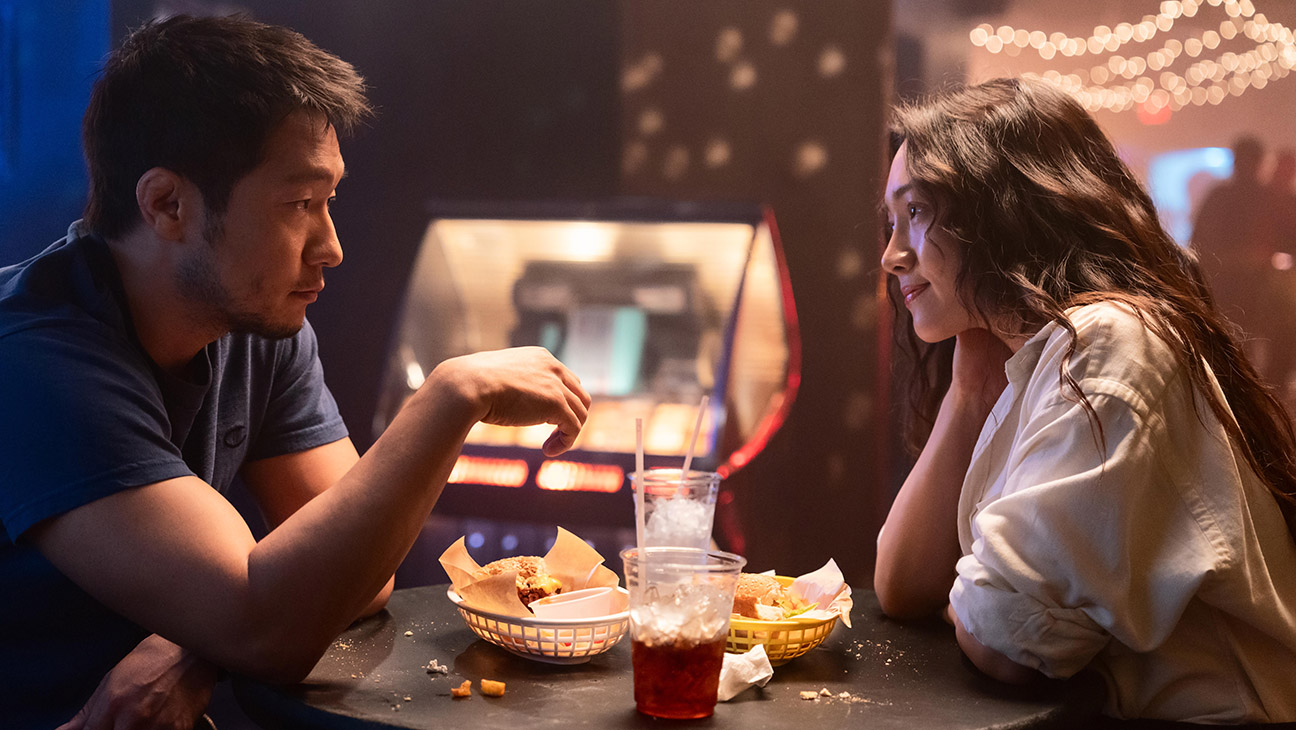
Almost inevitably, Bedford Park makes its way to the Korean concept of han, defined here by Audrey as “an ancient heartache when a person carries their family’s trauma.” Is it “carried voluntarily, like a sense of duty,” she and Eli wonder over beers and bar food, or do they have no choice in the matter?
The film doesn’t have any firm answers to counter these questions, let alone any easy reassurances or even a tidy happy ending. But in its nuance, its curiosity and its deep affection for its characters, it offers anyone familiar with burdens like Eli and Audrey’s the same thing they give to each other — the chance to sit down and take a breath, with someone who really gets it.
Read the full article here