




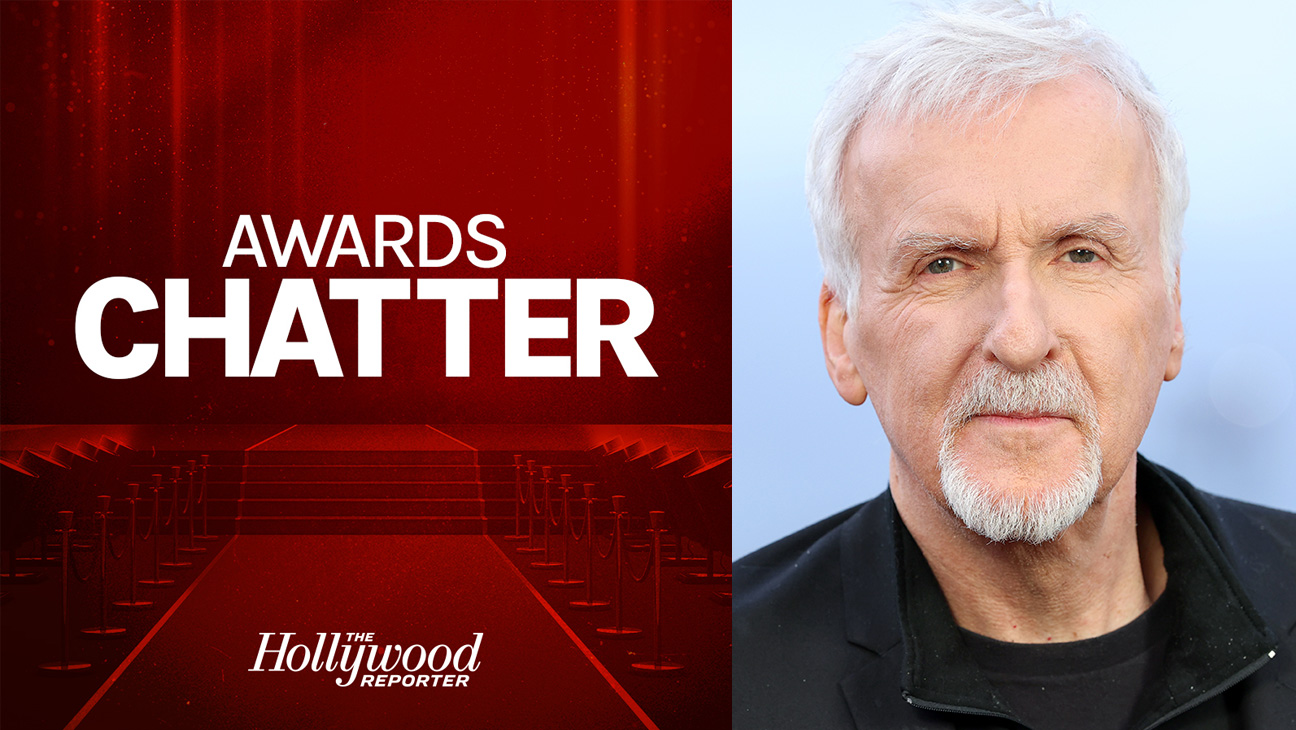


James Cameron, our guest on this special episode of The Hollywood Reporter’s Awards Chatter podcast, is a director, writer, producer and editor who is one of the most commercially successful filmmakers of all time, with credits including 1984’s The Terminator, 1986’s Aliens, 1989’s The Abyss, 1991’s Terminator 2: Judgment Day, 1997’s Titanic, 2009’s Avatar, 2022’s Avatar: The Way of Water and, most recently, 2025’s Avatar: Fire and Ash, which has topped the domestic box-office all four weekends since it opened on Dec. 19, has grossed $1.23 billion worldwide, and is still going strong.
A showman of the first order — really, a modern-day Cecil B. DeMille — Cameron has been named one of TIME’s 100 most influential people in the world and, in the words of The Guardian, “has the singular ability to see the future, at least as far as the movies are concerned” and has “been persistently, uncannily ahead of everyone else in the industry.”
The narrative features that he directed prior to Avatar: Fire and Ash collectively grossed $8.7 billion, more than any other filmmaker’s output save for Steven Spielberg’s. They include three of the four highest-grossing films of all time: Avatar, which, 16 years after its release, remains the top-grosser ever with $2.9 billion in receipts; Avatar: The Way of Water, which is in third place at $2.3 billion; and Titanic, which for 12 years was the highest-grossing film of all time, but now places fourth at $2.26 billion. Moreover, Titanic was the first film to gross over $1 billion; Titanic and Avatar were the first two films to gross over $2 billion; and Cameron is the only filmmaker to have helmed three films that each grossed more than $2 billion.
But Cameron’s films have not “only” been embraced by the public; they are also revered by his fellow filmmakers (as was evident during the recently-posted THR Directors Roundtable). He has thrice been Oscar-nominated for producing, for Titanic, Avatar and Avatar: The Way of Water; twice been Oscar-nominated for directing, for Titanic and Avatar; and twice been Oscar-nominated for film editing, also for Titanic and Avatar. Three of those seven Oscar noms resulted in wins on a single night, in 1998, when he took home statuettes for editing, directing and producing Titanic, and was within his rights to feel like “the king of the world.” And he may well be back at the Oscars in March for Avatar: Fire and Ash.
Over the course of a wide-ranging conversation at the LA offices of The Hollywood Reporter, the 71-year-old reflected on how he started down a blue-collar career path and then got redirected to a career in filmmaking; the origins of his fascination with the environment and technology, and how those interests fed into most of his filmmaking ventures; what inspired him some 30 years ago, before the release of Titanic, to begin jotting down ideas that would become Avatar once technology caught up to his vision, and to devote much of the next three decades of his life to further developing that story into three epic films; plus, much more.
Here are a few excerpts from the conversation, which you can hear in full via the audio player near the top of this post or on any major podcast app.
On the showings of the previous two Avatar films at the Oscars (the first was nominated for nine Oscars, including best picture, which it lost to The Hurt Locker, and best director, and won best art direction, cinematography and visual effects; the second was nominated for four Oscars, including best picture, which it lost to Everything Everywhere All at Once, and won one, best visual effects)
“Look, we’ll never know [with the first one], ‘Did we lose by one vote or 500?’ But we were there. We were in play. We weren’t in play at all on Avatar 2, and I consider that to be, in many ways, the most beautiful film that I’ve ever made. I won’t say I wasn’t disappointed, but I will say that my analysis of it after the fact, seeing what happened with the writers strike and how everybody went to the mat over fear of AI — I think that our filmmaking community, not understanding how I make these films and thinking ‘Oh, it’s made by computer and they’re probably usual generative AI and it’s probably a complete perversion of the acting process and blah-blah-blah,’ you can kind of write the script for that. I think we got hit by an anti-AI backlash on that, even though we don’t use the stuff! We’ve never used generative AI — there’s not one image in the new film that was created by generative AI. I think we just got painted by a very broad brush and a backlash at that moment. Now, that said, people may have legitimately just not thought the movie was good. I happen to think it was fucking good enough. It was good enough, guys!”
On his annoyance at being constantly asked whether Leonardo DiCaprio’s Jack could have actually fit onto the raft that was carrying Kate Winslet’s Rose in Titanic
“Don’t ask me about the fucking raft, people! Look, we even went to the lengths of doing an experiement to see if Jack could have in any way survived, or if they could have both survived, and people didn’t even hear the answer when I told them the answer: the answer is, if Jack somehow was an expert in hypothermia and somehow knew what science now knows back in 1912, it is theoretically possible, with a lot of luck, that he might have survived. So therefore, the answer is no, he could not have. There’s no way. The conditions were not met. He couldn’t have known those things.”
On “vicarious experience,” which he first explored in Kathryn Bigelow’s 1995 film Strange Days, which he co-wrote and produced, and later revisited in the Avatar films, which he had been developing around the same time
“Well, social media is basically vicarious experience now. I mean, the technology is very different than what we showed in Strange Days, but [it provides] that sense of voyeuristically eavesdropping or sharing your life. Everybody wants everybody to follow them and see what they’re doing — the whole influencer culture — so Strange Days did anticipate a lot of that stuff. It just seemed like a natural outgrowth of where media was going, to me. I mean, I was steeped in science-fiction, and in the science-fiction literature at that time, what was leading the pack was the cyberpunk genre — you had Neuromancer and things like that. So this seemed like it was in that general zone. It wasn’t about cyberspace at all, but it got lumped in with cyberspace moviesthat year, and I think it suffered from that because peoplethought it was like a VR [virtual reality] thing, and it wasn’t VR at all. It was actually direct recording. So it really had a lot more in common with social media and how we don’t have any privacy anymore. We just show everybody everything — I don’t, but so many people do — and you’ve got a whole generation now that’s grown up with that sense of privacy-optional. So I think it was anticipatory. It was a little ahead of its time. Kathryn related to it. She comes from a very intellectual art background and, for her, the semiotics around it were about scopophilia, watching. She and I both made the connection to Peeping Tom, which was a murder mystery, a quite graphic film about a guy who films the act of killing. We said, ‘All right, we’re going to do Peeping Tom, but a science-fiction version of it.’ We knew exactly what our reference point was with that, and we were both kind of enamored of this idea of the long-running sort of POV master and trying to figure out how to do that. So we both got excited about it from a visual perspective and from a storytelling perspective. She proposed that because we’d been through the [LA] riots — ‘Is there a way to ground us in events as we’d seen them play out in LA?’ We set it in LA. So it just all came together around creative conversations between me and Kathryn. We always worked well together. We’d already done Point Break together when we were married, and now we didn’t have any direct relationship other than creatively, a writer/producer with a director. I believed in her 100,000 percent. It just seemed like such an exciting experiment, which it was, but it didn’t get any love. I think it got lost in the shuffle of three or four other kind of cyberspace films of that year — Lawn Mower Man, Gnat, 13th Floor — there were a bunch of them right then.”
On his upcoming Billie Eilish concert film
“The Billie Eilish project just popped up like a mushroom in the backyard popping up overnight. I was talking to Billie’s mom, Maggie, who’s really into a lot of the same food choice and sustainability issues that my wife Susie and I are. That’s why we’re vegan and Maggie’s vegan. She does food programs around Billie’s tour, and she’s coming in as an executive producer on our sequel to The Game Changers, which is about plant-based athletes. We’re going to do that in 3D, and she was looking at a 3D demo that I was doing, and I said, ‘Maggie, why aren’t we shooting Billie’s tour in 3D? It’d be amazing!’ She said, ‘Well, I’ll ask her.’ One thing led to another, and Billie and I, we have a good vibe together, we really communicate well for some reason. She thought it was a cool idea, and so I offered her co-directing with me because she’s the architect of that show. If you see that show, it’s astonishing. It’s so beautiful, and it’s such a great platform for her, and I wanted to shoot it in 3D. I just thought it’d be fun. So I snuck out back in August and did that for a couple of weeks in England. We did four shows, and then we just shot two more shows a few days ago.”
Read the full article here