

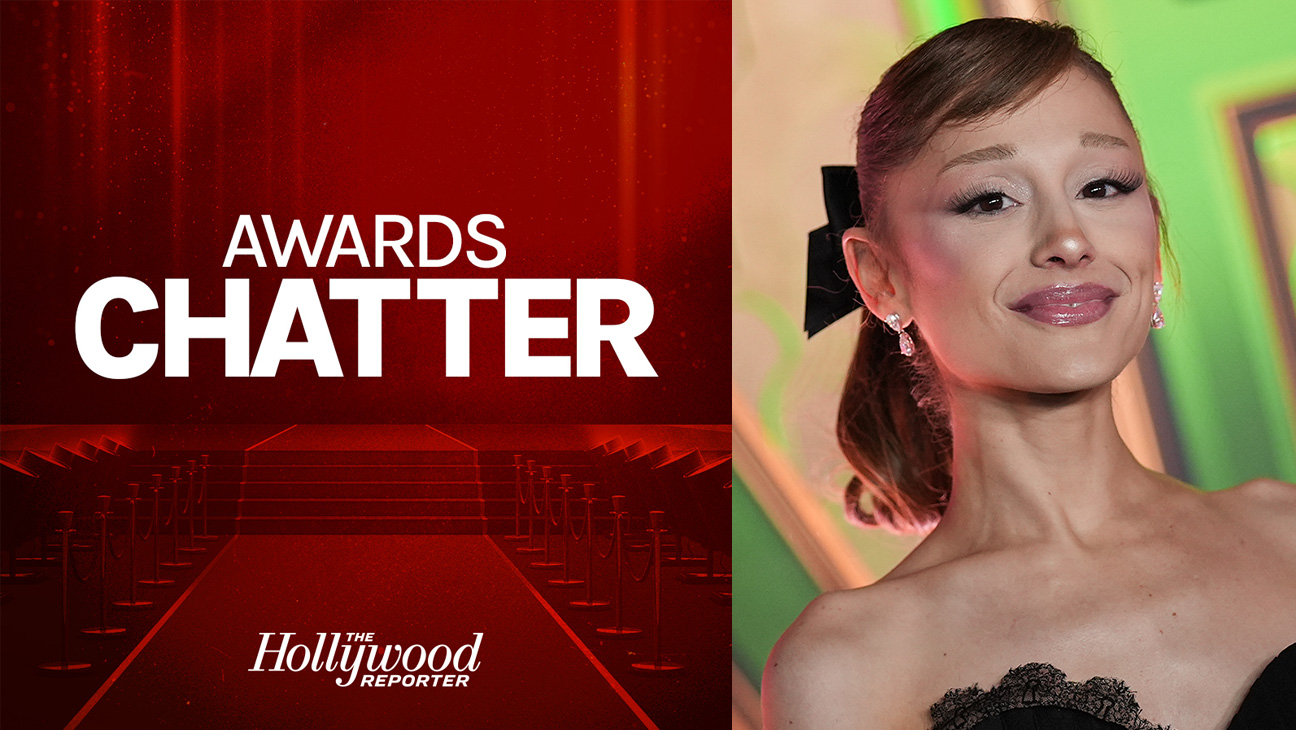


“Professor” Ariana Grande, our guest on this episode of The Hollywood Reporter’s Awards Chatter podcast, which was recorded in front of an audience of 500 film students at Chapman University, is having an incredible year (again). Hot on the heels of her acclaimed portrayal of Gahlinda — or Glinda — in the 2024 blockbuster film adaptation of the Broadway hit musical Wicked, she returned to the part in its 2025 sequel, Wicked: For Good, and garnered even better notices, as well as nominations for Critics Choice, Golden Globe and Actor awards. She is now poised to become just the seventh performer ever to land Oscar noms in multiple years for playing the same character, and only the second to do so in back-to-back years.
Remarkable accomplishments are nothing new for the 32-year-old, who, among other things…
- has been named one of TIME magazine’s 100 most influential people in the world twice
- was Spotify’s most streamed female artist of the 2010s — despite only making her debut three years into the decade
- was the first artist ever to have the lead single of each of her first four albums debut in the top 10 of the Billboard Hot 100
- has had a total of 23 singles crack the top 10 of the Billboard Hot 100, nine of which went to #1 — “Die for You,” “Thank U, Next,” “7 Rings,” “Save Your Tears,” “Stuck with U,” “Rain on Me,” “Positions,” “Yes, And?” and “We Can’t Be Friends”
- has had nine albums crack the top 10 of the Billboard 200, six of which went to #1 — Yours Truly, My Everything, Sweetener, Thank U, Next, Positions and Eternal Sunshine
- has been nominated for 19 Grammys — including a pending nom for best pop duo/group performance, for “Defying Gravity,” shared with her Wicked and Wicked: For Good costar Cynthia Erivo — winning two, best pop vocal album for Sweetener in 2019 and best pop duo/group performance for “Rain on Me” in 2021
- was ranked #9 on Billboard’s 2024 list of the 25 greatest pop stars of the 21st century, with the magazine hailing her “enduring, generational talent”
- was ranked #43 on Rolling Stone’s 2023 list of the 200 greatest singers of all time
Just as remarkably, she has endured — and been there for her loyal fans, known as “Arianators” — through thick and thin, including tragedies that would have felled many others, such as a 2017 terrorist attack outside of a concert that she had just completed in Manchester, England, which claimed the lives of 22 attendees; and the premature loss of a loved one and collaborator, Mac Miller, in 2018.
Indeed, she emerged as a beacon of light in the film versions of Wicked, an offshoot, of course, of The Wizard of Oz, with which she fell in love when she was still Ariana Grande-Butera, a diminutive community theater kid from Boca Raton, Florida, who loved Judy Garland’s Dorothy in the 1939 film and then, while on a trip to New York with her family when she was 10, saw a performance of Wicked on Broadway with the original cast that mesmerized her.
When the film adaptation finally began to come together, she fought to be considered for it. When she got the part of Glinda, she insisted on playing it as it has always been, as opposed to having it tailored for her. And when she played the part, she brought to it a rare understanding of the pros and cons of being “Popular” — and crushed it.
Over the course of this conversation, Grande reflected on a wide variety of topics. You can hear the full conversation higher on this page or via any podcast app. Key excerpts, lightly edited for clarity and brevity, appear below.
On her early dreams of Broadway, which led to her debut on the Great White Way in Jason Robert Brown’s musical 13
“I hoped to be a Broadway performer my whole life long. That’s what I thought would happen. But my dear friend Liz Gillies, who played Lucy in 13, she and I put ourselves on tape for an untitled Nickelodeon project while we were doing 13 on Broadway. And the day after 13 closed, we had a callback for the untitled Nickelodeon project. So we both got on a plane together with our moms and flew to LA and had our first callbacks for whate ventually became Victorious.”
On her own music coming into the picture
“While I was shooting Victorious and Sam & Cat, I was simultaneously working on ym first album, Yours Truly, the whole time. We would shoot these long days on set, working full adult hours, 12-hour days, and then we would go to the studio and write music. And I sort of collected songs ove rthe course of three years. My debut album took some time to figure out because there was also a strange kind of presence from Nickelodeon in my head at the beginning, like, ‘What should this project be? Does it have to be related to the person that they’re familiar with from the show, or can it be a completely separate thing?’ And I’ve never talked about this, but actually Malcom, who you might know as Mac, encouraged me to be myself, and that it was okay to shed that character and embrace my brown hair and make R&B-influenced pop music and separate and do the brave thing. I’ve never said that, but it was a great influence. I’m very thankful for that. That’s also why I was so eager to ask him to be a part of [‘The Way,’ the first song anyone heard from her first album], not only because he was perfect for the song, but I also felt like I had him to thank for finding my sound.”
On trying to juggle acting and music in those early years
“There was definitely a time when it was hard to do both at the same time. Logistically, it was quite crazy. I remember before the red wig entered the chat, when it was actually dyed red, there was a time when I was performing on the weekends as Ariana Grande, and I would have to tone my hair brown on Friday night after we wrapped filming. And then late Sunday night, I would have to do a clarifying rinse to try and get the red back for Monday morning to be on set at 6am or whenever I was supposed to be there. But Sam & Cat ended after a while and then naturally I was able to give more of myself to the music.”
On landing the part of Glinda in the Wicked films
“I was so desperate to even be seen for an audition. I heard murmurings of it, and I told my team then, ‘I would love to know if anything’s happening. When it’s happening, please tell me, because I will fly in for an audition. I will do anything. I will throw myself into it. I begged for them to see me. And in my first audition, I sang for both roles. I sang ‘No One Mourns the Wicked,’ ‘Popular,’ ‘Defying Gravity’ and ‘The Wizard and I.’ I did both songs twice. But, I mean, I was very obvious when I came in [about which part I wanted] because I had a pink thermos and a pink shirt.”
On returning to acting, for the Wicked films, after a long time away from it
“I had a long chunk of time — it was almost a decade — where pop music was the only thing. And I think my soul was aching for the acting piece. I just missed it so much. I think the break really fed me and informed me in a huge way. And spending time with Glinda was such an amazing gift. I learned a lot about my own craft. And I feel like it reconnected me to creating. It healed something that got disconnected along the way. The way that pop took over was something I wasn’t ready for.”
On singing as Ariana vs. singing as Glinda
“It’s just a very different style of singing. I have a muscial theater background. I trained when I was a young girl. I’ve sang classically in my life. But never like this. And there was a large period of my life where I was singing pop and using mostly my mix and my belty range or whistle notes — and whistle notes are not the same as operatic soprano, coloratura, that sort of warm classical sound. The vibrato and the tone is completely different, so I had to do a lot of extensive vocal training. I started three months before even my first audition, because I wanted to make sure it sounded legitimate by the time I got there.”
On upping her acting game to play Glinda
“I worked with an incredible acting coach, Nancy Banks. She’s a healer as much as she’s anything else. We discovered, through our lessons that we started a long time before I got the part, that I was really responding to the Stella Adler method. I wanted to design a completely, fully fleshed-out, life for her, kind of an internal mapping of all of her emotional wounds and triggers, so that I knew her well enough that in the comedic moments, there was a person with insecurities and little wounds underneath the comedy. And then in the second movie, you get to kind of see those come to the surface and to see her breaking point. It was really effective for me because I feel like having to use my own triggers — I don’t love doing that when it comes to acting, I find it a little bit distracting. I know everyone has their own things, and different things work for different people, but for me, I find it much more effective if I can just be Glinda and use Glinda’s triggers.”
On relating to Glinda
“When I’m talking about her journey, I have to really specify, because there have been certain moments in our lives that are really adjacent. I’ve experienced a lot of grief. I’ve experienced a lot of loss. And I also know what it feels like to perform through it, as a coping mechanism. I think that’s kind of what she’s doing a lot in this second movie especially. So yeah, it feels tricky. I had to really put that away and go deep on designing what her traumas and her experiences were, so that I could use only those.”
On shooting the two Wicked films at the same time, out of sequence
“It was pretty crazy. We would be doing something at Shiz, as like young school students, in the first half of the week, and then in the second half of the week I would be sobbing in a closet grieving my best friend. The emotional gymnastics were crazy, but in the best way — in a way that I would do again any day. Just the most delicious challenge.”
On the roots of her comedic gifts, which are on display in not only Wicked, but also her appearances on Saturday Night Live
“Trauma. Darkness. No, I’m kidding. My dad and I loved watching comedies together when I was little. It was so bonding. It felt like a connective language that he and I spoke. We loved all the same comedies and it just made me feel really close to him. So, just being a student of the great Christopher Guest movies, of SNL, of Adam Sandler and Ben Stiller and Jim Carrey. And Jennifer Coolidge.”
On originating the Stephen Schwartz song “The Girl in the Bubble” (which has been shortlisted for the best original song Oscar) in Wicked: For Good
“it’s the most daunting thing in the world to hear that you’re going to originate a Stephen Schwartz song for a Wicked movie — but I was excited. When I heard it and I discovered that it was this beautiful narrative piece, this very vulnerable thing, I was really grateful, because Glinda is a very complicated woman. I can’t judge her because I have to love her to play her — but she starts off in a place that’s not great. She’s a little superficial, a little insecure, a little bit ignorant, privileged in her bubble. And to get to spend that moment with her where she is finally able to make a real change and become better is a privilege. I’m so happy that that’s what that song is, that moment with her, because in the show you see her before that choice is made and after that choice is made. But I think letting the audience spend that moment with her, and especially starting it in utter silence, is a beautiful thing and it’s a layer of context that she deserves as a character — it humanizes her and it lets people in. And also, what I love about it is it emphasizes her loneliness in this movie. Elphaba is literally alone and is experiencing extreme loneliness, but Glinda is surrounded by so many people and so much noise and so many strangers validating her worth and telling her that she’s so goodly and all of this bullshit, when she knows that this isn’t it yet, there is more. “I need to be doing more. I can’t be complicit in this regime. I can’t be perpetuating this narrative against my best friend. I have to do the right thing.” She feels an emptiness. She’s suffering for much of this story, even though her dreams have come true. She’s really suffering and she’s very alone. And I love that sonically, this song also tells that story too.”
On the politics of the Wicked films
“The Wizard of Oz has always been political. L. Frank Baum [the author of the 1900 book that inspired the 1939 film] did not shy away from it, and Gregory McGuire [the author of the 1995 book that inspired the musical Wicked] certainly didn’t shy away from it. When the original show came out, that was the conversation, about how much the world needed it at that tie. And we’re still having that conversation today, and then some, because somehow things are even worse than they’ve ever been. I really like that it challenges people to take a look at themselves. And I think Glinda is kind of an example that it’s never too late — you really can turn it around for people and become a better ally, become empathetic, take a look in the mirror. A lot of people are more like Glinda than they’d care to admit. I think it’s an invitation to take a look at how we canshowup better for our neighbors, people we love, and people who are in vulnerable positions right now and are afraid.”
On Eternal Sunshine, her seventh and most recent studio album, which was made during the writers strike that forced a pause in production on the Wicked films, was released in March 2024, and inspired her upcoming return to touring after seven years away
“I wasn’t doing any music at all while we were filming Wicked —I kind of put it away. I did not enter a studio. I didn’t write anything. I tried my very best to literally erase that part of my life. It wasn’t until the writers strike happened and we had to stop — but I don’t really know how to stop, so I came to New York and I sort of thrust myself into the studio, because I have just having big feelings and I needed a place to put them. And then I wa spretty much done with it by the time the strike was over and we got to go back and finish the films. And when I got back, thankfully Glinda was still there waiting. I think my experience with Glinda definitely informed Eternal Sunshine in a million ways. It healed my relationship to music — I wasn’t sure if I would do it again before I left for Wicked, I didn’t know that I wanted to or that I would want to. I had some wounds that needed space and therapy and looking at before coming back to music. So I don’t think Eternal Sunshine wouldhave happened without Glinda. She definitely informed Eternal Sunshine, but Eternal Sunshine didn’t inform Glinda.”
On other things that influenced Eternal Sunshine
“With Eternal Sunshine, I was listening to a lot of the Beatles, I was listening to a lot of Rubber Soul [the Beatles’ 1965 album]. Little tiny musical tie-ins that you would never pick up on when you listen to the album are woven throughout… When I wrote [the single] ‘Eternal Sunshine,’ I said, ‘Oh, well, that’s the centerpiece of the album and that has to be the title.’ And all of the songs coincidentally mention rewriting things, ‘erasing you,’ all fo the things that are coincidentally what that [2004] film is about… A lot of my favorite writing is on Eternal Sunshine.”
Read the full article here