


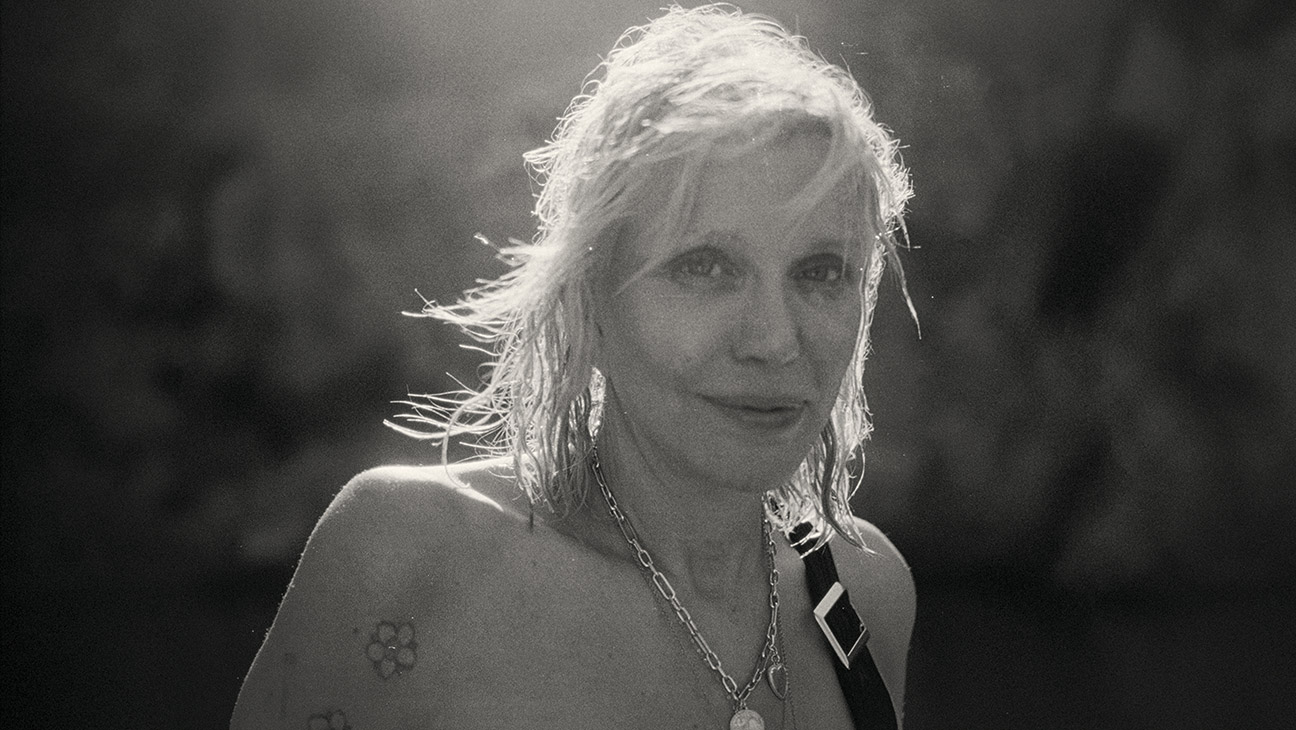

Of the many insights into turbulent genius Courtney Love in Brit filmmakers Edward Lovelace and James Hall’s adoring biographical doc Antiheroine, the most captivating is the alt rock queen’s sense of humor about her reputation as a wild-child wrecking ball with an endless catalogue of messy transgressions. “Everyone has a Courtney story,” she says early on with a shrug. “She fucked my boyfriend. She stole my grandmother’s wedding ring. She ate my muesli.” Love is not interested in denying or confirming any of these claims, and it’s her unapologetic, unfiltered candor that makes her a great hang.
If you’ve ever screamed along or jumped around in your underwear to “Violet” or “Olympia” — no, that’s not a confession — you are sure to find this exploratory step back into the spotlight thrilling. It’s an overdue reaffirmation of Love’s place in rock history with an intimate glimpse into her creative process, especially as a lyricist, while she works on her first album of new material in more than a decade.
Antiheroine
The Bottom Line
An unholy icon sheds her celebrity skin.
Venue: Sundance Film Festival (Premieres)
With: Courtney Love, Michael Stipe, Melissa Auf der Maur, Eric Erlandson, Patty Schemel, Billie Joe Armstrong, Butch Walker
Directors: Edward Lovelace, James Hall
1 hour 38 minutes
“I’m a household name stuck in 1994,” Love says, referring to the year that, within the same week, her husband Kurt Cobain died from a self-inflicted gunshot wound to the head, and her band, Hole, released the angry howl Live Through This, one of the best and most ageless albums of the ‘90s. Vilified by the press and detested by Nirvana fans, Love says that when the jokes started about her having killed Cobain, she knew that was going to be her whole life from then on.
In allowing their subject to tell her own story, Lovelace and Hall make it clear that Love refuses to see herself as a victim. She owns the charges of being abrasive, rude, scrappy, ferociously ambitious and a complicated figure in music history. But the fearlessness and determination with which she pulled herself back up from the depths make her a survivor, one whose music served as her armor through drug addiction, illness, controversy and everything else the world could throw at her.
Even when defending her talent, so often unfairly written off, Love seems unconcerned about being liked. Of the artistic intent behind Hole’s 1991 debut album Pretty on the Inside, she says: “It was me announcing that I was a great fucking poet, and me announcing my persona as a cunt.” Her longtime friend Michael Stipe puts her in the Marianne Faithfull school of women in music: “Fuck you, this is who I am.”
The recap of Love’s early life is brisk but illuminating. Born in San Francisco in 1964, she grew up in what she describes as a countercultural household. Her father lost custody for giving her LSD at age four. She had her first drink at age 10, when a stepfather she calls “evil” deliberately got her smashed and made her sick for days.
Her narcissistic mother moved the family to New Zealand in 1973, but Love was sent back to live in Portland with family friends after being expelled from school for bad behavior. At age 14 she was arrested for shoplifting a Kiss T-shirt and sent to a juvenile hall for a spell, where a counsellor gave her a copy of Patti Smith’s seminal Horses album, which Love says changed her life.
All this is related first-hand by Love, and an occasional detail here and there gives the vague impression that too many fried brain cells have made her an unreliable narrator. It’s unclear at times if it’s the punchy edit (Jinx Godfrey, Dan Setford and Daniel Lapira are credited in that role) or Love’s attention span that keeps the conversation bouncing around.
But the trajectory is raw and real, at times making you wonder how Love even made it into her 20s. And irrespective of how much her mind pings from one thing to another, often sparked by journal entries that bring the past to life, the doc leaves no doubt that her intelligence, humor and drive are what have kept her going.
She shares youthful memories of hanging out with and learning from post-punk bands in Liverpool like Echo & the Bunnymen and The Teardrop Explodes, whose frontman Julian Cope Love says taught her how to walk into a room and behave like a rock star.
She started playing guitar in 1980 and moved back to San Francisco, already knowing how to get famous, in her own words, and just needing money and discipline to get there. The movie makes a cogent case that being a rock star was wired into her metabolism rather than something she methodically set out to do.
Even brutal experiences became fodder for her creativity, like a near rape from which she ran in a ripped dress with one shoe back to her Hollywood Blvd. apartment, then picked up her guitar and wrote Hole’s 1990 debut single, “Retard Girl.” Hole has long been acknowledged as an important feminist band, which is validated by a back catalogue of unflinching songs about sexual politics, exploitation, misogyny and objectification. Love is the composer of “Doll Parts,” after all.
She is forthright about her drug use and addiction, whether to heroin or fame, and credits Milos Forman with saving her life when he fought to cast her in The People vs, Larry Flynt and later in Man on the Moon, sending her to rehab to get clean before the first movie.
The real meat of the doc, for many, will be Love’s thoughts looking back on her relationship and marriage with Cobain, captured in affecting archival images and home movies. Music, talent and mutual admiration were their magnet, and Stipe describes the couple as “these two intelligent, raw people riffing off each other in a beautiful way.”
Love talks about the common experience of parental rejection that drew them closer; about the dream of their wedding in Hawaii like “being on acid;” and she tenderly recalls a tranquil period after the birth of their daughter, Frances Bean Cobain, when they retreated to Washington state and found a bubble of happiness out of the public eye.
This idyll occurred because the family was forced to leave California — when custody of Frances was at risk after allegations emerged in a Vanity Fair profile that Love was doing drugs while pregnant. (Love points out that she took weekly drug tests throughout her pregnancy.) But that contradiction between public vilification and private peace is part of the mystique surrounding their marriage.
There’s clearly still a lot of pain as Love speaks ruefully about how she ultimately was better equipped for fame than Kurt, who craved oblivion and found it too easily. Hole bassist Melissa Auf der Maur recalls heroin being everywhere when the alternative grunge scene was cresting, and the sight of people shooting up backstage was not uncommon. Cobain overdosed on Rohypnol and spent three days in a coma in Rome the year he died, while Nirvana was touring Europe.
The torture of knowing Kurt tried to call her at the Peninsula Beverly Hills, and the desk staff failed to connect him despite Love’s instructions to put him through at any time, obviously still haunts her. She considers that the moment he died.
Self-pity is not in Love’s vocabulary, but band members and friends talk about how the Hole touring schedule, right after Cobain’s suicide, gave her no time to grieve. There are moving accounts of her delivering 100 percent onstage and then crumpling backstage, “a broken, tortured person trying to overcome the pain of her entire life.” The lack of humanity from people determined to make her the villain left scars.
The film drifts over much of the past two decades except to say that Love stayed clean, turned to Buddhism and rediscovered her need to write music after decamping to London. There’s a brief discussion of Frances obtaining legal emancipation from her mother in 2009, when she was 17, and the daughter’s absence among interviewees is conspicuous. Love volunteers that she was no picnic as a parent, though her joy at one point when she’s flying off to California to see her grandson hints that there’s been at least some degree of repair to the relationship.
There are other notable absences, including collaborators like the Smashing Pumpkins’ Billy Corgan, who co-wrote several songs on the 1998 Hole album Celebrity Skin, including the hits “Malibu” and the title track, and helped smooth the band’s transition into a more commercial pop-punk sound. (Love amusingly calls it “my dark Fleetwood Mac record.”)
But Lovelace and Hall make no claim of presenting an exhaustive chronology, mostly leaving it to their subject to go where her reflections take her. That predominantly becomes the new album, which is still in the works, with no news of completion or a release date. Stipe, who co-wrote some of the new songs, confidently calls the album a classic: “We’ll see how the world responds to it.”
After years of sitting it out as other people told her story, at times with gross misrepresentations, Love just wants to get the album right and have her say in music, which she points out is the only way anyone will listen to her. The fragments of the new songs we hear — either tinkering away on them at home or laying down vocals in the studio, at one point with Auf der Maur in a gorgeous reunion moment — sound promising.
Says Love: “I got kicked out of the party and now I’m coming back after a very long time.” I won’t be the only one rooting for her renaissance.
Read the full article here