






At first, the idea of horses and wheelchair users might sound like an unlikely combination.
Yet, with the Hayday with Horses programme, this pairing is exactly what’s happening — and for a 76-year-old nursing home resident Jimmy Lau, otherwise known as Uncle Jimmy — it’s become something to look forward to for the past 10 weeks.
For those who aren’t familiar, Haydays with Horses is Singapore’s first equine-assisted programme launched earlier in February this year.
The pilot programme is a partnership between Temasek Foundation, Equal (a non-profit organisation focused on animal-assisted services), NTUC Health, National University of Singapore and the Intitute of Mental Health.
It aims to harness the “therapeutic power of horses” to improve the overall health and wellness of seniors like Uncle Jimmy.
The programme includes bringing the senior participants to Equal’s horse stables at Upper Thomson, as well as bringing the horses to active ageing centres and nursing homes, which allows participation even for residents that have limited mobility.
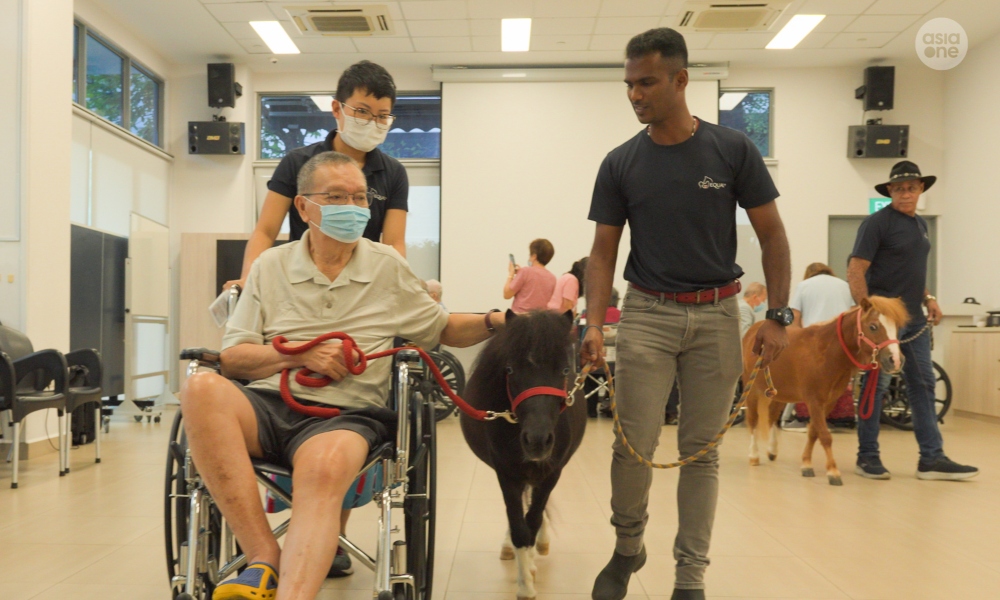

After recovering from a mild stroke in 2019, Uncle Jimmy had a fall at home which led him to become a wheelchair-user. He currently resides at NTUC Health’s Jurong West nursing home as part of his recovery.
For someone who used to be a passionate golfer and who enjoys being out and about, this transition to a quieter and more sedentary lifestyle at was difficult to deal with, often leaving Uncle Jimmy feeling “bored”.
But Uncle Jimmy finds joy in the programme, expressing to AsiaOne that he enjoyed the change of scenery beyond the nursing home’s four walls and interacting with the horses at the stable every week.


Additionally, it also aids in his recovery.
“Playing with the horse and feeding the horse, that’s a form of exercise,” he said.

According to a study published on National Institute of Health’s (NIH) National Library of Medicine, equine-assisted therapy has shown positive effects in patients with cerebral palsy and other psychomotor disorders.
This includes improvement in balance, range of movements, postural control, functionality and motor control, as well as in cognitive, sensory and emotional capacities.
No words needed
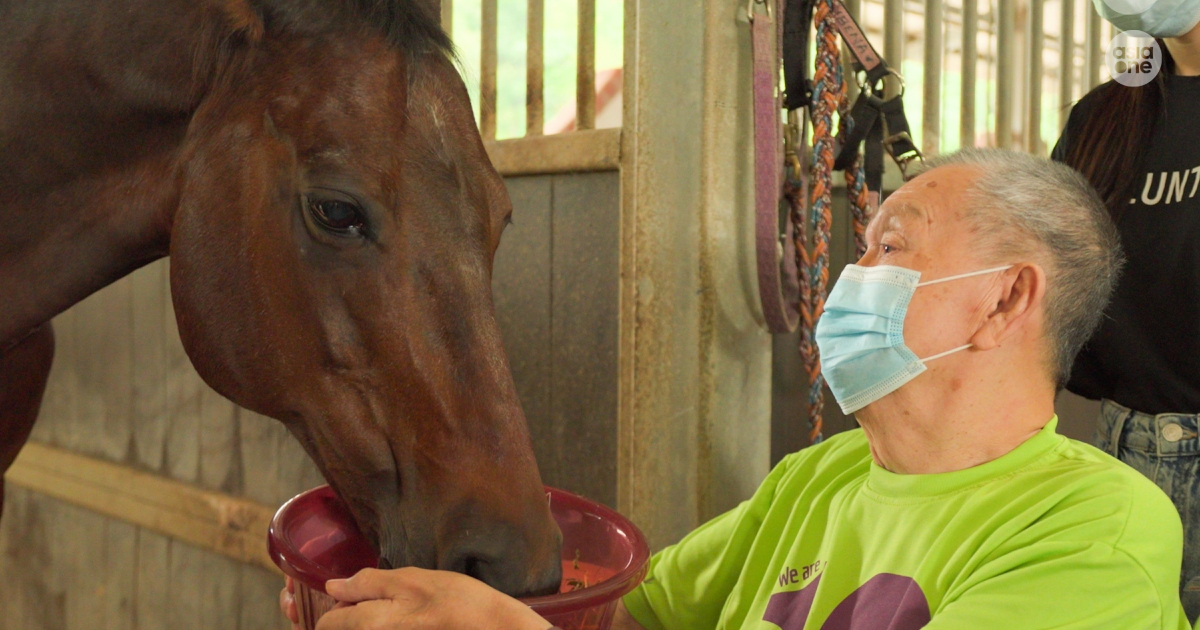
Throughout the programme, Uncle Jimmy’s favourite activity is feeding the horses and seeing how it makes them happy.
“You see the way they really love to eat the food,” the 76-year-old said. “You see them enjoy the food, you will also [be] happy.”

During the programme, seniors were also taught how to observe a horse’s body language as a way of understanding and communicating with them — such as allowing them to sniff a person as a first step in getting to know them.
Recalling an interaction with Falco — a horse residing at Equal’s stable that Uncle Jimmy is particularly fond of — the 76-year-old expressed that he thinks, or hopes that the horse remembers him.

“When I put my hand [to him], first time, he smelled it for a longer time. The second time we went [to the stables], he just smelled it for a bit and he knew already,” said Uncle Jimmy.
Love for animals
For animal lovers like Uncle Jimmy, who used to have a dog named ‘Boy boy’, the equine-assisted therapy programme provided more than just healing for his mind and body, it also reminded him of fond memories with his past pet.
“When you play with the horses and pet them, it’s just like petting a dog,” he explained.

And these interactions with horses might be able to help many more beyond animal-loving individuals like Uncle Jimmy.
A study published on Science Publishing Group showed that equine-assisted therapy can help to enhance mental health, having been proven to be able to address various conditions like anxiety, depression and autism.
[[nid:718460]]
carol.ong@asiaone.com
Read the full article here