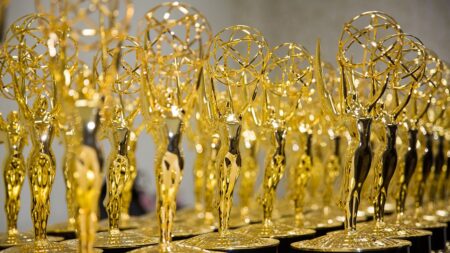

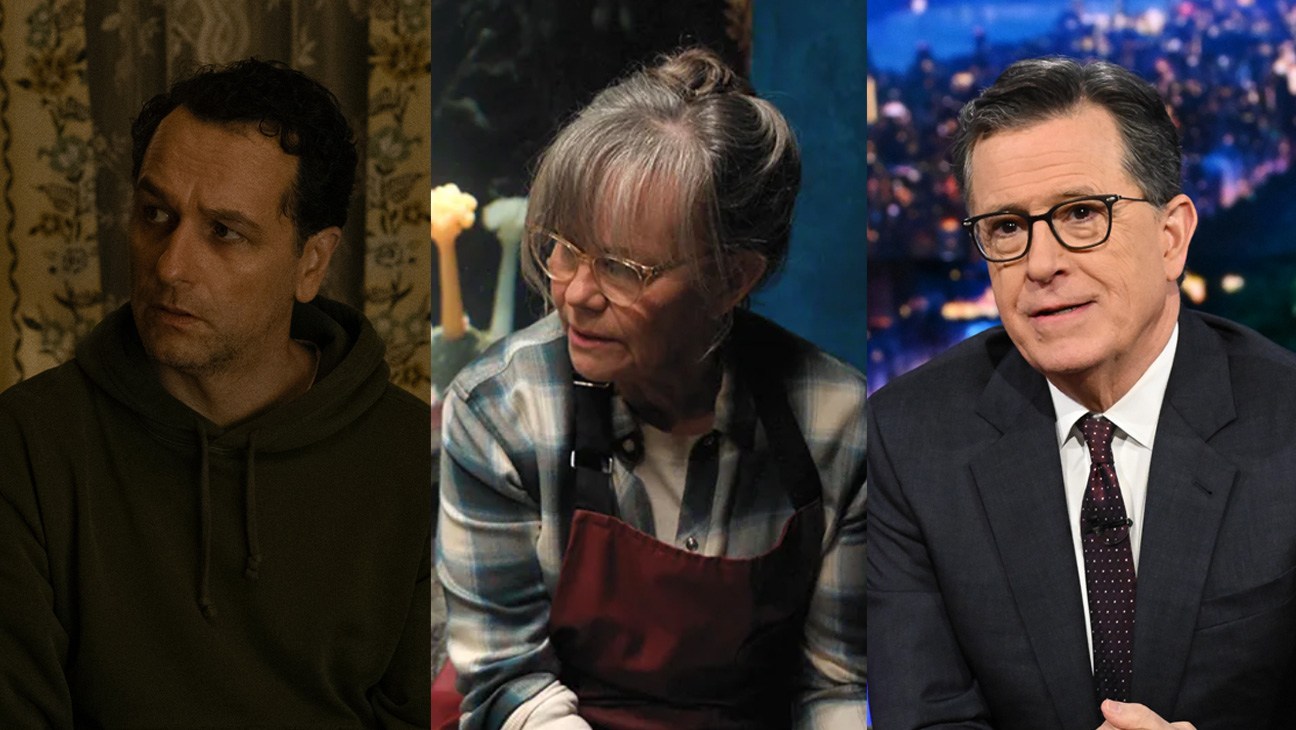

The 78th Primetime Emmy Awards is now in the books, bringing an end to the 2025-2026 TV awards season. Now it’s time to try to figure out why we wound up with the results that we did.
Let’s start with Apple TV’s Widow’s Bay, which essentially swept the comedy categories. Between Monday’s Primetime ceremony and last week’s Creative Arts ceremonies, it claimed a field-leading 14 wins including best comedy series, actor (Matthew Rhys), supporting actor (Stephen Root), supporting actress (Kate O’Flynn), directing (Hiro Murai) and writing (Katie Dippold) — all despite barely registering on anyone’s Emmys radar until well after it began rolling out at the end of April, just one month before the eligibility cutoff. Even the good folks at Apple were fully on the Shrinking train until momentum really began to shift in June.
Rarely, if ever, has a show come out of nowhere so late in the season and then dominated to this extent. Indeed, the only major comedy award that didn’t go to Widow’s Bay was best comedy actress, a category in which Widow’s Bay didn’t even have a contestant. (That one went to Jean Smart, the star of HBO Max’s Hacks, which was the show that most had expected would coast to a best comedy win for its fifth and final season before Widow’s Bay came along, and that still wound up with five more noms than Widow’s Bay did, 24 to 19. Deservedly, Smart is now the first person to win an acting Emmy for every season of her show.)
What explains the Widow’s Bay surge? A few things, I think. It’s a comedy/horror hybrid that debuted in a moment when horror is all the rage; indeed, it was being consumed at the same time that the films Obsession and Backrooms were becoming surprise mega-blockbusters. It’s also fresh, in terms of its story and style and talent, whereas Hacks, in the view of numerous TV Academy members with whom I spoke, had grown to feel a bit stale by the end of its run. (A common refrain was, “How many times can you break up and reunite Deborah and Ava without it getting old?”) And lastly, the TV Academy likes crowning new shows even more than celebrating departing ones — four times versus two over the past decade in the best comedy category, for those keeping track at home.
The folks behind Hacks will be fine — over the course of the show’s run, it was recognized not only five times for Smart, but also once for Hannah Einbinder, once for best comedy, once for best comedy directing and twice for best comedy writing. I feel sorrier for the folks behind Shrinking, which has gotten better as it has gone along, and was up for its best season yet. A second loss in a row for Harrison Ford — last year to Somebody Somewhere‘s Jeff Hiller, this year to Root — is particularly sad, as Ford, who is now 84, couldn’t have a better season than the one for which he was nominated this year. But one can’t begrudge a first Emmy win for Root, whose face should appear in the dictionary when one looks up “great TV character actor.” (Also, he’s 74?! I can’t believe that, but assuming it’s true, it makes him the best comedy supporting actor category’s oldest-ever winner.)
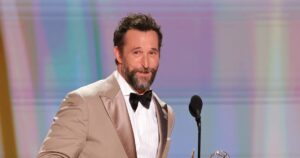
As for the drama categories? A year after HBO Max’s The Pitt won best drama series and actor (Noah Wyle), among other prizes, on the heels of 13 noms, its second season landed a field-leading 25 noms, far ahead of its drama series competition: Apple’s Pluribus (18), HBO’s A Knight of the Seven Kingdoms (9), Apple’s Slow Horses (9), HBO’s The Gilded Age (8), Netflix’s The Diplomat (7), Hulu’s Paradise (7) and Apple’s Your Friends & Neighbors (1). It was always going to win those aforementioned two awards again.
But, interestingly enough, The Pitt was probably its own worst enemy in most of the other major races in which it had a nominee. It accounted for three of the eight nominees for best drama supporting actor and four of the eight for best drama supporting actress, and lost both prizes — a year after winning the latter — to shows that had only one nominee competing for them: the eminently worthy Tom Pelphrey of HBO’s Task and Allison Janney of Netflix’s The Diplomat (whose eighth career win, like Smart’s, puts her into a tie with Cloris Leachman and Julia Louis-Dreyfus for the most acting Emmys for a single performer over the course of a career). Moreover, The Pitt was the only show up for best drama writing that had more than one nom in the category, which, along with sentiment for the great Vince Gilligan, who had somehow never won a directing or writing award, probably paved the way for Pluribus to win that category. (Unlike last year, though, this year The Pitt had no such excuse for losing best drama directing to Slow Horses.)
The most interesting drama race, to me, was the only one in which The Pitt did not have anyone in the running: best drama actress. This one pitted against each other two beloved veterans who had both been nominated many times but had never won: Pluribus’ Rhea Seehorn, who came in with Critics Choice and Golden Globe wins for her show’s rookie season, and The Diplomat’s Keri Russell, who came in with an Actor Award for her show’s third. Seehorn ended up prevailing, probably not by much, and probably in part because her show was new and therefore more exciting to voters (with 11 more noms than Russell’s).
Which brings us to the limited or anthology series and/or movie categories. At last week’s Creative Arts ceremonies, HBO’s DTF St. Louis won best limited/anthology series or movie directing and writing (both Steven Conrad), as well as supporting actor (David Harbour) and supporting actress (Linda Cardellini), and Netflix’s Remarkably Bright Creatures was awarded best movie. It turned out those were accurate harbingers of which way the wind was blowing.
On Monday night, DTF continued to roll, winning best limited or anthology series over Netflix’s Beef (which ended up winning only two sound categories and costumes) and FX’s Love Story (its only win was for casting). DTF, however, didn’t have anyone in the mix for best actor or actress in a limited or anthology series or movie, both of which wound up going to Neflix shows: Rhys won for The Beast in Me (becoming the first person to ever win multiple lead acting Emmys in the same year) while Sally Field won for Remarkably Bright Creatures.
Field’s win, an upset which I predicted, proved the old rule that the eventual winner is often the nominee that is unlike any of the other nominees, in this case a beloved veteran (she was up against four relative youngsters, The Beast in Me’s Claire Danes, All Her Fault’s Sarah Snook, Beef’s Carey Mulligan and Love Story’s Sarah Pidgeon) and the star of a movie (whereas the other nominees all hailed from limited series). This is the first time in 14 years that the category was won by someone who was nominated for a performance in a movie; not many performances in movies even manage to get nominated, so this is a reminder that when one does, attention must be paid.
The biggest mystery of this year’s Emmys, for me, pertains to the result of best variety series. The surprise is not that CBS’s dearly departed The Late Show with Stephen Colbert won — that was bound to happen from the moment Donald Trump put a target on the show — but rather that it was the category’s only winner. When the TV Academy merged talk and sketch shows into one category back in January, it also converted the category into an “area award,” meaning it could produce multiple winners. Instead of voters being asked to identify a single winner, they were asked about each nominee, “Does this nominee merit an Emmy? Yes/No.” Any nominee that reached a 90 percent “Yes” threshold would receive an Emmy, and if no nominee reached the 90 percent threshold, then the nominee with the highest “Yes” percentage would be declared the sole winner.
In other words, the fact that The Late Show was the sole winner means either that none of the category’s nominees met the 90 percent “Yes” threshold or that voters only got behind The Late Show to that degree. I suppose that the former scenario is likelier than the latter, but I must say I’m surprised. It was my impression that multiple shows would have sufficient support to end up in the winner’s circle — HBO’s Last Week Tonight is the TV Academy’s default late night favorite, ABC’s Jimmy Kimmel Live! was also targeted by Trump, and both Comedy Central’s The Daily Show and NBC’s Saturday Night Live also have loyal fanbases.
For those shows, at least, there’s always next year.
Read the full article here