

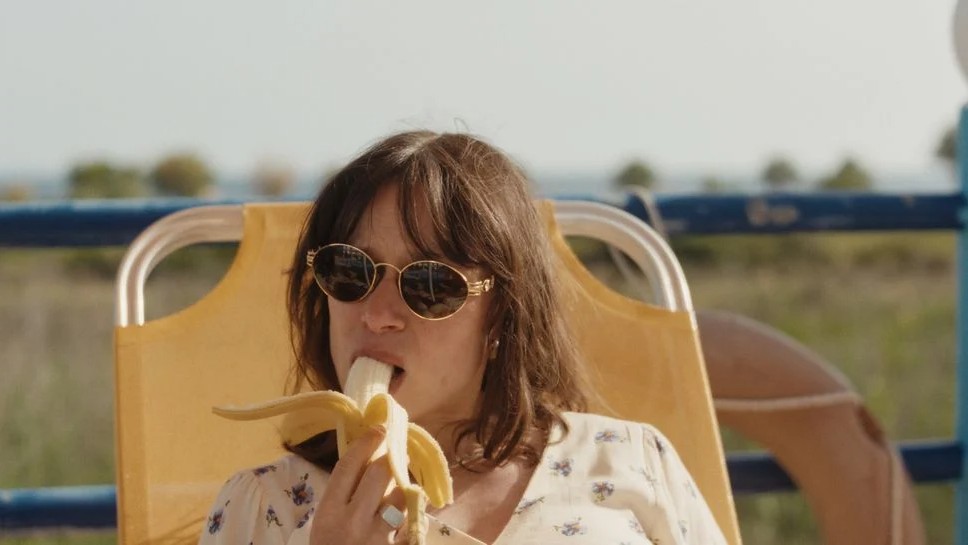

Swedish-Danish writer-director Maria Bäck (I Remember When I Die, Psychosis in Stockholm) likes to push the envelope. With her new feature, Brave New Love, she invites us to talk about love, relationships and desire — but not within the tidy bounds of what’s considered “normal” or “right.”
The film centers on Kate, a mother torn between her husband, Orla, and a secret relationship with another man, Andreas. A triangle of madness? Of sadness? Of badness? Something else entirely? Watch and decide for yourself.
Brave New Love stars Kathrine Thorborg Johansen (Post Mortem: No One Dies in Skarnes) as Kate, Simon Sears (Shadow and Bone) as Orla, young Noemi Carbone Mannov as their daughter Athena, Anders Danielsen Lie (Sentimental Value, Everybody Digs Bill Evans) as Andreas and Angeliki Papoulia (Dogtooth, The Lobster). The film world premieres Sunday, Aug. 9, in the main international competition at the 79th edition of the Locarno Film Festival in Switzerland.
Produced by Anna-Maria Kantariusand and featuring cinematography by Maria Von Hausswolff, Brave New Love was edited by Julius Krebs Damsbo. Reinvent Yellow is handling international sales.
Ahead of the Locarno premiere of the film, Bäck talked to THR about the inspiration for Brave New Love, why she enjoys asking tough questions, working with a cast of actors who have made names for themselves and why the film’s title reminds you of that famous Aldous Huxley novel.
What was the inspiration for Brave New Love?
My interest in all kinds of normative questions has been something that’s been following me forever. I have, for the last 30 years or so, been either in or out of relationships, and my friends have been in or out of relationships. So it’s this huge collection of dilemmas and problems with love life, which has always been something that interests me.
I’m also fascinated by how hard it is for people to confront habits. That doesn’t only apply to love, but when you study something like love, which is so present in our lives, many of these things become very clear because we always struggle with love. And not so much has changed regarding the rules of love in modern times.
When I think about what drove me to make the film, I keep returning to this want and need to share a loneliness and the feeling of “being fundamentally wrong.” It is so human to fuck up; we all do it all the time! And you can feel empathy with — almost — anyone if you understand their inner world.
The film doesn’t come across as a recommendation though…
Yes, the film is not trying to say that you should have an open relationship. I don’t have an open relationship. I live very conventionally in many ways, but it’s just interesting how we can feel like we are very liberal and open, but when we are confronted with reality, things turn out to be different. When you hear of a woman like Kate, a mother who falls in love with another man, most people will have a strong opinion. Even though we might consider ourselves liberal, we all have these [ingrained] ideas, and there is shame — so much is about shame.
I think all these ideas and feelings are deeply rooted in us. We just have all these predefined and automatic reactions, and we tend not to question them much or update our worldview. This human contradiction is just fascinating and amusing to watch in a way. It’s stimulating to explore that with a story and characters, because there’s a lot to dig into.
The only thing I really didn’t want with the film was to create something convenient about love that we’ve already seen before. A love triangle is one of the oldest themes, and I really wanted to challenge that narrative, both story-wise and conceptually in terms of the film’s language. For me, it’s always about questions rather than answers. I feel I know nothing. I just question and doubt everything.
I found myself going from laughing to cringing and thinking, “No, don’t do this!” It was a rollercoaster of emotions. How did you write and “build” the movie and its world?
I worked on this project for six years, so it’s been a long, long process. Like with all my films, usually it starts with an emotion and an abstract universe that tries to become more concrete. In my head, these themes and this character kept circling around. I write a lot and there was a poem I wrote where I pictured this woman. So she came to me. I didn’t know it was Kate back then. But the first picture I had was this naked woman in a cave watching a man, and I didn’t know who she was.
So then you connected her to the themes you were pondering?
Yes, it becomes an investigation, kind of. Of course, I am in charge because I write, but I also feel a lot that I’m following something that I’m trying to understand. Who is she? Where does she come from? So, things usually come to me in the form of different images, different situations. And I also always collect things from my own life that I find fascinating or provocative or just beautiful, and they make it into the film. Such as a balloon scene, for example, in Brave New Love. My son was playing with this balloon when I was hoovering, and all of a sudden the balloon did something I had never seen. That became a little note and then a scene. Some things come from really concrete stuff like that, and other things come from more abstract feelings that I need to translate.
Did you get any help in the writing stage?
What I want to mention about the writing process is my collaboration with Eskil Vogt (Sentimental Value, The Worst Person in the World), who was my script consultant both on Psychosis in Stockholm and Brave New Love. His humorous and generous mind has meant a great deal for the process in terms of asking me disturbing and provocative questions that helped me shape the film. I work a lot with different methods for different stages of writing — sometimes very open and flowy, and then periods with lots of lists and dots and arrows and stuff that I translate into pretty basic, traditional storytelling. But a guide for me is always a strong desire to surprise and do what you don’t expect. I think that is important.
You mentioned shame. I also want to ask you about guilt. There are scenes where I can imagine viewers saying, “Kate is a bad mother. How dare she?!” How difficult is it to write something so different from the traditional all-loving, all-caring mother?
That’s one of the biggest challenges. I didn’t want to make a film that I had seen before. And I didn’t want to make a film that was convenient. Kate was pretty obvious to me as a character from the beginning, and I knew that I had to defend her. You always apply for money, and from the start, it was very clear that it was provoking to people that she was a mother, and she still insisted on her desire, instead of just putting a lid on everything. People asked me why I even wanted to tell this story because, “She’s so egoistic, and the audience wants somebody they can sympathize with.”
So it comes back to me in the sense that I have to work with my own shame, and I have to work with my own willingness to be vulnerable in these kinds of situations. Luckily, this is also something that triggers me in a creative way. I get provoked by the people who get so provoked. If they have this idea that a mother should be a very specific way, that makes me angry. So then it’s easier for me to find the energy to stand up for Kate.
And people like Kate exist in real life…
Yes, I think this idea that you should change as a person just because you become a parent is so ridiculous. Of course, you change a lot of your values. But why would you stop having the same kind of desire and emotions just because you have kids? It’s easy to say about Kate that she should say goodbye to one of the men, or she should get a divorce, blah blah. Or people would also say she has to be honest and tell her husband. But she knows that her husband doesn’t want to know, so then what? Or if she has to get a divorce, that would mean even more pain for everyone.
But I have no good answers. And I wanted to make a film where there were no good answers. It’s not a proposal or recommendation — like, “please come and live your life the way Kate does.” She’s struggling a lot. It’s not something I would suggest. But these things and situations happen. I know a lot of Kates, and I know a lot of Orlas, and I know a lot of Andreas. All these perspectives are all around us all the time. So why wouldn’t we see them in a film?
What’s up with all the Greek references and themes in the film? The daughter is named Athena, there is a Greek island, and there seem to be some references to Greek mythology.
That’s a good question. I absolutely love Greece, and I’ve done so all my life. I was a very strange, lonely kid in many ways. And Greek mythology really meant a lot to me. Through cassette tapes, I listened a lot to Greek mythology on my Walkman. Even as a kid, my interest in mythology started. It’s just an interest in stories, basically. And then on top of that, I’ve been to Greece a lot in my life, both as a kid on holidays and also later, and I have always felt at home in Greece. I cannot explain why.
Even though the film is not about me at all, I use a lot of my own fascinations, so it just came naturally to me to include it in Kate’s character. I’m not romanticizing ancient Greece, but it’s interesting to see how they built Christianity and other cultures on top of it.
When Locarno unveiled Brave New Love for its lineup, I immediately wondered if it was a reference to Aldous Huxley’s Brave New World. And when I watched the film, I did notice that this title was indeed not a coincidence, right? How early did you know the title?
The title I actually had pretty early. I think it was in the first or second draft of the script. I read the book as a teenager, and it made a huge impression on me. I haven’t read it again, actually, but I still have a strong feeling from it. This whole idea of how much society forms our ways of acting and our desires is the core element, of course, of Brave New Love. Of course, it’s a very loose reference. The book works with this very dystopian world where desires are controlled. So I thought what would happen if you had a protagonist who just follows her desire without any restrictions? There is also a scene where Orla is reading that book.
Do you know what you will work on next?
I’m very early in developing my fourth feature. In parallel, I’m actually expanding Brand New Love as a novel.
Read the full article here