


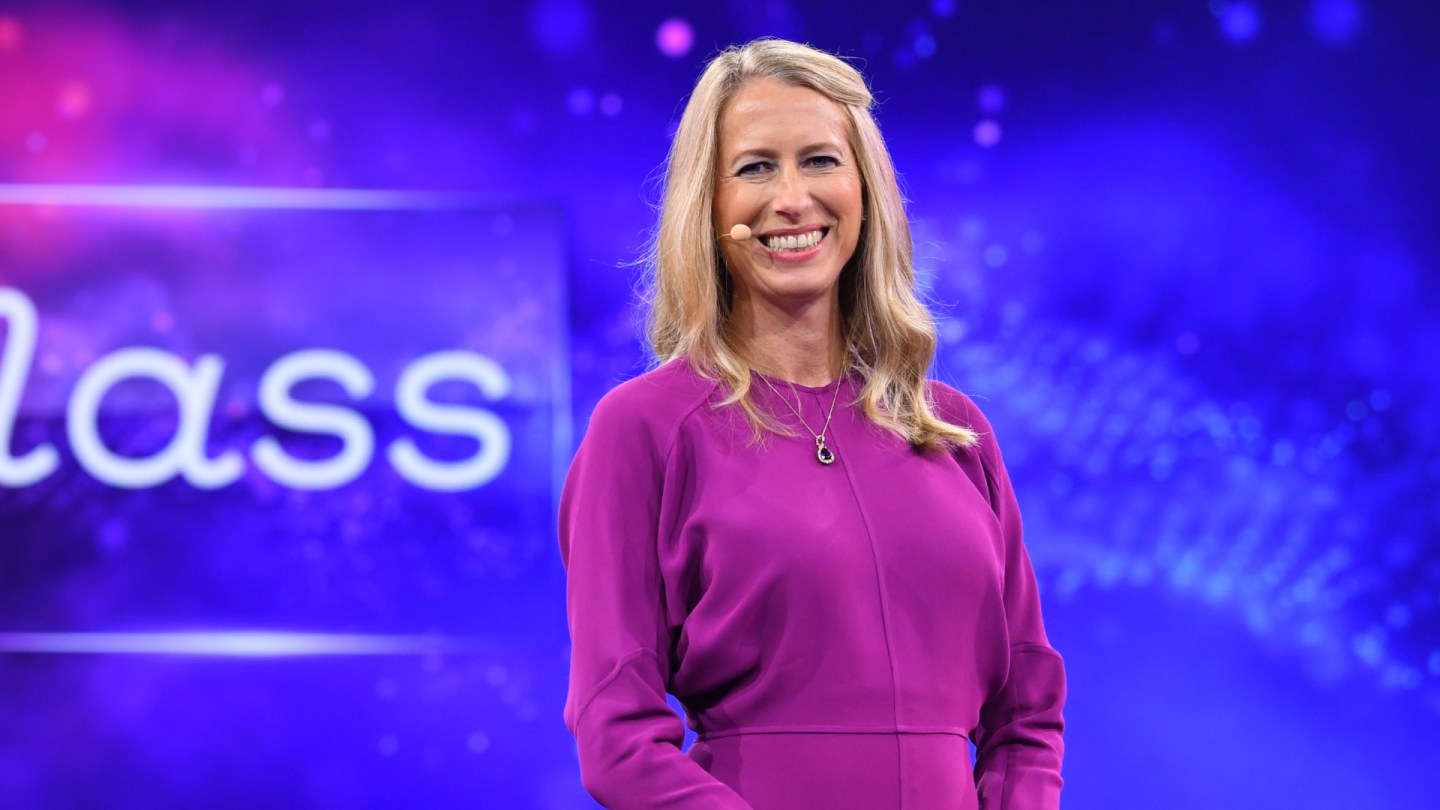

Sky CEO Dana Strong jumped on a late-morning call to answer a barrage of questions from the British media on Monday following the landmark news that the Comcast-owned company will acquire ITV’s networks and streaming businesses in a £1.6 billion ($2.13 billion) deal.
Strong was joined by Sky’s group chief operating officer Nick Herm and Cécile Frot-Coutaz, chief advertising and content officer and CEO of Sky Studios, for a moderated Q&A that kicked off with questions on government approval and clarity on the future of ITV News. Closing on the deal, they said, is expected to take approximately a year.
“We are very excited for a big day for Sky and ITV, coming together to create a U.K.-focused national streaming champion,” began Strong. “We think this is very compelling logic, bringing these two iconic and complementary brands together, creating a streaming service leveraging NBC’s global streaming platform, Peacock, and ITV — 40 million viewers per month, 16 million monthly active users on ITVX, to create a scaled operator in the U.K.”
She has grounds to be enthusiastic: A combined Comcast-owned Sky and ITV would create a formidable British media group — the U.K.’s dominant commercial free-to-air broadcaster paired with its largest pay-TV operator. Under the proposed structure, Sky would acquire ITV’s networks and streaming businesses — including the ITV channel portfolio and ITVX — while ITV Studios, the production arm behind franchises such as Love Island, Britain’s Got Talent and Netflix hit Fool Me Once, would be spun off as a standalone listed company. The merged operation would sit alongside Comcast’s NBCUniversal assets, bringing together ITV’s mass-reach advertising business, public-service broadcasting obligations and sports rights with Sky’s subscription TV, streaming, broadband and mobile operations.
The strategic logic is straightforward. Traditional broadcasters are seeking scale as advertising and viewing shift toward global tech platforms. Combined, Sky and ITV accounted for an 18.3 percent share of U.K. TV and streaming viewing in May, according to BARB, the official ratings body. YouTube alone was slightly larger, at 18.6 percent. That comparison is likely to be central to the companies’ regulatory defense — a merger that once might have looked overwhelmingly dominant can now be framed as a response to the growing power of YouTube, Netflix, Google and other global digital players that increasingly capture audience attention and advertising budgets.
Regulators will nevertheless scrutinize the deal closely. The Competition and Markets Authority is expected to examine the combination of ITV’s powerful free-to-air advertising business with Sky’s pay-TV and ad-sales operations, particularly given concerns that the merged group could command a very large share of the U.K. television advertising market. Potential remedies could include changes to Sky’s third-party ad-sales arrangements.
Strong answered on whether this domination in the ad market will be good for the likes of competing PSB Channel 4: “ITV’s remit is a very different strategy, it’s looking for a mass audience, and ITV and Sky, together, really are two complementary services, not really overlapping services, and we believe that the world has really changed, and that the definition of a TV ad market from a linear standpoint is quite antiquated.” She explained that the combination of both ITV and Sky will account for 6.5 percent of the U.K. advertising market — “quite a minority” — and lauded their partnership with Channel 4 through Comcast’s self-service platform Universal Ads.
“We believe that having the combination of our two organizations in order to invest in better ad technology and better choice advertisers is good for brands,” continued Strong. “Brands want digital, they want choice, they want more digital advertising capability powered by data, and we have quite a lot of those assets in the NBCUniversal universe that we can help build a really powerful opportunity for brands and advertisers.”
Beyond competition issues, the deal raises politically sensitive questions about U.S. ownership of a major British public-service broadcaster. ITV is not simply another media asset: it remains Britain’s largest commercially funded free-to-air network and a key part of the country’s cultural landscape, with obligations to provide original U.K. programming and regional content.
Strong was asked by Deadline‘s Jake Kanter about whether it’s healthy for British broadcasting that the U.K. PSBs are now effectively Hollywood-owned. Strong referred to Comcast’s track record, calling the company an “exceptional” owner of Sky. “They have continued to invest in locally-produced sports and premium drama […] and quite importantly, all of the obligations that Sky News signed up to as a part of the transaction have not only been met but have been awarded with journalistic medals for nine years running with the RTS News Channel of the Year.” She added that Universal’s £5 billion investment in the Universal United Kingdom Resort and theme park is proof of Comcast’s “further commitment to the U.K… So I feel very confident saying that Comcast have been great stewards of the Sky business with custodians, and I feel very comfortable that Sky and ITV will remain deeply British.”
News plurality is likely to be another flashpoint. The combined company would bring together Sky News and ITV News, raising questions about whether two major news operations — Britain’s second-largest after the BBC — can coexist under the same corporate roof over the long term. “We’ve been very upfront and clear, saying that Sky News will continue after our commitments. We love Sky News,” said Strong early in the call. “We think it’s a wonderful voice in the marketplace, we believe in interrupted journalism, and we continue to back Sky News.”
“The editorial voices between Sky News and ITV News will remain distinct,” she continued. “They do have different editorial points of view, and we think that that’s a real source of strength. We have said that we’re quite excited about ITV regional news specifically, and the ability for us to make that more visible and much more accessible. We think we can supercharge that on some of our digital platforms, and really make that a different strength.” She added that Sky is “absolutely committed” to Sky News beyond 2029 and expect both newsrooms to survive “past the 2030 mark.”
There is no denying that those concerns echo the U.K. government’s recent scrutiny of the proposed Paramount-Skydance/Warner Bros. Discovery transaction, where Culture Secretary Lisa Nandy cited the need for a “sufficient plurality of views in news media” alongside concerns about consolidation in the streaming market. While the Sky-ITV deal may face similar objections, the broader trend toward consolidation — and regulators’ growing recognition that traditional broadcasters are competing against global digital giants — suggests approval is more likely than it would have been a decade ago.
The other major story is ITV Studios. By separating the production business from the broadcaster, ITV is effectively creating a standalone content company with more than £2 billion in annual revenue and a library of globally recognized formats and dramas. Industry observers already view ITV Studios as a potential acquisition target, particularly after Banijay’s merger with All3Media created a production powerhouse spanning franchises such as Big Brother, MasterChef, The Traitors and Black Mirror. Banijay Group CEO François Riahi recently summed up the prevailing mood with a blunt assessment: “Consolidation is the name of the game.” He pointed to the proposed Paramount-Warner Bros. Discovery merger as evidence that media companies increasingly need global scale to remain relevant, and analysts are already speculating that ITV Studios could be Banijay’s next takeover target.
On moving some of those free-to-air TV hits behind a paywall, Strong said there were currently no plans to do such thing. “We have no plan or intention of putting those love shows behind a paywall,” she said, “and we’ve been really, I think, very clear and upfront about that. That’s an important commitment that we’re making in this partnership. We want that. It’s good for advertising dollars, good for viewers, good for the ITVX platform, so we wouldn’t see that changing.”
The Sky executive described the combination of Sky and ITV’s relative sports portfolios as ” a core source of strength for consumers in the deal.” She said: “We want to put more sport into free [to-air]. We want to do a range of sport. We think there’s an opportunity there to really drive more fandom and more engagement with, frankly, one of the critical assets the U.K. has, which is an unbelievable sporting community. If you can see from last night,” she added, referencing England’s historic win over Mexico in the World Cup (a sporting feat that kept Britons up until 4 a.m. local time), “we’re all pretty passionate about our sport. We’d love to tap into that by putting more sport on ITV.”
On staff reductions — Sky said that, post-completion, a committee will be erected to assess future structures, and that £200 million is expected to be generated on a run-rate basis by the end of the third year after closing — Strong replied: “The majority of those synergies will be marketing technology platforms and non-U.K. content. There is a minority of the synergies that do come from some elimination of duplication, but we expect that to be the minority of synergies, and primarily in corporate and commercial function.”
As a historical footnote, the deal carries a striking irony. Nearly 20 years ago, Sky’s predecessor BSkyB — then controlled by Rupert Murdoch’s News Corp. — attempted a stealth takeover of ITV. In late 2006, as cable operator NTL (later Virgin Media) explored a merger with ITV, BSkyB secretly bought a 17.9 percent stake in the broadcaster for about £940 million, effectively gaining a blocking minority that could thwart a rival takeover. The move triggered a fierce regulatory backlash: competition authorities concluded the stake was anti-competitive and threatened media plurality, and in 2008 BSkyB was ordered to reduce its holding to below 7.5 percent. The Murdochs ultimately sold down the stake. What was deemed too concentrated in the Murdoch era may now be viewed through a very different lens — one shaped less by fears of television dominance than by the rise of YouTube, Netflix and the global technology platforms that have transformed the media landscape.
Read the full article here