



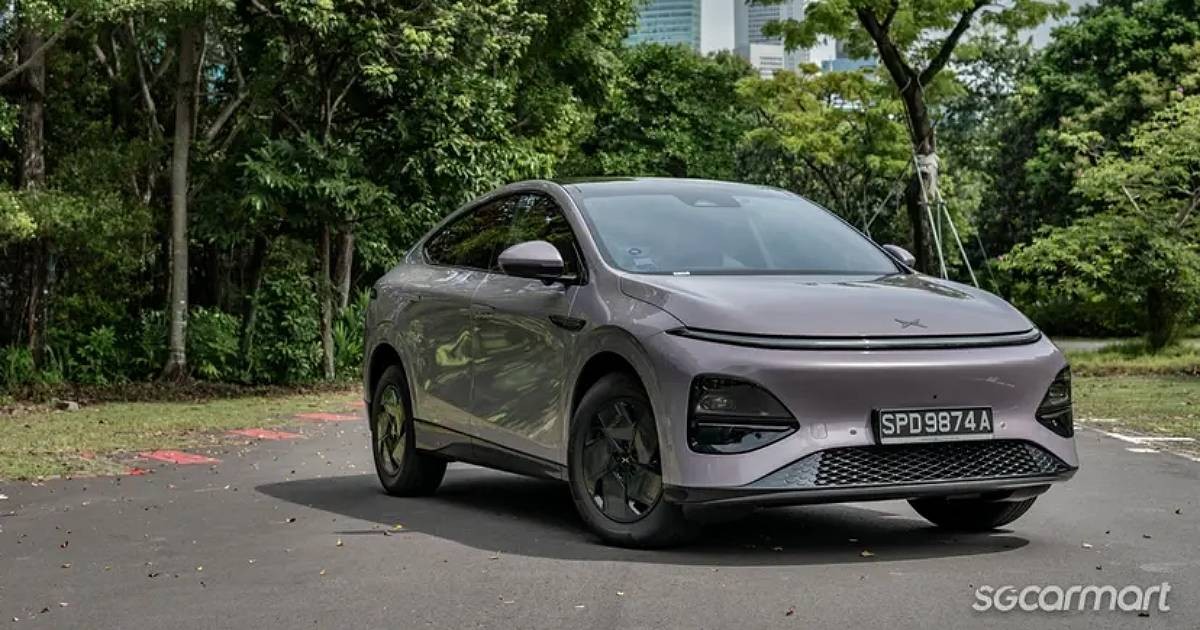

The G6 in Singapore has been nothing short of a success for Xpeng, racking up sales of over 300 units within the first year of its debut.
With slick technology, a cushy cabin and punchy performance, it put the brand on the map and into the minds of many would-be buyers.
Then in late 2025, Xpeng rolled out an updated G6 with improved ride quality, an upgraded OS, and higher charging speeds (just to name a few upgrades).
A range-topping Performance model joined the lineup as well.
The overall result was a more refined driving experience for most buyers, and an exciting option for keen drivers.
Now, we have the Cat A G6 Air. It promises an experience like its siblings, but it has been pared down in some areas to meet a price point.
At time of writing, it costs $19,000 less than the Pro Long Range RWD variant. Are the savings worth it?

Spotting the changes
Outside, the only noticeable difference between the G6 Air and its siblings are the smaller 18-inch wheels (it’s 20 inches for the other two variants) with a different wheel design.
These rims also have comfort-oriented tyres (with higher aspect ratios). And instead of Michelin, the G6 Air gets Maxxis tyres. Something to note if branded tyres are a consideration.
Welcome lighting is still present, so when you approach the car, the headlamps come on. The doors unlock and the handles pop out as you come closer. So far, so good.


At first glance, nothing inside looks different — the 10.25-inch instrument panel and 15.6-inch infotainment display are still present.
However, vegan leather instead of Nappa leather is used to upholster the seats, and the roof liner is fabric instead of the suede-like Microfibre.
Look closer, though, you’ll notice that the rearview mirror is the conventional type, whereas the one in higher-end variants is a digital one — useful when tall occupants are in the back.
Also, while the front seats are ventilated and heated, they don’t have massage functions.
However, you still get to choose between a lively or relaxed cabin, as 256-colour ambient lighting remains standard, and a four-zone voice activated virtual assistant is still present.


Behind the scenes, the OS is powered by a different processor — instead of a Qualcomm Snapdragon SA8295, the G6 Air has a MediaTek 8676.
There’s been a reduction in hardware, too, as the model only gets five cameras and four radars, versus 12 cameras and five radars in its siblings.
According to XPENG, this is why the Lane Centring Control (LCC) is less refined. In the intelligent view on the instrument panel, the traffic from behind isn’t displayed — only vehicles and road users from the front and side appear.
All that said, neither the infotainment nor the auto parking functions seemed slower (or quicker) than the Snapdragon-powered systems.
It may have fewer ponies, but the 440Nm of torque help ensure you won’t be left behind when the lights turn green
Arguing specs
There’s no escaping the fact that the G6 Air is slower than its siblings.
To qualify for Cat A COE, the electric motor is capped at 110kW (148bhp). As such, it takes 9.6 seconds to finish the century sprint, nearly three seconds longer than the G6 Long Range.
Sure, you feel the car’s 2,065kg mass when first moving off, but there’s not much to complain about during city driving. The motor still makes 440Nm of instantaneous torque, so the G6 Air has no trouble leaving most ICE cars behind.
One thing that I thought the G6 Air would be better than its siblings at is ride comfort.
But despite the smaller wheels and tyres with higher aspec ratios, the ride remains firm and even becomes busy over pockmarked tarmac.


As the entry-level variant, the G6 Air has a smaller battery – 68.5kWh versus 80.8kWh for the Long Range and Performance models.
The smaller capacity results in a claimed WLTP range of 470km, versus 525km for the Air’s siblings.
Also, the DC charging speed tops out at 382kW, compared to 451kW for the other two. But at these speeds, juicing up the battery will be very quick, and I’d imagine most owners won’t need this feature. Besides, Xpeng claims the 10 per cent to 80 per cent charging time is 12 minutes either way.
Apart from range, the other big consideration would be the monthly payments.
Assuming a seven-year loan of 70 per cent of the purchase price and an interest rate of 2.78 per cent, the monthly payment for the Air is about $1,494 a month compared to $1,954 for the Long Range.
Over the loan period, the Air owner would have saved $38,640.

Down to dollars and sense
If you’ve got your mind set on a G6, then the Air is a tempting proposition.
Despite the reduction in equipment, the experience is largely the same, as the infotainment doesn’t lag and functions such as the auto park are no slower (or quicker).
The only reason to fork out an extra $19,000 is if you’re someone who insists on the extra kilowatts of performance, demand the highest charging speeds available, and want even more cameras.
Even then, you should ask yourself: Are these requirements genuine, or am I just concerned about paper specifications?
If the answer is no, then save that $38,000. It will surely come in handy when it comes time to change cars.
[[nid:737875]]
This article was first published in sgCarMart.
Read the full article here