




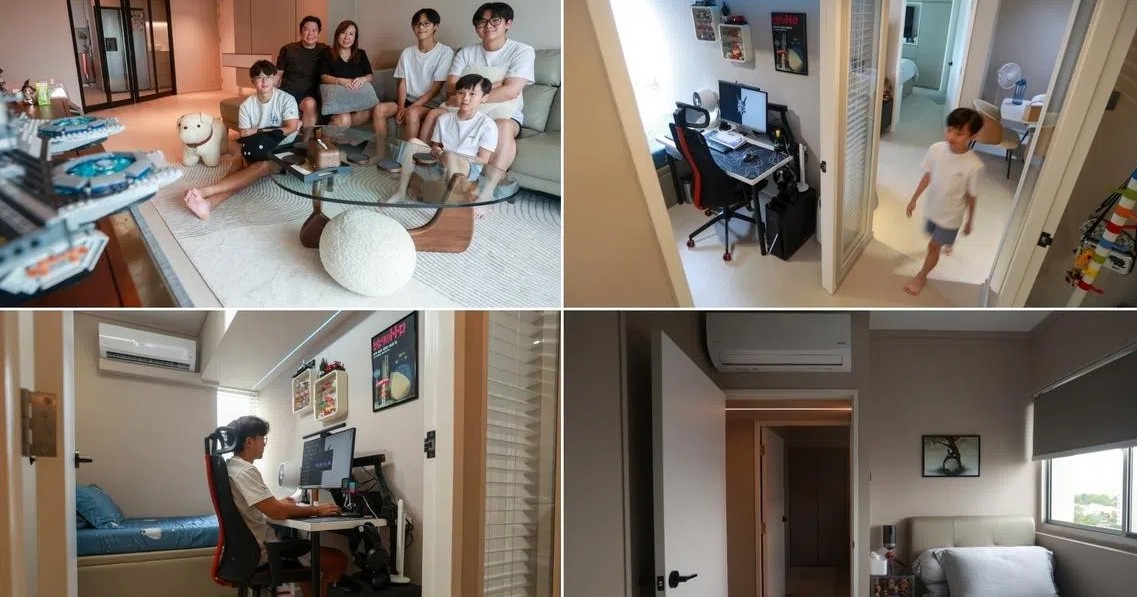

SINGAPORE – While many Singapore home owners are knocking down walls to make way for bigger rooms, Lawrence Lim and Jacinda Lau decided to buck the trend when they moved into their Ang Mo Kio home in 2023.
They added “walls” to two of the bedrooms in their 1,350 sq ft, five-room resale flat, which resulted in four bedrooms – one for each of their four sons, aged 12, 15, 17 and 19 – while retaining a sizeable master bedroom.
Some space was also taken from the living room and balcony to ensure that each bedroom would easily accommodate a single storage bed, a three-door wardrobe, a study desk and a dedicated air-conditioning unit.
While each room is a cosy fit, there is still enough leftover space to comfortably move around.
“We wanted our four growing boys to each have their own private retreat for study and rest,” says Lim, a 51-year-old civil servant.
Before moving to Ang Mo Kio, the family had lived in a 1,571 sq ft maisonette flat in Bishan for 13 years.
“We had previously torn down some of the smaller rooms because we didn’t need separate spaces then and preferred having everyone together,” says Lau.
But as the children grew older, they needed their own rooms and privacy. The stairs also became less practical.
“Everyone felt too spread out and it was a hassle,” says Lau.
Since the layout no longer worked for them, the family decided to sell the maisonette and move to a home that would better accommodate their current needs.
“Individual privacy is now the most important feature of a home for us,” says Lim.
“At the same time, we didn’t want to ‘squeeze’ everyone in.
“It was also important to have a generous communal area where we can all gather comfortably as a family.”
Lim and Lau worked closely with their design team from i.Poise Interior Design to reconfigure the layout of their new flat.
The renovated home features a spacious living room, dining hall and even a gaming den, which was previously a balcony.
The kitchen was reconfigured so that its entrance is more centrally placed between the dining hall and living room.
The new entrance is composed of glass door panels, making the overall space feel brighter and more connected as a communal space.
A storage room was torn down to be combined with the kitchen.
“We also carved out a service yard within the original kitchen, so that every functional need could be met within the original footprint,” says Lim.
To construct the four bedrooms for each of the boys, a small amount of space was taken from the balcony and living room.
To create two bedrooms from each of the original bedrooms, the design team – led by i.Poise Interior Design’s founders, Alicia Koh and Eugene Seah – did not construct a new dry wall.
Instead, they used two wardrobes – one for each bedroom – to form the partition. As a result, the back of each wardrobe forms the wall of the adjacent bedroom.
Additionally, glass panels were installed in two of the bedrooms – one originally without windows, another with only a small window from the former balcony – to make up for the lack of natural light.
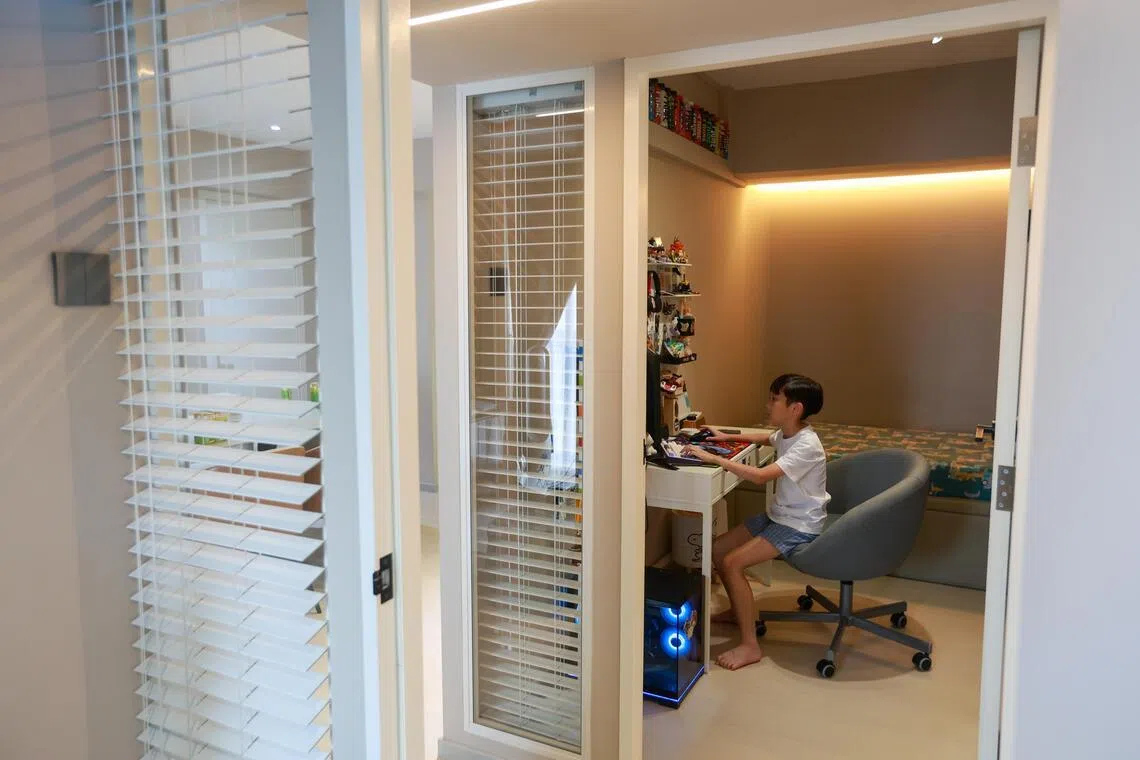
“The fixed glass panels allow light to flow in. And if the boys want privacy, they can just close the louvred blinds,” says Koh.
One challenge that the design team faced was configuring the overhead ducting to each bedroom so that each has its own dedicated air-conditioning unit.
“All of this ducting would be quite unsightly, so we had to construct an artificial ceiling that runs down the hallway between the four bedrooms,” says Koh.
This artificial ceiling is “lower than normal for most homes, but still above door height, so it works for us”, says Lim.
But the low ceiling does make it tricky to install light fixtures in the hallway.
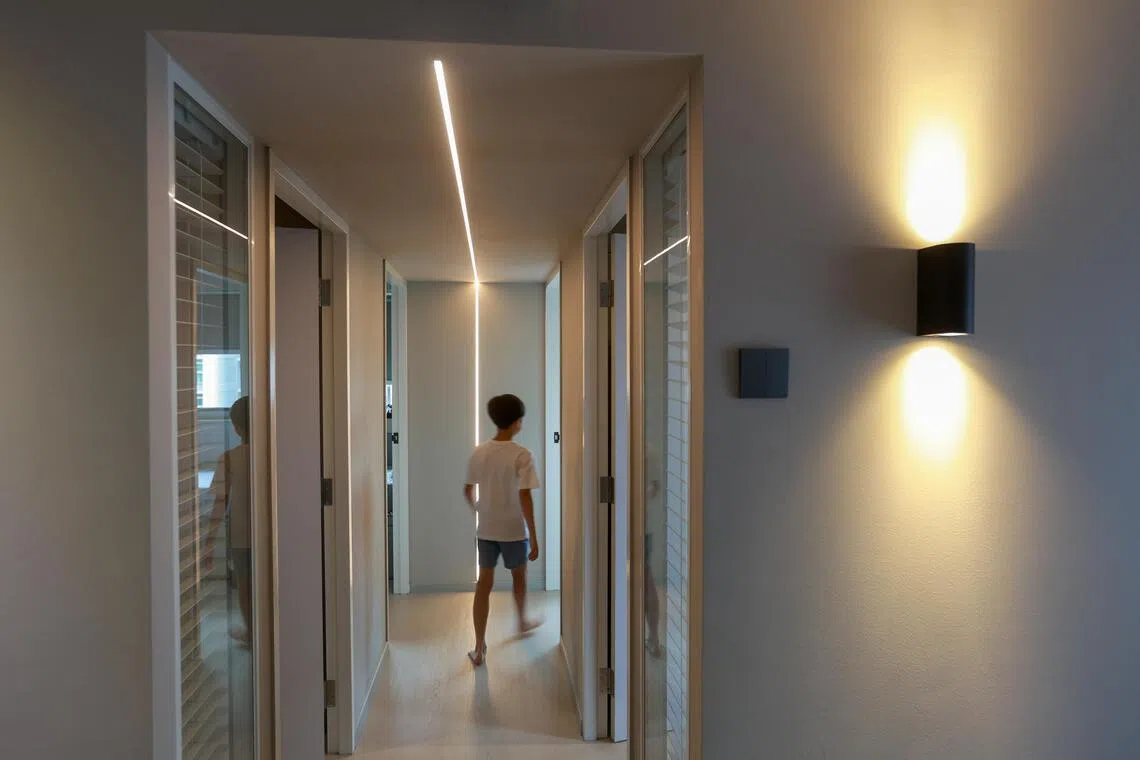
“We installed an embedded light strip to address the lighting issue here. It also acts as a night light in the evenings and lights the way to the common bathroom,” says Koh.
This and other design and architectural details create a calm and cohesive feeling throughout the space, says Lim.
He adds: “Thanks to the natural earth-tone palette that our designer used throughout the house and features like the glass panels, this part of the house feels bright rather than closed off.”
To further enhance the airy and spacious atmosphere, the Lims have also taken care to minimise the amount of loose clutter and furniture throughout the home, sticking to carefully chosen statement pieces and strategically designed built-ins.
And while their rooms are on the smaller side, the boys say they are happy just to have their own individual spaces.
“I don’t mind the size because all my stuff still fits easily. I’m just glad to have my own private space away from my brothers because we didn’t have that in our previous home,” says 17-year-old Thaddeus.
Lim says that finding the right HDB unit, with a functional floor plan and generous footprint, made all the difference in the reconfiguration.
“Even before renovation, all 1,350 sq ft of space was very much usable. The right ‘bones’ made it much easier to mesh different zones without wasting a single square inch,” he says.
“It allowed us to retain a sizeable master suite with a four-panel wardrobe and a full workstation, to have a large entertainment set in the living room and a six-seater dining set in the dining area – in addition to giving each of the boys their own bedroom.”
Designer Seah adds: “Properties with fewer structural beams and more regular-shaped layouts typically offer greater flexibility.
“Most importantly, home owners should be open to challenging conventional layouts as bold design decisions are needed to create new possibilities.”
Lim agrees: “Don’t feel restricted by the original floor plan. If you focus on smart storage – with storage beds and thoughtful built-ins – and a consistent colour palette, you can fit a lot of living into the space.
“The important thing is to create a space that serves your family’s specific lifestyle.”
[[nid:738084]]
This article was first published in The Straits Times. Permission required for reproduction.
Read the full article here