




Banff World Media Festival-goers are used to unpredictable Canadian Rockies weather, where drizzling rain can become snow showers and then balmy sunshine over a single day due to geography and elevation.
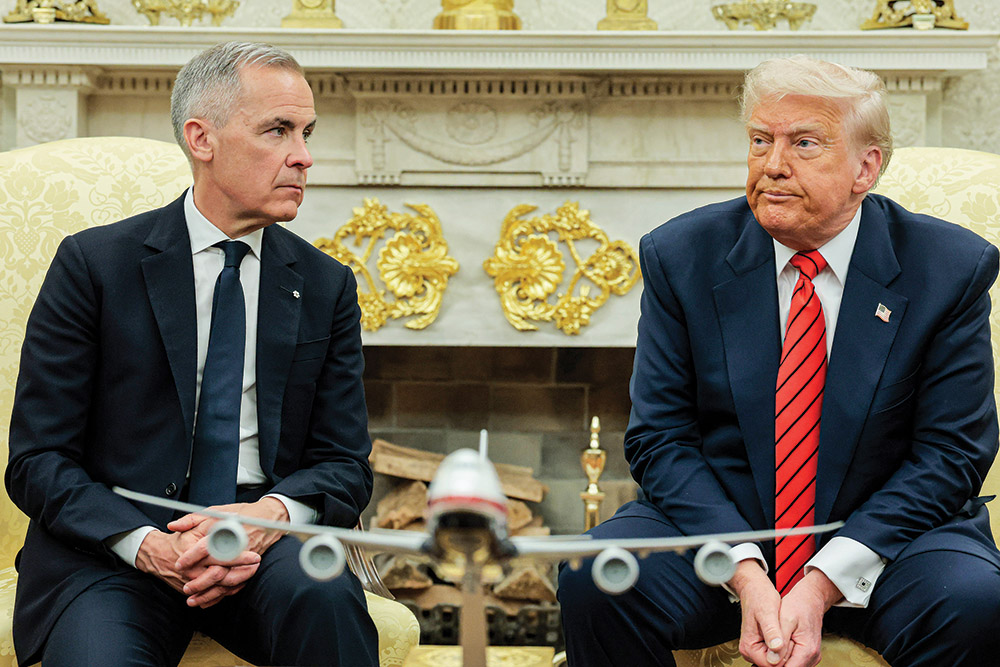
But escalating cross-border trade and political tensions between the U.S. and Canada will see Donald Trump — who has talked about annexing his northern neighbor as the 51st U.S. state and putting tariffs on non-U.S. movies — casting a dark cloud as Banff’s 47th edition kicks off this weekend. That follows in early June the federal government in Ottawa killing regulatory plans to triple a local tax on foreign, mostly U.S. streamers to get more favorable terms on a new cross-border trade deal from the U.S. president.
Canada caving to U.S. pressure followed Motion Pictures Association reps in Canada taking aim at Canada’s Online Streaming Act, a law that forces U.S. digital giants to finance Canadian media content production, the U.S. ambassador calling for its repeal and the U.S. Trade Representative branding the legislation as “discriminatory” towards U.S. companies.
Getting foreign streamers to support local content creators so Canadians could view their own films and TV shows rather than rely on Netflix and Prime Video for popular fare may have seemed a good idea among bureaucrats and regulators in Ottawa. And it was certainly applauded by local unions and guilds, indie producers and others looking for American web giants to dig deeper in their pockets to underwrite homemade content.
But it was bad politics as Canadian prime minister Mark Carney shadowboxes with Trump while attempting to renegotiate the Canada-U.S.-Mexico Agreement (CUSMA) trade deal during talks he has yet to officially join. “We thought we were negotiating an infusion of capital for Cancon (Canadian content) based on streaming and viewership and taxation, and instead it has become a trade issue at a delicate time for cross-border relations,” Catherine Warren, president of Vancouver-based FanTrust, tells The Hollywood Reporter about Trump’s latest trade war plot twist.
The Canadian government, with its choices and tradeoffs made to secure a new North American free trade deal with the U.S., has now asked taxpayers to pay an extra $600 million for homegrown media content as Canada’s TV czar reconsiders how to implement an Online Streaming Act that became law in 2023, but has yet to be enacted due to an appeals court challenge by American media giants.
Marc Miller, the federal minister for Canadian identity and culture, will be in Banff for a keynote conversation on Sunday afternoon. He’s expected to face aggrieved local creatives and producers asking why his government promised to get foreign streamers to pay into Canada’s production ecosystem to protect the country’s cultural sovereignty, only to see Trump cause a perfect storm by implicating audiovisual content in North American free trade talks.
And all because Ottawa has put ensuring special access to the U.S. market for vital exports like Canadian-made automobiles, steel and aluminum over using foreign streamer dollars to support local indie content production. “We thought we had a situation where the platforms were contributing. Now we’ve got Ottawa writing a check,” Warren, who also hosts the YouTube and Optik TV talk show Truth & Consequences: Documentary in the Age of AI, added.
The Canadian content funding crisis have been a long time coming, only for the denouement to quickly unfold ahead of Banff. In June 2025, Ottawa scrapped plans to levy a tax on digital companies like Apple, Amazon and Meta after Trump made trade talk threats over what he called a “direct and blatant attack on our Country.”
Killing Canada’s separately planned tax on U.S. tech giants had implications internationally where governments have similarly considered imposing regulation and taxes on dominant foreign streamers in their markets to fund domestic film and TV industry ambitions. That leaves ongoing tensions between Canada and the U.S. over how to capture the value of Canadian-made media content, and who will control it, overshadowing the Rocky Mountains industry retreat running June 14 to 17.
Canadian producer, director and writer Uga Carlini of Vancouver-based Towerkop Creations is headed to the annual media festival to bring partners on board for her TV series and movies in development just as Canada’s cultural objectives to support homegrown content production have morphed into major cross-border trade issue. “No one likes to be told what to do with their money. Have you ever been through a divorce?” Carlini tells THR about foreign streamers facing off with Ottawa over how they should invest in Canadian film and TV production, and where.
So, while pitching in Banff a movie titled White Bear and a midlife immigrant comedy TV series The Man Manual, among other projects on her development slate, she remains determined to make unashamedly Canadian content that resonates globally by collaborating with foreign producers, including Americans. “I’m practical. Who are my best partners and who wants to go on that journey with me? Because I need to get my story told. If it means I partner with Americans, and that’s the best for my story, which will always be Canadian and will always be branded as a Canadian story, then great. Why not?” Carlini explains.
In the face of escalating political challenges, she won’t be alone among content producers and buyers in the Canadian Rockies pursuing more collaboration across borders as American and other international producers look to their own new partnerships to offset budgetary challenges. Veteran actor-turned-producer Gerald Augur has his Calgary-based production banner, 4 Directional Studios, at work on Watcher, an indigenous true crime version of 48 Hours where a 12 year-old girl is abducted from a First Nations reserve, plunging her community into crisis.
The homegrown drama stars Colm Feore (Landman)and Augur as a Woodland Cree tracker who reluctantly partners with a former city detective, played by Jason Barbeck, to search for the young girl, only to confront Canada’s cultural and historical divides. Augur said he intends to shoot Watcher partly in Alberta, but has concerns after the province’s First Nations have become embroiled in an upcoming pro-independence referendum and oil pipeline tensions.
“Now there’s people who don’t feel safe to tell stories or bring projects here (Alberta) if it has any indigenous content because of what’s happening in the political arena,” he explained. Augur added the political fallout from Albertans being asked in an Oct. 2026 vote if they want the province to stay in Canada or if a second binding referendum on separation should be held is widening political divisions at a time when Canadian stories like Watcher aim to reduce discord and foster reconciliation.
“That’s why I got involved with Watcher, because it’s promoting unity, it’s promoting how we need to check ourselves before we wreck ourselves as human beings based on how much is being shaped by the political landscape,” he insisted. Elsewhere, energy-rich Alberta, which has hosted the Banff festival for nearly five decades, has been the beneficiary of recent oil price rises amid the ongoing U.S.-Iran war.
In March 2026, the province in its latest operating budget slashed by $35 million, to $60 million, what it had set aside to draw major studios and streamers to shoot locally based on fluctuating production levels and payouts on Alberta’s Film and Television Tax Credit in recent years. But now the western Canadian province, where the popular HBO drama The Last of Us was shot during its first season, is more assured foreign movie or TV series will tap its film tax credit while shooting locally as royalties from oil exploration and drilling once again pour into its coffers.
“Alberta has already proven it can attract large-scale productions, create jobs, and deliver real economic impact. With continued government support and a growing industry, the province is well-positioned to meet rising global demand for high-quality content. That momentum will be on full display at the Banff World Media Festival,” Dylan Pearce, an Edmonton-based indie producer and board chair at the Alberta Media Production Industries Association, told THR in a statement.
That has players in rival Canadian provinces headed to Banff also with an eye to bringing Hollywood producers to their locales in a hyper-competitive global locations business. Meghan Duffy, CEO of Winnipeg-based Black Watch Entertainment, a boutique film and TV producer with credits like the Lifetime mystery thriller I Have to Kill My Neighbor, will look to convince American producers in a tough market to tap a Manitoba film tax credit that offsets up to 65 percent of production salaries with bonuses, and with no Canadian content in projects required.
She also touts Canada’s favorable exchange rate against the U.S. dollar and a province that doubles for anywhere. “We bring to the table one of the most aggressive tax credits in the world, with a very low Canadian dollar, which helps maximize low budgets by making them look larger on screen,” Duffy argued.
The Manitoba film tax credit also applies to co-productions shot in foreign locations and where a global producer is looking to close a budgetary gap on their financing and can’t do it in their home market.
“We could film part of the show in Manitoba, or not. If they use my team for the production, we still get the full (Manitoba) tax credit anywhere in the world because it’s tied to me, Meghan Duffy,” she added.
For Jenn Kuzmyk, executive director of the Banff World Media Festival, putting on her event’s 47th edition will be about delegates navigating unprecedented industry disruption even as her event could potentially no longer be held in Canada if Alberta separatists get their way in the fall referendum and the province secedes.
“Of course, we are always watching with interest what happens in politics, whether it be in Alberta, federally or around the world. There’s a lot to pay attention now, in terms of trade talks and everything else,” Kuzmyk said.
Read the full article here