



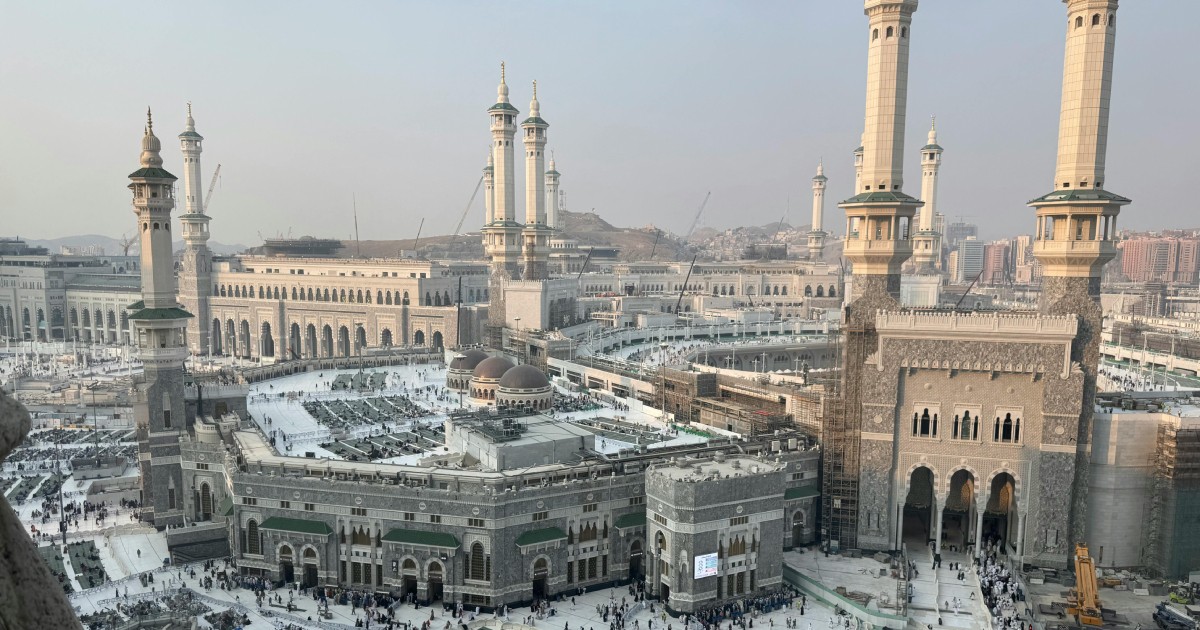

Hajj Badal is when a trusted proxy performs Hajj on behalf of a loved one who cannot make the journey themselves.
For many families, it’s how a parent’s lifelong wish is honoured — and in 2026, the rules around it are tighter than before.
What Hajj Badal means
Hajj Badal is when a proxy performs the pilgrimage on behalf of someone who cannot make the journey themselves.
Families usually arrange it for a parent who has passed away, an elderly relative, or a loved one living with a permanent illness.
Important: Hajj Badal is only meant for those who genuinely cannot travel — whether they have passed on, are too frail, or live with a condition that won’t recover.
It isn’t a shortcut for someone who could still go.
Who Hajj Badal is for
Three situations make Hajj Badal the right choice. Outside of these, the person should plan their own pilgrimage when they’re able to.
- A relative who has passed away without performing Hajj during their lifetime, even though they had the means and health to do so
- An elderly parent or grandparent whose age makes the journey unsafe for them
- A family member with a permanent illness or disability that rules out the physical demands of Hajj
If the person could realistically travel in the coming years — even with planning and patience — they should go themselves.
Wego’s guide to Hajj waiting lists and quotas is a good place to start that conversation.
How Hajj Badal is usually arranged
If this is your first time arranging Hajj Badal, the good news is that you don’t have to find a proxy on your own.
There are two paths, and most families take the first one.
Buying a Hajj Badal package
Licensed Hajj operators, charities, and national Hajj missions sell dedicated Hajj Badal packages.
You pay a single fee, share the name of your loved one, and the operator assigns a qualified proxy who travels to Makkah on your behalf.
This is the route most families use, especially when arranging Hajj for a parent who has passed away or a relative living far from Saudi Arabia.
You don’t need to know the proxy personally — the operator handles vetting, paperwork, and confirmation.
Appointing someone you know
The second path is asking a trusted family member, friend, or scholar who is already travelling for Hajj to perform it on your loved one’s behalf.
They must have completed their own Hajj first, and they can only perform Badal for one person that season.
This route is more personal but harder to arrange in 2026, since the proxy still needs an official Hajj permit through Nusuk or their national mission — and quotas are limited.
The 2026 rules that apply
Saudi Arabia has overhauled how Hajj travel is managed, and the changes apply to proxy pilgrims as much as to any other traveller.
There is no separate Badal visa or permit category — the proxy travels as a standard pilgrim.
Mandatory permits and packages
According to the Saudi Ministry of Hajj and Umrah, no one may perform Hajj 2026 without an official permit.
Entry to Makkah during the Hajj season is restricted to permit holders, residents, and authorised workers.
Penalties are significant. Arab News reports fines of up to SAR 20,000 (S$6,784) deportation, and a 10-year re-entry ban for unauthorised pilgrims.
Operators or sponsors who facilitate violations face fines of up to SAR 100,000.
How proxies apply
The route depends on where the proxy lives:
- Residents of 126 served countries (US, UK, EU, Canada, Australia and others) book through the Nusuk Hajj platform using a licensed service provider
- Residents of national-quota countries (India, Pakistan, Indonesia, Malaysia, Bangladesh, GCC states) apply through their country’s official Hajj mission
- Saudi residents apply for a domestic Hajj permit through Tasrih or Absher
What’s off the table in 2026
Performing Hajj — Badal or otherwise — on a tourist or visit visa is not permitted.
The proxy must hold a designated Hajj visa or a domestic permit.
Operators who attempt to route pilgrims through visit visas face the heaviest penalties under the 2026 framework.
Costs and what’s included
Hajj Badal pricing reflects the proxy’s flights, accommodation in Makkah and Madinah, the sacrifice (dam), and the operator’s arrangements. Costs vary widely depending on where the proxy is travelling from.
| Proxy’s Origin | Typical Cost Range (2026) | What It Reflects |
|---|---|---|
| Saudi resident proxy | SAR 5,000 – 15,000 | Lowest cost; proxy already in-country |
| UK / Europe | £2,500 – £4,500 (S$4,200 – S$7,500) | Full package via licensed charities |
| South Asia | USD 2,000 – 4,000 (S$2,546 – S$2,559) | Through licensed private operators |
| Southeast Asia | MYR 4,000 – 16,000 (S$1,294 – S$5,174) / IDR 10M – 45M (S$724 – S$3,261) | Tabung Haji and licensed operators only |
What a good package includes
A well-run Hajj Badal package goes beyond the price tag. It usually covers flights, accommodation close to the Haram, transport between the holy sites, meals, the sacrifice, and a written confirmation once the pilgrimage is complete.
- Flights from the proxy’s home city to Jeddah or Madinah
- Accommodation in Makkah hotels within walking distance of the Haram
- Transport between Mina, Arafat, and Muzdalifah during the five Hajj days
- The animal sacrifice (dam), arranged through licensed channels
- Written or photographic confirmation that the pilgrimage was completed for the named recipient
Be wary of unusually cheap offers
Hajj authorities across Muslim-majority countries — including Malaysia’s Tabung Haji, India’s Hajj Committee, and Indonesia’s BPKH — have repeatedly warned about Hajj Badal packages priced far below the real cost of flights, accommodation, and the sacrifice in Makkah.
If an offer looks dramatically cheaper than legitimate packages from licensed operators, it’s almost always fraudulent. Walk away.
How to choose the right operator
Take your time.
This is a journey being made in someone’s name — often someone you’ve lost or someone you care for deeply.
The right operator will be patient with your questions and clear about what they offer.
- Licensing: The operator should be registered with Nusuk or your national Hajj mission, with a licence number you can verify
- Proxy’s own Hajj completed: Ask the operator to confirm — in writing — that the proxy has already performed their own obligatory Hajj. This is non-negotiable
- One person per proxy: A single proxy should perform Hajj Badal for one named individual per season — never pooled across a list
- Sacrifice (dam) included: Confirm the dam is part of the package and arranged through licensed channels in Saudi Arabia
- Business banking: Payment should go to a registered business account, never to someone’s personal account
- A real office: A physical address you can visit — not just an Instagram page or WhatsApp number
- Written agreement: Naming the person it’s being done for, what’s included, the sacrifice arrangement, and how you’ll be told it’s complete
- Payment in stages: Spread payments across the journey rather than handing over everything upfront
- Refund policy: Get the operator’s refund and reschedule terms in writing, in case the proxy’s visa or permit doesn’t come through
- Clear confirmation: Know upfront how and when you’ll be told the pilgrimage is complete — usually a written or photo confirmation, four to six weeks after Hajj
[[nid:731769]]
This article was first published in Wego.
Read the full article here