




When Tao Okamoto first read the script for Ryusuke Hamaguchi’s All of a Sudden, one scene told her above all others that this was hers for the taking. The sequence saw her character, a well-regarded playwright named Mari, explaining the systemic failures of modern capitalism. The monologue is long and complex, propelled by interconnecting arguments that, on the surface, might resemble an academic paper; it’s complete with her drawing whiteboard graphics to illustrate and summarize her points.
“This is something that I’d been thinking about over the years — and I got to lecture people on it in the movie, it’s amazing,” Okamoto says. “I think it will help a lot of people to connect the dots. I don’t think I’ve ever seen any movie explain and verbalize the system of capitalism and where we are like this.”
Of course, All of a Sudden is not an academic paper. Hamaguchi’s film feels about as far from that as you can get, in fact, playing as a richly textured and emotionally vast tapestry of human connection. But it’s no small detail that one of the screenplay’s most outwardly intellectual portions is where Okamoto felt most artistically inspired. This is a movie overflowing with big ideas, determined to imbue them into its intimate, character-driven story.
Hamaguchi tends to operate this way, most notably with Drive My Car, a three-plus-hour epic that won the 2022 Oscar for best international feature and received nominations for best picture, director and adapted screenplay — the only movie to do so in Japanese cinema history. His most recent drama, Evil Does Not Exist, examined the natural world as besieged by modern industry. With All of a Sudden, which like Drive My Car also runs more than three hours and will premiere at the Cannes Film Festival, he turns his attention to caretaking. Loosely adapted from the book You and I — The Illness Suddenly Get Worse (Léa Le Dimna co-wrote the screenplay with Hamaguchi), the film traces the deepening bond between Okamoto’s Mari, who is dying of cancer while staging a new production just off the Seine River, and Marie-Lou (Virginie Efira), the director of a nearby nursing home in Paris.
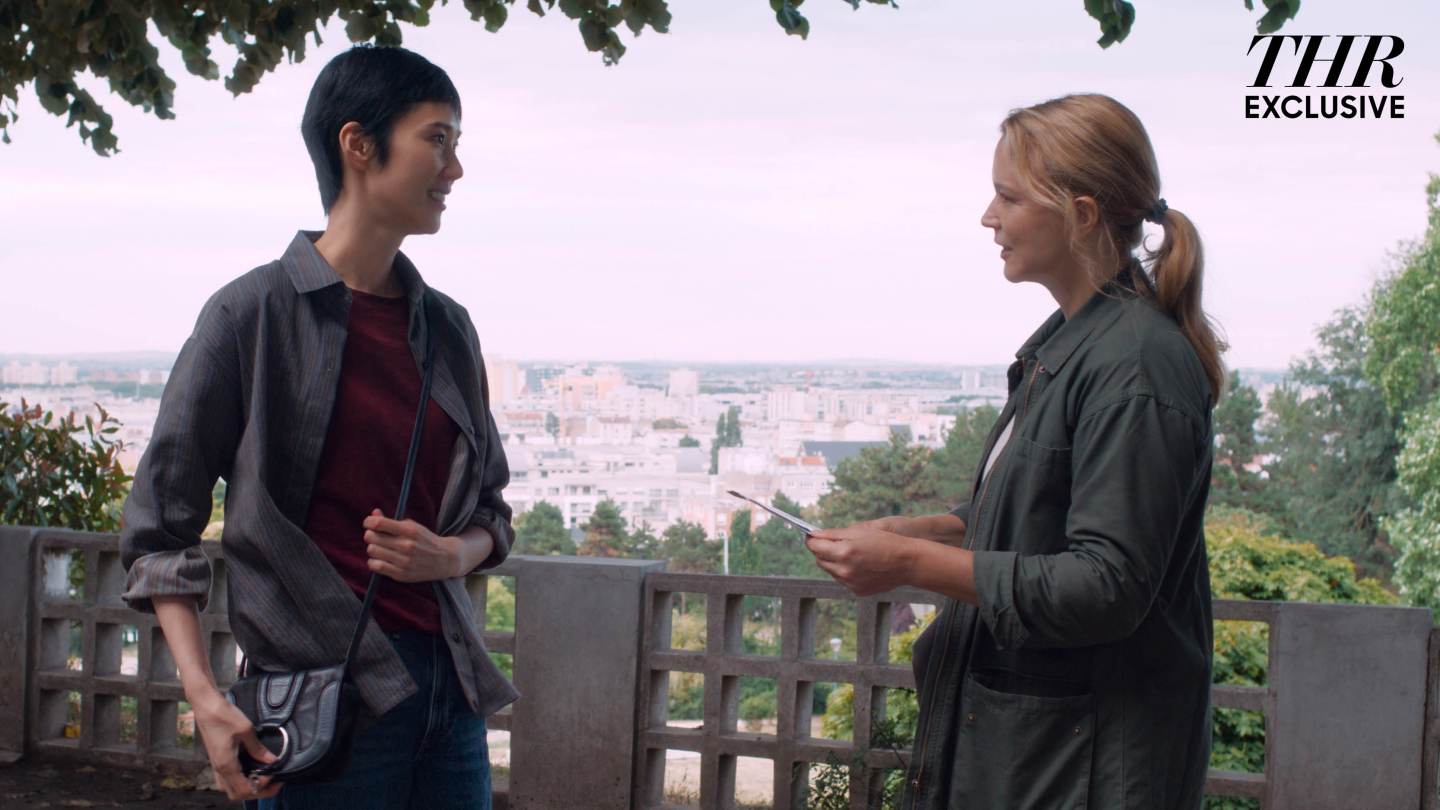
It’s an instant meeting of the souls. The two strangers first encounter each other in a park, where Mari invites Marie-Lou to see her show. Marie-Lou attends, finds herself extremely affected, and stays behind to chat with the writer about it — a bravura getting-to-know-you setpiece that becomes the first of many lengthy conversation scenes wherein Marie-Lou speaks in French and Mari in Japanese (except when they occasionally switch, meaning yes, each is fluent in both). Over just a few days, the deeper they dig, the more they come to rely on each other. This kind of mutual caretaking, physical as well as emotional, prods larger conversations about the state of the world — particularly, Marie-Lou’s nursing home facing a perpetual funding crisis.
“I was very sensitive to how intellectual the film was because the way of looking at things through otherness and this philosophical lens can broaden our horizons,” says Efira. “We shot in a working nursing home with real residents, and it was all about these bodies who are not functional anymore for capitalism. Then, Hamaguchi’s dialogue is extremely powerful to the point that it can combine the intimate and the political.”
The two stars came into All of a Sudden willing, even eager to completely surrender to the material, and that commitment shows in their finely tuned and vulnerable performances. Hamaguchi cast them with interest in their past individual work with noted directors: He quizzed Efira about her collaborations with Paul Verhoeven (Elle, Benedetta) and gushed to Okamoto about acting for James Mangold in, of all things, Wolverine. “I wouldn’t think he would be watching that type of movie,” Okamoto says with a laugh, “but he remembered me from that time, 13 years ago.”
That X-Men installment actually served as Okamoto’s film debut, following a successful modeling career that brought her to New York, and the Japanese native went on to star in other studio-driven Hollywood projects like Batman v Superman: Dawn of Justice and The Man in the High Castle. In 2023, she moved back to Japan to refocus her career away from blockbusters, and toward auteur-driven cinema. Then Hamaguchi came calling. Okamoto pretended she knew French, since that was required of the role, before actually gaining some command of the language after her casting. She had 12 months of prep all told, immersing herself in various facilities like a cancer research center while chewing on the many layers of the dense script.
Efira, a César Award winner, came in later, first meeting Hamaguchi at the Place de la Bastille in Paris. “He has this attentiveness, this curiosity, and that puts you in sort of a trance,” she says. “After we met, I was left there almost like I was drunk.” Like Okamoto, she felt a profound kinship with her character’s story, explaining, “It had a spiritual power to it, and it felt like I couldn’t let this script get away from me.” She didn’t know any Japanese, so started with the basics, but was astounded by how Hamaguchi facilitated such thorough preparation for his actors. For instance: “He wrote entire scenes that were not in the script, that we [acted out], just to inform the characters by creating memories for them. All this was in prep.”
Both admit to a learning curve to Hamaguchi’s methods. It’d take two days to complete a given conversation scene, which could run for 20 minutes or more. He’d begin with one tracking shot, then break it down into smaller sections, then return to a master — and then rehearse what the next day would look like. “If something goes wrong or you misunderstand or misreact at the 12th minute, we just start all over,” Efira says, noting they had to be exact with the script’s words but were totally free in how they interpreted the dialogue.
Okamoto felt the pressure of stepping into a very different style of filmmaking. “I have been complimented before on how I can be aware of where the light is coming from, where the camera is without looking at it, how I’m being captured — I thought that was my strength,” she says. “But he told me the first week, ‘Can you just forget that you’re acting?’ It was quite a challenge for me to cancel all these systems within myself.”
Okamoto and Efira developed a friendship over the two-month shoot that mirrored the dynamic between Marie-Lou and Mari. “Even though Virginie seems very confident and experienced, she was very nervous — it was so cute, she made me touch her heart, and it was beating like crazy,” Okamoto says of one of their earliest days on set. “She was also a real caretaker, on and off set.” Efira adds, “It turns out the best summer of my life was in a nursing home, which I never expected. We all say that it changed our lives and I’ve never had this on any other set — and that’s not a promo line.”
Indeed not — Okamoto takes that sentiment a step further: “It changed my life completely. I was scared of death as a child — it was one of my biggest fears, and something that I learned how to avoid thinking about growing up — and I had to face it again.”
While still politically uncompromising and laced with cutting wit, All of a Sudden is a remarkably open-hearted work, confronting seemingly intractable systems with a simple belief in people. Hamaguchi holds tight to that conviction from beginning to end.
“The result of the movie is just him being himself, as a human being,” Okamoto says. “And that’s beautiful. If someone doesn’t know who Hamaguchi-san is, it’s all there. That’s him.”
Efira puts it this way: “It’s so difficult to make a movie about kindness.”
As for that rather significant runtime? Hamaguchi regulars shouldn’t be deterred, but Efira argues that, true to All of a Sudden’s spirit, all should walk in with their hearts and minds open. “It’s always best to see a good film that’s three hours long, rather than a bad film that’s an hour and 20 minutes,” she says with a smile. “Hamaguchi has this sense of detail. He doesn’t take you by the hand and tell you what to think. He really takes his time, and I think our society needs that time — we don’t have it, but we need it.”
***
All of a Sudden premieres May 15 at the Cannes Film Festival. Stay tuned for more Cannes 2026 first looks and exclusives.
Read the full article here