



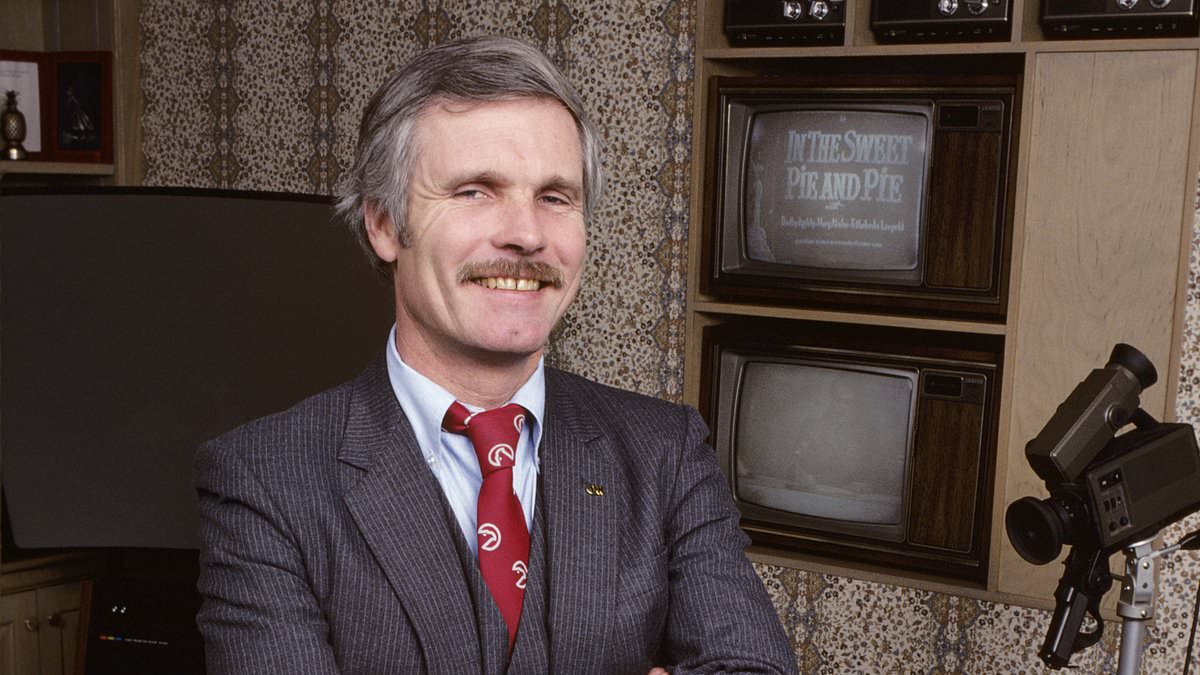

Everyone who ever met him seems to have an outrageous anecdote about the late CNN founder Ted Turner, but few can match the one recalled this week by the network’s former chief news executive, Eason Jordan.
In the first years of the groundbreaking cable channel, set up by the flamboyant media tycoon in 1980, the workaholic Turner wanted to stay so close to his new business that he often slept in a pull-out bed in his office above the newsroom.
An early riser, he’d sometimes wander down into the newsroom wearing only a bathrobe to get a coffee. Jordan, then only an overnight desk assistant, said Turner didn’t usually interact with the night staff – until the morning he suddenly came in with company.
It was Raquel Welch, the bombshell actress and international sex symbol – and they were both wearing bathrobes.
‘Ted was so proud of himself for having such good company that he introduced himself and Raquel Welch to everyone in the newsroom at 4 o’clock in the morning,’ Jordan recalled to NPR on Wednesday, the day the irrepressible Turner died aged 87.
The cause of death was complications of Lewy body dementia, the debilitating and progressive brain disorder which he revealed to he’d contracted just over a month before his 80th birthday in 2018.
Brash and outspoken, Turner was the source of so many scandalous remarks and stories – many of them about his inveterate and shameless womanizing – that it was sometimes easy to forget that he was also one of the most important media moguls in US history.
The maverick and eccentric Atlanta billionaire, who was nicknamed the ‘Mouth of the South,’ changed news broadcasting forever when he had the idea for a cable channel that broadcasts only news – and for 24 hours a day.
The maverick and eccentric Atlanta billionaire, who was nicknamed the ‘Mouth of the South,’ changed news broadcasting forever
In 1991, he married Hollywood star Jane Fonda (pictured together in 2013)
Later, in 1991, he married Hollywood star Jane Fonda and almost changed her forever, too. Devoted to the charismatic but deeply chauvinistic and domineering Republican tycoon, the former feminist, left-wing radical gave up acting to take on the role of his obedient trophy wife.
The marriage was over within a decade – officially because the atheist Turner was appalled by Fonda’s adoption of the Baptist Church, but family insiders said Jane was emotionally exhausted by his philandering while she admitted she was tired of having to nanny him.
She’d surely known what she was letting herself in for: before they married, Turner had once shamelessly asked her if she thought their relationship would last because, if not, he didn’t want to get rid of his other girlfriend since he couldn’t face spending a night alone.
An immensely complicated man in large part because of the manic-depressive tendencies he inherited from his overbearing father, Turner usually endeared himself to others with his optimism and gregariousness. He won Playgirl magazine’s Sexiest Man of the Year award in 1980.
However, he was also moody and – especially in his younger days when he drank heavily – could be boorish and confrontational. He admitted that he took the anti-depressant lithium to contain the swings in his mental health.
His vast ambition – a biographer once described him as ‘probably the most competitive guy you would ever meet in this world’ – was, said insiders, another legacy of his abusive father, who left instilled in him a deep insecurity. The macho businessman described himself as a ‘bulldog that won’t let go,’ although underlings recalled he could be a nasty bully if he was crossed and would have histrionics in meetings.
According to a friend, Turner’s life was spent wrestling ‘three bears’ – ‘insecurity,’ a ‘manic, restless nature’ and ‘lust.’ A relentlessly ambitious and audacious businessman, he was not only a world-class philanderer but also a world-class competitive yachtsman.
He skippered the US boat, Courageous, to victory against Australia in the 1977 America’s Cup and two years later won the grueling 1979 Fastnet Race. US Sailing, the sport’s governing body, named him Yachtsman of the Year four times. (His America’s Cup victory earned Turner another nickname, Captain Courageous.)
His long-running feud with fellow media baron Rupert Murdoch actually started on the high seas after a Murdoch-sponsored yacht collided with Turner’s boat during a 1983 race off Australia, causing the latter to run aground. The pugnacious Captain Courageous ended up challenging Murdoch to a televised fistfight in Las Vegas
Turner was deeply idealistic – a quality that attracted anti-Vietnam War campaigner Fonda – and devoted his later years to philanthropy.
Turner died aged 87. The cause of death was complications of Lewy body dementia
Jane once said she was emotionally exhausted by his philandering and admitted she was tired of having to nanny him
According to a friend, Turner’s life was spent wrestling ‘three bears’ – ‘insecurity,’ a ‘manic, restless nature’ and ‘lust’. He is pictured with Fonda
He was surrounded on his deathbed by his family, which included five children (from three marriages) and 14 grandchildren. They didn’t need to be told that he wasn’t leaving them much as, in 2010, he had joined Warren Buffett’s and Bill Gates’s Giving Pledge, thereby vowing to donate the majority of his fortune to charity upon his death.
A fervent supporter of the United Nations, he donated a record $1 billion to set up a foundation to fund the organization’s work.
Although a hunter, Turner was also a keen wildlife conservationist, and becoming America’s biggest landowner – he at one time owned more nearly two million acres in a dozen states – bred bison in an attempt to reintroduce them to the US wilderness.
A man who made clear he was trying to save the planet, he admitted that modesty was not one of his virtues. ‘If I only had a little humility, I’d be perfect,’ he once said.
‘I’m trying to set the all-time record for achievement by one person in one lifetime. And that puts you in pretty big company – Alexander the Great, Napoleon, Gandhi, Christ, Mohammed, Buddha, Washington, Roosevelt, Churchill.’
The grandson of sharecroppers, Turner revealed in a 2008 autobiography that his father had advised him: ‘Be sure to set your goals so high that you can’t possibly accomplish them in one lifetime. That way you’ll always have something ahead of you.’
Born in Cincinnati, Ohio, in 1938, Turner was packed off to boarding school at the tender age of four and the family later moved to Savannah, Georgia. His father, Ed Turner Jr, who drank, would beat him with a leather strap or a coat hanger. (Jane Fonda recalled bursting into floods of tears when her husband described his formative years to her on their second date).
He had at one time considered becoming a missionary but the death of his sister in her teens from a rare form of lupus, which attacks the immune system, shook his faith in God.
He studied at Brown University, where his father stopped paying his tuition in fury that he decided to major in Classics, which he regarded as a pointless subject. Turner was thrown out of the Ivy League college after he was caught – predictably – with a girl in his room.
Ted went to work for his father’s billboard advertising company and, aged 24, had to take the reins of the $1 million business when his father committed suicide, shooting himself in the upstairs bathroom of their family home.
Turner embarked on a steady expansion of the business, buying a radio and TV stations as well as a huge trove of old programs to show on them. By 1986, he owned the film and TV libraries of MGM, adding the Hanna-Barbera cartoon studio five years later.
He even bought the Atlanta Braves baseball team and Atlanta Hawks in basketball after first purchasing the rights to broadcast their games.
He studied at Brown University, where his father stopped paying his tuition in fury that he decided to major in Classics
Turner bought the Atlanta Braves baseball team and Atlanta Hawks in basketball after first purchasing the rights to broadcast their games
In 1996, his empire – grouped together into the Turner Broadcasting System – merged with Time Warner and, in 2001, the group was acquired by tech giant America Online (AOL) in a deal which created America’s fourth biggest company, AOL-Time Warner, valued at $350 billion. Turner described the revolutionary converged media behemoth as ‘better than sex’ – which, from him, was praise indeed.
However, the subsequent dotcom crash sent tech shares plummeting and Turner was one of its biggest victims. As the company’s largest individual shareholder, he lost at least $8 billion and his business reputation – not to mention his private fortune – never recovered. Aged 64, he was forced to resign as AOL-Time Warner’s vice-chairman and he retreated from commerce to concentrate on his philanthropy.
His domestic life was similarly turbulent – and almost entirely because (as the raucous Turner would no doubt have put it) he couldn’t keep it in his pants.
First wife, Julia Nye, a fellow keen sailor he married in 1960, produced two children, but the union rapidly ran aground. It was reported that he couldn’t control his wandering eye and ‘often returned home late at night… with lipstick on his collar and alcohol on his breath’. Nor can it have helped the marriage when, while competing against his wife in a yacht race, the uber-competitive Turner rammed his boat into hers to stop when he saw she was about to win.
He married second wife, Jane Smith, a beautiful blonde former flight attendant who became his personal pilot, just four years later in 1964. They had three children and, despite his open affair with a former Playboy magazine cover model, Liz Wickersham, whom he tried unsuccessfully to turn into a CNN anchor, they managed to hold the marriage together until 1988.
Turner, whose insecurity extended to a terrible fear of being alone, was immediately on the hunt for a replacement. He quickly homed in on Jane Fonda, whose second marriage to political activist Tom Hayden had recently crumbled.
They had little in common but as Fonda later revealed in a memoir, he dazzled her. She compared his charisma to ‘a 3-D stereophonic, Shakespearean-level, sound-and-light show.’
Fonda, now 88, had established herself as a sex symbol as the star of the 1968 sci-fi movie Barbarella and won two Oscars before establishing herself as an exercise video goddess.
They married on her 54th birthday at his Florida estate in 1991, both wearing white.
Turner would, in retrospect, call her the ‘love of my life’ and boasted that they had sex three times a day. She had breast implants and started to wear more conventional dresses, presumably to please him.
His domestic life was similarly turbulent – and almost entirely because (as the raucous Turner would no doubt have put it) he couldn’t keep it in his pants
Turner was said to be a world-class philanderer. He is pictured with a date attending the International Radio & Television Social at the Waldorf-Astoria Hotel in 1989
Yet Fonda reportedly discovered he was cheating on her just a month after they married, his misbehavior made all the easier by the fact that they had 26 homes. Rumors persisted he was having affairs with another pin-up actress, Bo Derek, and an old flame, French explorer Frederique d’Arragon.
Fonda would light-heartedly refer to his lunchtime liaisons with other women as ‘pulling a nooner’ and publicly insist that everything was fine in their marriage.
However, they reportedly clashed over politics, especially when Turner mooted the idea of running for US President, which Fonda opposed.
Turner admitted in 1999 they were having marriage counseling – ‘Jane wants me to become a saint but I’m not,’ he complained at an awards ceremony.
And in a 2013 memoir, Fonda’s adopted daughter, Mary, claimed that the marriage was ‘eating [Fonda] alive’ because of Turner’s infidelity and the star was left ‘greatly diminished physically and emotionally’.
Mary, who didn’t want them to separate, said Fonda ‘wanted to share with me some of the things Ted was doing that destroyed their relationship, but I refused to listen’.
Fonda, who split up with Turner in 2001, appeared to bear this out when she said that it wasn’t until they ended their marriage that she felt like a ‘whole’ person.
Turner, in his turn, claimed he contemplated suicide after almost simultaneously losing Fonda and his job at AOL-Time Warner.
Fonda said that Turner, who reportedly never had intimate friends, was terrified of being alone.
‘He knew my daughter was having a baby and it would take me away from him,’ she told the New Yorker in 2001. ‘We went in different directions. I grew up.’
She went on: ‘He has been severely, hauntingly traumatized. He was always thinks something is about to be pulled out from under him. He has no belief in permanency and stability.’
However, in a lengthy tribute posted after his death, Fonda wrote in part that she ‘loved Ted with all my heart.’
‘He swept into my life, a gloriously handsome, deeply romantic, swashbuckling pirate and I’ve never been the same.’
In a lengthy tribute posted after his death, Fonda wrote in part that she ‘loved Ted with all my heart’
Turner called Fonda the ‘love of my life’ and boasted that they had sex three times a day
An insider close to Fonda told the Daily Mail that Fonda ‘is heartbroken’ over his death.
‘Jane and Ted over the years have had tremendous respect for each other and she remembers their time together fondly, though their relationship didn’t work out.
‘She is heartbroken and will remember him as a person that not only changed her life for the better, but millions around the world.’
Our source said that despite their differences, Fonda always ‘saw him as such a good person.’
‘They were never against the love they had for each other. They both made each other better, were champions for each other, and they both were perfect for each other until they weren’t.’
In a 2012 interview, Turner – then 74 and divorced from Fonda for a decade – revealed he followed a schedule of spending a week per month with each of his four girlfriends, although less racily, he went to bed religiously at 9pm every night, followed by an hour of reading. The arrangement was complicated, the old lothario admitted, ‘but nonetheless easier than being married.’
Read the full article here