

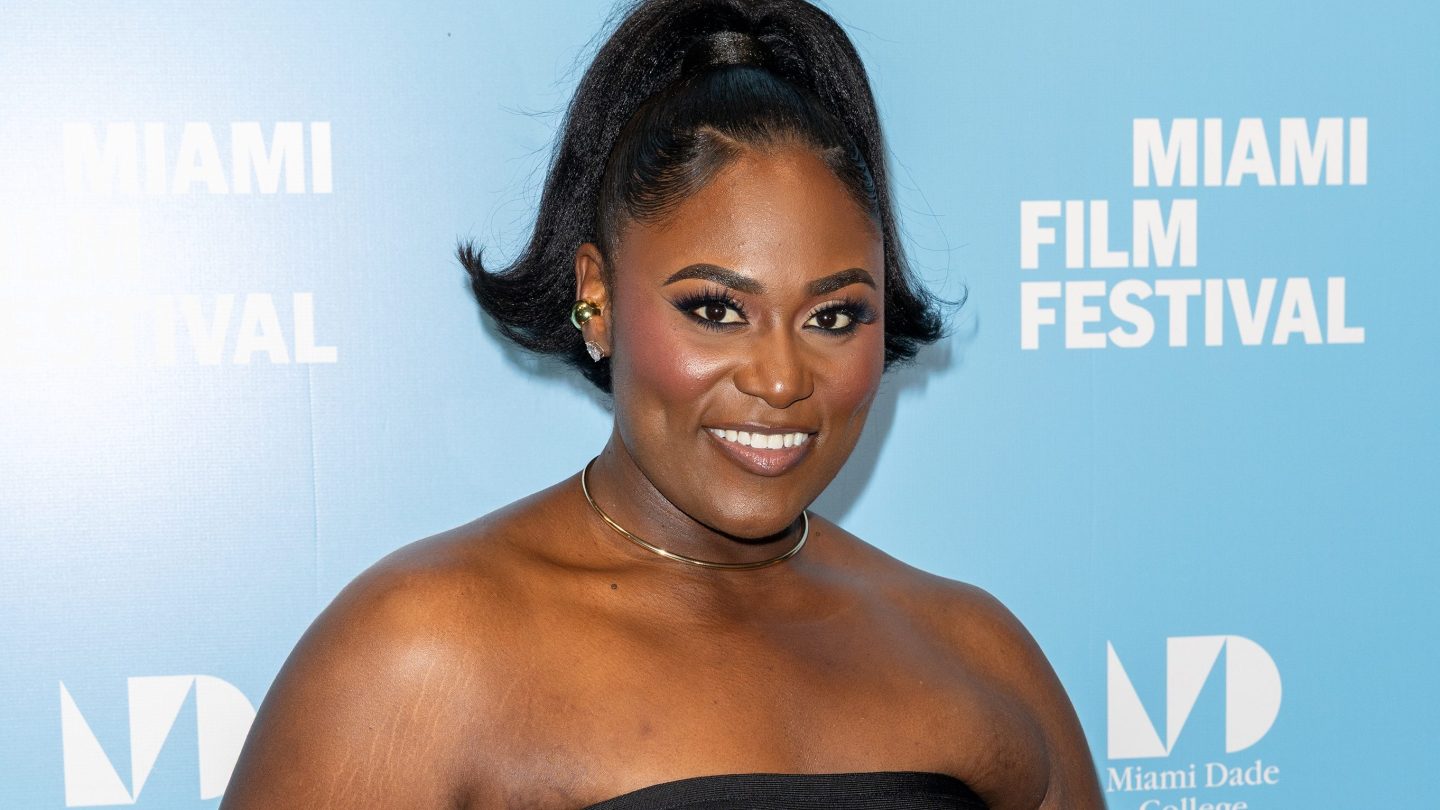

Major productions across the stage and screen have been a cornerstone of Danielle Brooks’ career, from her breakout role in Netflix’s Orange is the New Black to her Broadway debut in The Color Purple, for which she earned a Tony Award nomination for best featured actress in 2016, to the 2023 musical film adaptation of Alice Walker’s book which earned her Oscar and Golden Globe nominations. Yet it’s indie projects, the Juilliard grad says, that make her feel most connected to her craft and purpose.
“Independent films are so incredible because I think they reflect the truth of who we are,” Brooks said during the Miami Film Festival, where she received the Art of Light Award following a screening of her latest project, If I Go Will They Miss Me Tuesday night. “It’s not about big blockbuster movies to make a dollar, it’s about the people. And that’s why I got into this, so that I could be a reflection, the light, because there were people in this industry, artists that were that light for me.”
Brooks stars as Lozita Harris, a mother of three trying to hold her family together as her partner, Ant (J. Alphonse Nicholson), struggles to connect with their son when he returns home from prison in the semi-biographical, mythical feature from Walter Thompson-Hernández.
During the Miami film festival, Brooks chatted with The Hollywood Reporter about why she so deeply believed in the project, which, since its Sundance premiere in January, has been acquired by Rich Spirit, shooting in a public housing complex in Watts and how working on the film inspired her to make her own short.
Your connection to If I Go, Will They Miss Me dates back to Walter Thompson-Hernández’s 2022 short of the same name. What drew you to the project?
My team had come to me and said, “Hey, there’s this film that we want you to think about being involved in. There’s this amazing new up-and-coming director, Walter Thompson Hernandez.” And I’m always like, “Ooh, new. I like,” because that means there’s a new energy that’s being put out into the film industry, and that excites me. So they were like, “Come look at the short.” And I looked at the short, and I was like, “Wow, this is different from what I’ve seen before, but it still has this energy, sort of like a Moonlight, that I liked.” And I loved how he shot Black people, but I also knew that there was passion behind it because I could tell that there wasn’t this big budget that he had, that everything that he was putting out there was community-based. …And when I met with him, we sat down at the London hotel, and we talked for over an hour, and I immediately told my team, “Yes, I’m down.” And this truly was a passion project. This is one of those films that you end up spending money to be in it. It wasn’t something that came with a large check, and I knew I wanted to be a part of it because it felt honest and real. It was so different from anything that I’ve ever played before, people like Sophia [in The Color Purple] or Taystee [in Orange Is the New Black] who were bigger-than-life characters; there was a quietness about her that I was drawn to.
Your character, Lozita, and all of the characters in this film are based on real-life people. What did your preparation look like, and is there a difference in how you approach roles that are biographical in nature versus fictional characters?
It’s very different. I enjoy playing people who are real. I got the chance to play Mahalia Jackson in the past, and each character that you play does require something different, but this one was interesting because Lozita was based on a true person, and so was Big Ant. But unfortunately, the person that I played had passed away, so I wasn’t able to speak with her. Everything that I was learning about her was from her partner, who was still alive, and from Walter, the director, who was good friends with her, and pictures. Pictures tell a thousand words. There’s one thing I really wish I could have had, which was her tattoos, because she had all these tattoos, and I felt like they told such a story about who she was, and she wore braids. So I was like, “I’ve got to make sure I have these braids.” And just how she held her mouth. I got to see pictures of her and her husband and how he would hold her, and all of these things that just told me a story.
What did Walter say it was about Lozita and Ant that made him want to make this film?
It’s this thing about life. None of us asked to be here, but we all have to figure out how to survive it. And that’s what we’re watching this family do is figure out how are we going to survive our circumstances, the things that we’ve been through in the past, how are we going to make it through that? And what are we going to pass to our children? We had multiple conversations about it. And there were a lot of times that it felt too real because we’re shooting in Watts, too. We shot in the projects, and so we weren’t in a position to say, “All right, everybody, leave your homes for a while and come back in tomorrow.” We’re in their environment. And sometimes it was really real. Life imitates art, and art imitates life, so there was no moment for me to escape the character. I felt like I was always close to her because I would see kids beautifully playing outside with skates on. This is not a community that has access to iPads and all of that stuff. So the kids are outside watching us, and that was amazing because now I’m asking, “What do you want to be when you grow up?” [and they say] “I want to be an actor,” because they see a reflection. The children are just as chocolate as me or as round-faced as me.
You had an amazing screen partner in J. Alphonse Nicholson, and there’s so much emotion that comes out in the scenes with you two in the bedroom, trying to figure this relationship out. Were you all big on rehearsal? Were you just finding the emotion in the moment?
We did have some rehearsal. We didn’t have much time, though, but let me talk about J. Alphonse. I freaking love that brother. He is one of the best scene partners ever, super talented, and I’m going to take some credit. I was like, Walter, “We need him,” and Walter was like, “OK, let me sit down with him,” and they just hit it off. He brings so much to every character that he plays, but the way that he works, he allows you to be vulnerable. Being in a space with him, having to take my shirt off and have intimate scenes, it was a safety with the way in which he works that I felt comfortable to give all myself to her, no problem. We had some very personal conversations about personal experiences we both have been through, because I’m going to tell you right now, I don’t look like what I’ve been through. I say that because I can really relate to [Lozita] and the same with J. [and his character] so there are moments where it felt like this is too much, but we had each other to be like, “You good?” And that’s important. It’s very important to be able to trust your same partner that way.
What was your reaction when you saw the finished film?
I cried like a baby. It messed me up…it’s like, this is what it is like to say, “I love you, but you’re not good for me. You’re not healing me.” It’s such a beautiful reflection of, again, survival, how tough life can be, but yet we’ve got to push through it. And what does love really look like for my character? Love is getting up out of there. She had to go for her family, for herself, for her kids, and watching Ant, he’s having to take a moment and reflect. He’s trying to do the right thing, but it’s too late.
The overall journey of this film is inspirational, I think, especially for the audience at a film festival like this. Walter made his original short film in 2022 and won the jury award at Sundance; in 2023 it was selected for the Sundance Institute Screenwriters & Directors Lab; in 2025 it got two grants and you all made the feature film, then it had its Sundance premiere in January 2026 and in March it was acquired by Rich Spirit so now we’re looking at a theatrical release this fall. Did you expect to be able to take this project this far? What would you say aspiring filmmakers should take away from this journey?
Did I expect this film to go this far? Yes, because it is good. Like you just know. And there’s something special about this film. I think the hard part is, is it the right timing? And I do feel like it’s the right time — we’re in a crazy time, and we’re trying to figure it out — but I do feel like it’s the right time. What aspiring filmmakers can take is that you can do this thing. I am one of the aspiring filmmakers, and it’s because of the way that I saw [Walter] work that I ended up shooting my own short film. If you have a passion for it, get it done. There are people that will align with that passion. There are people that are trying to figure this thing out, too, and find their community. Just start talking about it and say, “Hey, this is what I want to do.” And it might not be that first person you run into, but somebody will say yes. And one other thing that I want to say while I have the mic is I feel like this is a film that will be successful by word of mouth. So we’re going to need you.
Read the full article here