


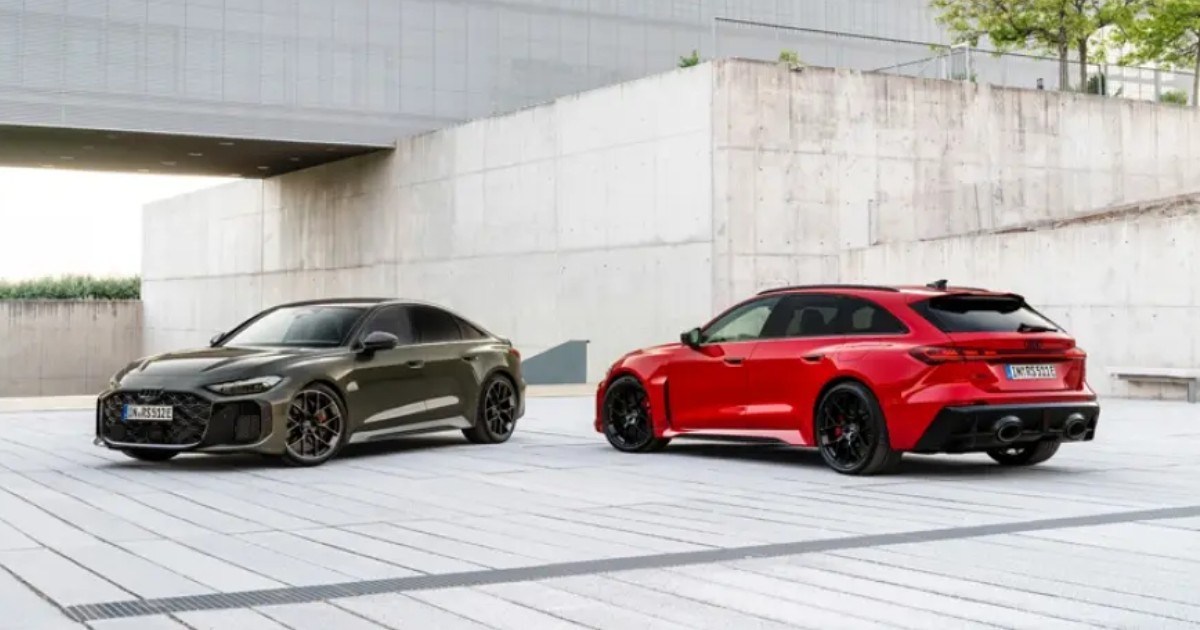

Move aside Mercedes and BMW. Audi has a shiny new high-performance contender straddling the compact to mid-sized segments, and you should be familiar with its name: The Audi RS5. Except that this latest RS5 might feel different on multiple fronts.
For starters, here’s a reminder that this actually marks the joint successor to the Audi RS4 Avant and the previous-generation RS5 Sportback/Coupe, since the A4 nameplate has been canned (for now) within the Audi family. As a result, the RS5 is now no longer a Coupe or Sportback, but either a Sedan or Avant.
You’ve probably already caught the current-gen A5 on Singapore’s roads or in the Audi House of Progress Singapore; imagine the RS5 as its meanest triplet, outgunning the aggression of the V6-powered S5 both on the styling front and in terms of power.
The latter brings us to the biggest headline with the latest RS5: It now marks the first-ever high-performance plug-in hybrid in the Audi family. (Interestingly, however, this certainly isn’t the first time that Audi has electrified its hallowed ‘RS’ badge.)
Aft of its gaping black front grille lies what Audi is calling an “improved” iteration of its long-serving 2.9-litre twin-turbo V6 engine, which has now been tuned to put out a total of 375 kW (503 bhp) and 600Nm of torque.

For that massive 44kW (59bhp) bump in output from the previous-generation V6, Audi has credited a number of innovations from its Audi Sport team – including a modified Miller cycle that allows the intake valves to close earlier and increase the engine’s efficiency. The new engine also sports a new intake system built from the ground-up and new water-to-air intercoolers.
But of course, that engine doesn’t work alone. Propelling the RS5 in tandem with it is a new electric motor that provides 130kW and 460Nm of torque on its own, and integrated into the car’s all-new hybridised eight-speed gearbox.
Powering it is a 25.9kWh battery (gross), which can support AC outlets at up 11kW for a full recharge in 2.5 hours. Provided you live just about 40km from your nearest track, you could technically do your journeys to and from track days purely on electric power alone too, since the RS5 boasts an all-electric range of up to 84km on paper.

But back to the RS5’s performance. What’s the system output, you ask? A whopping 630bhp and 825Nm of torque. By way of that new gearbox and an updated quattro all-wheel drive system (more on that in a bit), the RS5 will rocket to 100km/h from rest in just 3.6 seconds (Audi hasn’t differentiated the timings for the Sedan and the Avant thus far). That’s despite the fact that the RS5 has put on quite a bit of weight in its partial embrace of electric power; both the Sedan and Avant tip the scales at north of 2.3 tonnes unladen.
In a straight line, that puts it ahead of the pure combustion-powered BMW M3 Competition with M xDrive, but still behind the Mercedes-AMG C63 S E Performance, which can shred the century sprint in just 3.4 seconds.
While the most traditional of petrolheads may bemoan the loss of yet another performance car to electrification, it’s worth noting that the RS5’s plug-in hybrid setup has allowed Audi to achieve unprecedented frontiers in performance.

For starters, the latest RS5 is claimed to be the first production model in the world to boast a rear transaxle with electro-mechanical torque vectoring – a system Audi has dubbed ‘quattro all-wheel drive with Dynamic Torque Control’.
An actuator, overdrive gears, and a differential on the rear axle all work together to intelligently transfer torque between the car’s rear wheels – and they do this almost fully variably, in response to any given driving situation.
In fact, Audi has a staggering figure to illustrate their power. A control unit onboard the RS5- labelled the driving dynamics controller (with an internal ‘HCP1’ code) – is claimed to be able to recalculate the optimal torque distribution between the rear wheels every five milliseconds.

In the brand’s words, this new electro-mechanical torque vectoring system is an “invisible maestro conducting an orchestra of performance and making sure customers experience driving fun and safety like never before”. In essence, what drivers can expect is for the RS5 to exhibit more eager turn-in and immense traction on corner exits. Directional stability, and thus safety too, are both elevated as a result, thanks to the car’s ability to react more precisely and directly to steering inputs.
Implementing the new electro-mechanical torque vectoring system apparently also necessitated that Audi revise the car’s chassis quite thoroughly, with an updated front axle and a completely reworked rear one.
The RS5 also gets a new RS sport suspension with twin-valve shock absorbers, RS-tuned steering, and standard 20-inch wheels shod in specifically tailored tyres, though 21-inchers are also available as an option.

Interestingly, the RS5 is now going down the brake-by-wire route too, with the car’s braking system primarily using regenerative braking, and then turning to the friction brakes only when more braking force is required.
Speaking of the latter, the RS5 gets powerful steel discs as standard, but for those who want even better stopping power, Audi is offering 21-inch RS ceramic brakes too, which can shave a total of 30 kilos off the car’s total weight.
Best of all, separating the RS5 from your run-of-the-mill A5 won’t be too difficult; it’s possibly one of the least understated designs we’ve seen from Audi in recent times, in fact, even by the standards of its RS cars.
.jpg)
For starters, the RS5 is a good 40mm on both sides, and both up front and at the rear – in no small part thanks to those swollen wheel arches. Its signature Singleframe grille has also been enlarged and given the black gloss treatment, with a three-dimensional honeycomb pattern up front, as well as a ‘dark mask’ that stretches into the side air curtains. And like the facelifted RS3, Audi’s playfulness with light takes the form of an RS-specific signature that mimics chequered flags.
The rear-end of the RS5 is all tough aggression too, thanks to a strong rear diffuser with functional vertical fins, as well as a gaping twin exhausts with matte oval tips. The Sedan even comes with a subtle ducktail spoiler.

Audi has done commendably in spicing up its latest-gen interior for the RS5 too, offering will-be customers five distinct interior designs to choose from.
And if you’ve found the overall look of the latest MMI infotainment system rather too minimalist, Audi has made sure to note that the RS5 will come with specific displays, including ‘sporty dials’ tailored to the car that display engine revolutions, speed, and a shift light.
For your days out on the track, performance data including G-force, temperatures and pressures for individual tyres, lap times, as well as detailed information on the car’s drivetrain, power, and acceleration can also be accessed.

Like the outgoing RS5, the new Audi RS5 Sedan and Avant will be built at Audi Sport’s headquarters in Neckarsulm. Germany, with orders for European buyers set to open in the first quarter of 2026, and deliveries expected to commence from mid-year. Sgcarmart understands that the models are expected to reach Singapore before 2026 ends, although Audi Singapore has yet to confirm their exact period of arrival.
This article was first published in sgCarMart.
Read the full article here