

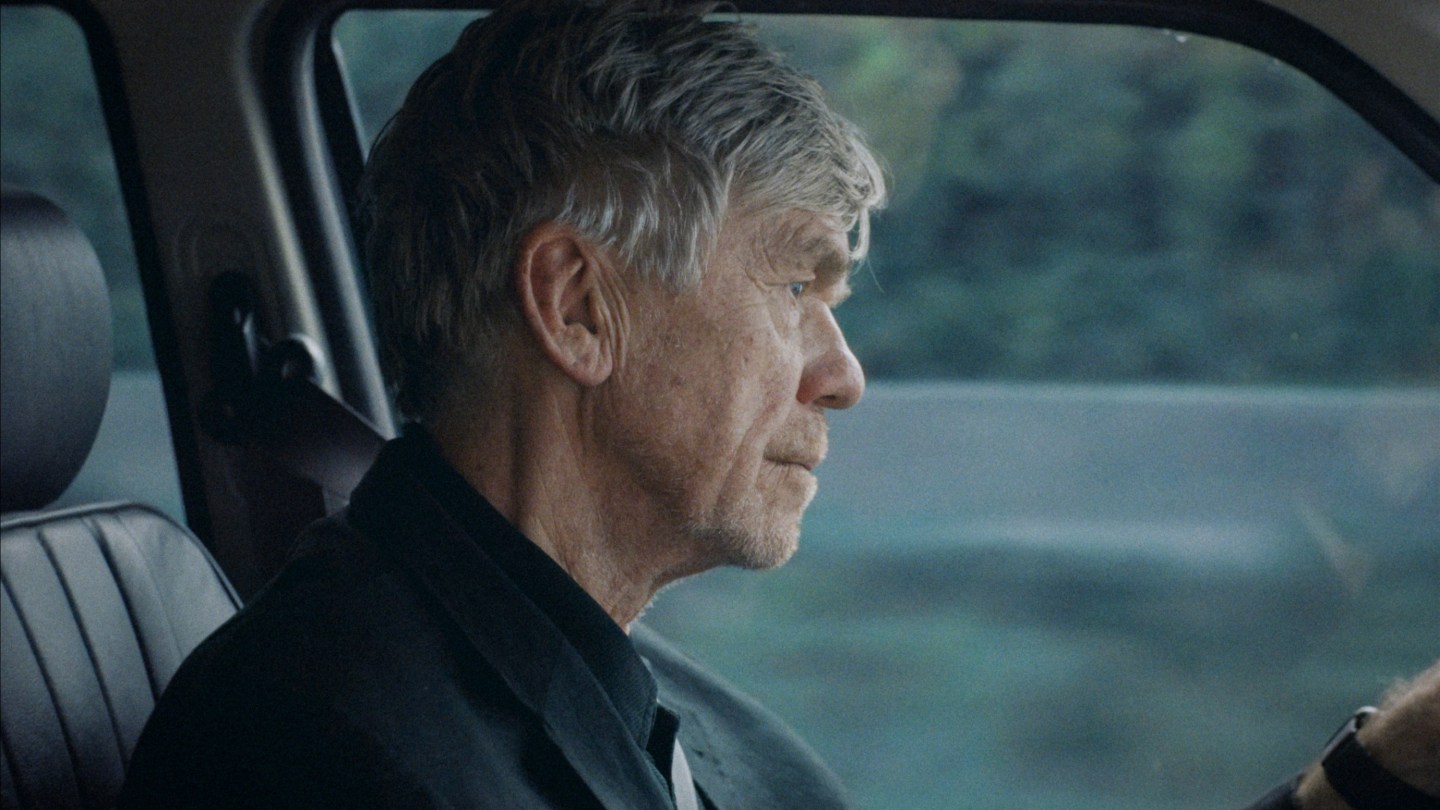

“The setting was very strict, because we were in the studio,” explains Sebastian Brameshuber. “But this strict set-up brought about this freedom for how the conversations could flow.”
We are discussing London, the new film from the Austrian director of Movements of a Nearby Mountain and And There We Are, in the Middle, which will world premiere in the Panorama program of the Berlin International Film Festival. It is described as “neither a documentary nor entirely fiction.”
The film features Bobby Sommer as Bobby, who is always on the road, driving up and down a highway that links the Austrian cities of Vienna and Salzburg. Via a car-sharing service, he picks up other people who are looking to travel the same route while saving money on petrol, including a young man struggling with the country’s mandatory military service, a queer woman who is about to get married, a supermarket trainee, and an academic exploring the history of the highway.
Square Eyes is handling world sales for the movie from Panama Film producers David Bohun and Lixi Frank that debuts at Berlin on Monday, Feb. 16.
Brameshuber picked and cast people and put them in a car with Sommer in a studio to imitate the experience of long rides and allow for free-flowing conversations to develop, sometimes giving Sommer pointers, via an earpiece, about questions and topics to pursue.
“The most important thing for me was making this film about this particular form of encounter between strangers,” the director explains. Through this collection of interactions, the movie creates “a portrait of today’s Europe,” highlights a synopsis.
And audiences find out more about Bobby, his youth, his parents, his take on aging, and his friend in a coma in Salzburg, who is the reason for all his car trips.
The reason for car sharing to be the central concept that London is built around is the fact that Brameshuber himself used this form of travel for regular trips between Vienna and Berlin in the past. “Traveling in a car with somebody who is a stranger for a long distance and spending a lot of time together produces a certain quality of conversation and a certain atmosphere that I found super interesting,” he tells THR. “You’re mostly looking straight ahead, while making conversation with the person sitting next to you, so you don’t look at the person, or at least only occasionally.”
Shares Brameshuber: “The road is coming towards you, the landscape is passing by; you’re efficiently moving towards a destination while just sitting there relaxed. This experience drags you into a certain atmosphere. And I ended up feeling that I would like to make a film about this.”
Brameshuber shares how Sommer ended up in the film. He had seen him in a movie and met him in person because he needed somebody to record a poem for a short film. “I found he had a resemblance to GTO, the character Warren Oates plays in [Monte Hellman’s 1971 film] Two-Lane Blacktop,” the director recalls. “And I really liked the scenes in that film where GTO is basically traveling with different passengers and reinventing his story for each passenger. So I sent Bobby the film because he hadn’t seen it. And from there, the dialogue with Bobby started. But it took us basically close to 12 years for the film to come out.”
The rest of the casting process focused on finding “young people who were engaging in conversations, willing to share a lot about their lives, but at the same time keeping a bit of a mystery,” explains Brameshuber.
The A1 motorway, also known as the Westautobahn, that audiences see in the film has a complicated and dark history. “The sequence of views along this motorway was designed by the Nazis to create a picturesque route, which is very interesting to me, because it links back to my previous projects about historically charged locations,” Brameshuber tells THR. “I’m always interested in places that carry history within them, and for the Westautobahn, that’s very true.”
He adds: “Actually, it’s a past that’s not very visible because it’s mostly under the motorway – bridges and viaducts from that period that carry parts of the Westautobahn to this day. As for the landscape views, you don’t necessarily think of them as a design; you just take them as a given.”
The working title for London was actually In Current Traffic for a very long time. That was a nod to the digital age, explains Brameshuber. “It was because Google Maps, or maybe some other navigation system at the time, had these estimates for trips: 13 hours until the destination in current traffic.”
How did the film end up with the title London? Brameshuber says he often changes his titles when he nears finishing projects and feels what title makes sense. “The title is not supposed to be an enigma; it relates to the film in a more associative, poetic way,” he highlights. “London came up because, first of all, Bobby mentions it as the place he went to as a young man – for the music, for the spirit, for being free.”
Concludes the director: “For me, the title opens up the narrow space of the car to a mental geography and to a destination that’s more of a feeling.”
Read the full article here