

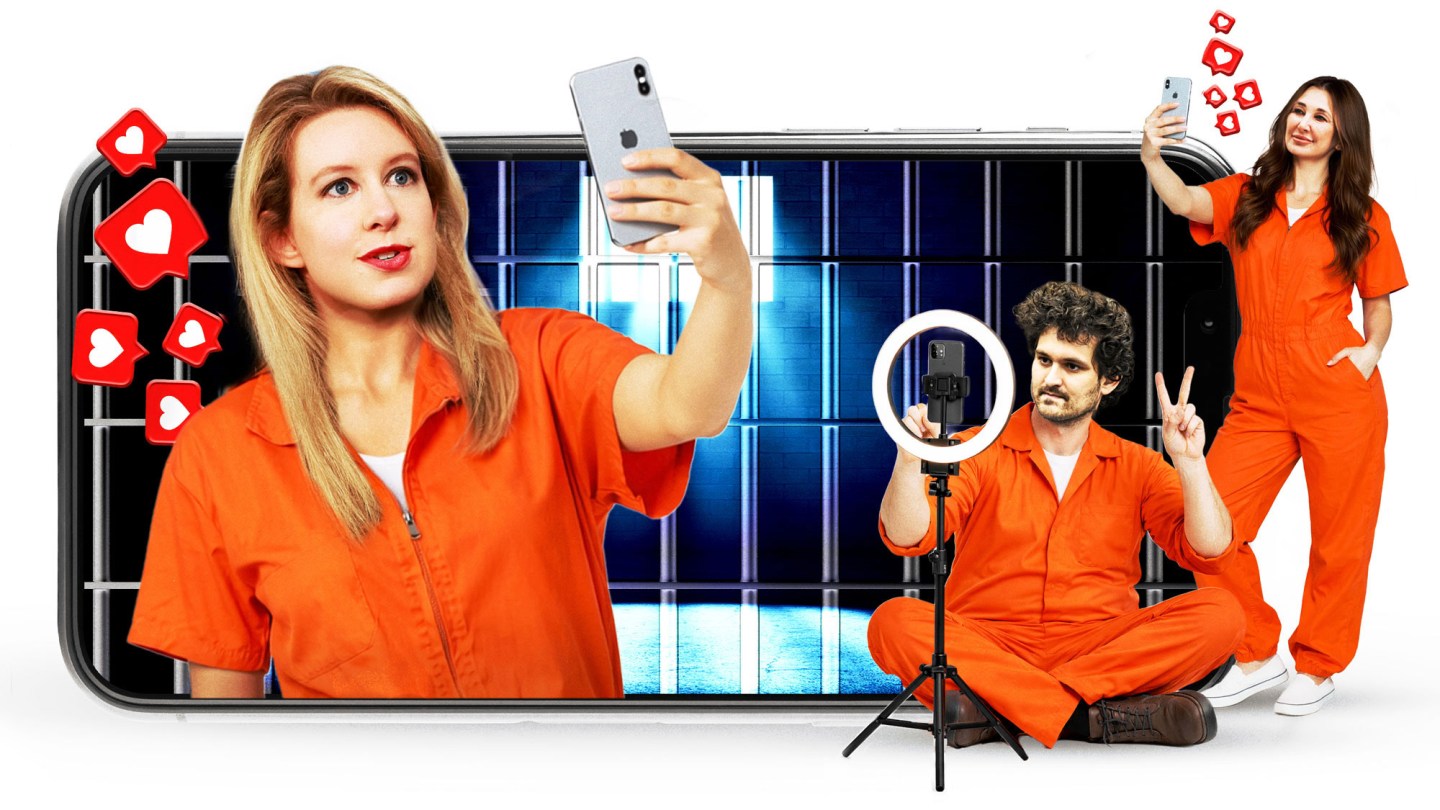

In January, venture capitalist Sam Lessin playfully suggested on X that convicted fraudster Elizabeth Holmes should start “a jailhouse venture fund.” The idea seemed preposterous. For Holmes, it was an invitation to chat.
Nearly four hours later, the Theranos founder replied directly to the Slow Ventures partner and his 100,000-plus followers on X, thanking him for “the kind words” and volunteering her prison address. “I was surprised,” admits Lessin.
It’s not uncommon for prisoners to plead their cases from the slammer (Barbara Walters built a career out of that). But as legacy media recedes, a growing cohort of famous felons are leveraging new media to rehab their images. Inmates including Sam Bankman-Fried and Harvey Weinstein have turned to such right-wing firebrands as Tucker Carlson and Candace Owens to present alternative narratives to their cases.
Others are more tech-forward: Nicole Daedone — subject of the Netflix documentary Orgasm Inc. and now awaiting sentencing in Brooklyn — an AI version of herself reading a message to her Instagram followers. And, increasingly, many are mounting charm offenses on X in the hopes of becoming MAGA darlings.
But these jailbirds aren’t using their own fingers to fire off missives or create clones. While civilians surf the world wide web like an information superhighway, one prominent lawyer compared inmates’ internet access to a one-lane dirt road. Since their computer privileges are highly restrictive, experts believe Holmes and others hand over social media management to advisers outside of prison.
“The reality is they have teams and people. They’re trying to keep their voices alive,” alleges ex-Congressman George Santos, whose seven-year sentence was commuted by President Trump. “I had nine people delegated to my account.”
Santos served fewer than 100 days behind bars. Rather than go full creator in his commutation push, the fabulist opted for a less viral form of media: newspaper op-eds, placing them in The South Shore Press, a Long Island rag. “I didn’t want to put the onus on my family. They were working on other stuff on the back end,” he says. “So for me, that was more effective than Twitter.”
In May, Weinstein, who is locked up in Rikers, appeared on Owens’ podcast. It was an unlikely home for his first on-camera interview in almost a decade. (Owens has trafficked in antisemitic tropes, and Weinstein once accepted an award from the Simon Wiesenthal Center, telling the audience to “kick these guys in the ass,” referring to antisemites.)
But for canceled convicts, right-wing political podcasts are heterodox playgrounds, where their stories can go largely unchallenged. “The podcasts are willing to go above and beyond for us,” says PR whiz Juda Engelmayer, who reps Weinstein. “If we have a counter-narrative that in some way makes the prosecution look like they have been faulty, a lot of media won’t run it.”
It’s also a way for federal convicts to unleash Step One in the commutation playbook: drumming up support in MAGA World. In March, FTX founder Bankman-Fried appeared on Carlson’s podcast with the episode title, “Sam Bankman-Fried on Life in Prison With Diddy, and How Democrats Stole His Money and Betrayed Him.” It ultimately backfired. The New York Times later reported that Bankman-Fried was placed in solitary confinement because the crypto swindler violated the Federal Bureau of Prisons’ rules. He has yet to receive any support from Trump.
Some lawyers see more downside than upside in prison-fluencing. Alan Jackson, the celebrity legal eagle, doesn’t recommend clients entrust their social media accounts to third parties —even if those clients crave commutations. “There are ways to do that through the legal process that does not include trying to develop a social media personality, which you cannot control from inside prison,” says Jackson, whose client list has included Karen Read and Nick Reiner. “You can barely control that outside of a custody facility.”
Not every convict is a natural fit to be a creator. Engelmayer has yet to launch social media pages for Weinstein, though it’s something he considers. Weinstein isn’t as native to social media as others; he’s a septuagenarian ex-producer. SBF and Holmes are products of Silicon Valley. “Harvey didn’t have a natural social media base, so putting him out on social media would require immense resources and immense time,” notes Engelmayer.
Ghislaine Maxwell’s lawyer, David Oscar Markus, says mounting media campaigns from federal prisons is hardly as simple as buying a ring light and pressing record. But X offers a workaround. “The Bureau of Prisons takes a very, very strict view about press from inside jail,” he says. “X is different because somebody else can be typing the words for you.”
Beyond confinement, giving up technology is often most difficult for inmates. Yet for those with yearlong stints, that can be a respite. “Those who have short sentences say it was a great detox from their phone,” admits Markus.
This story appeared in the Feb. 11 issue of The Hollywood Reporter magazine. Click here to subscribe.
Read the full article here