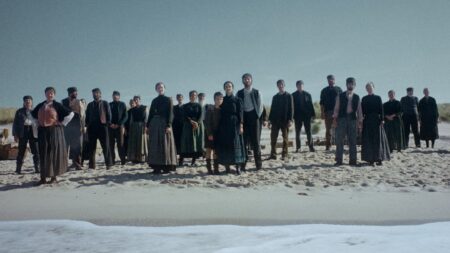






Gugu is almost 12 years old and, like many Brazilian kids, dreams of becoming a soccer player. He is growing up in a small community near a reservoir that is slowly drying up to expose the ghostly remains of a submerged town. His grandmother Dilma cares for the boy, with her warmth and open-mindedness, giving him the space to be – well, simply himself. Welcome to Gugu’s World, the new feature from Allan Deberton (Pacarrete, The Best Friend), which world premieres on Feb. 14 in the Generation Kplus section of the Berlin International Film Festival.
The pair’s quiet but powerful bond shields them from the disapproval of Gugu’s father and the community around them. But subtle changes begin to shake up their routines, and Dilma becomes increasingly frail. Worried that he could lose the only safe space he has ever known, Gugu becomes more and more determined to keep his and his grandmother’s world intact.
Gugu’s World stars Yuri Gomes as Gugu, Teca Pereira as Dilma, Lázaro Ramos as father Batista, as well as Carlos Francisco and Georgina Castro.
Deberton directed Gugu’s World based on a script by André Araújo. m-appeal is handling world sales for the movie produced by Biônica Filmes and Deberton Filmes.
THR can premiere an exclusive trailer for Gugu’s World, inviting you into a world of tenderness coming under threat. Check out the sights, the sounds, and the dancing here.
Deberton shared with THR some insights into how Gugu’s World came about, the music, finding its young, charismatic star, and the collaborative effort behind the movie.
What spoke to you about this tender story of a young queer boy, his grandmother and his worry about losing his safe space?
What moved me first was the idea of a child who doesn’t yet have the words to name who he is, but already feels that something essential is at risk. Gugu lives in a fragile balance between affection and fear of losing the only place where he feels protected and understood. The relationship with his grandmother is central because it represents unconditional care, even when it is imperfect or unspoken.
I was drawn to that emotional territory: a queer childhood lived through gestures, silences and imagination, rather than declarations. This felt very honest, delicate, and close to my own childhood memories, and also to those of André Araújo, the screenwriter. We were both born in Russas, a small town in northeastern Brazil.
I love how the story is set in a very specific location in Brazil, but also feels universal. How did you approach it?
Yes, absolutely. Gugu’s World is deeply rooted in a very concrete place, in its landscape, its light, its sounds, and its social dynamics, but the emotional experience of the characters goes beyond any geographic boundary. Childhood, the desire to belong, fear of loss, and affection are emotions that can be recognized anywhere in the world. At no point did I want to neutralize the Brazilian identity of the film to make it “international.” I trusted that authenticity would be the true bridge to the audience.
How did you find Yuri as your young star? He is so full of life and charisma and fits so naturally with your adult stars!
Finding Yuri was a long and very careful process. Together with Luciana Vieira, our casting director, we were looking not only for a talented child actor, but for someone with emotional openness, imagination, and a strong on-screen presence. When Yuri appeared, there was something immediate. A combination of vulnerability and vitality that felt perfect for Gugu. It was beautiful to see how naturally he connected with Teca Pereira and Lázaro Ramos. These relationships were built on trust, listening, and affection, not on performance. That honesty was essential to the film.
I loved the music and remembered that music was also key in The Best Friend. How do you think about music and its importance in film?
I think of music as a feeling, as access to something intimate when words are not enough. I grew up listening to mixtapes. My uncle, who helped raise me, worked producing cassette tapes with hits, and I would listen to those songs sitting on his lap. My films carry those memories. “Time After Time” (Cyndi Lauper) and “Sentimental Demais” (Altemar Dutra) were part of that universe, and in Gugu’s World these songs, together with contemporary Brazilian hits, help us enter both Gugu’s inner and outer worlds. Composer João Victor Barroso was fundamental in shaping the psychological universe of the characters through his original score.
Is there anything else you would like to highlight?
I would highlight the deeply collective nature of the film. Gugu’s World is the result of an intense collaboration across many departments, and we are very proud of the team we assembled. I was fortunate to find producing partners such as Karen Castanho, Bianca Villar, Fernando Fraiha, João Macedo, Marcelo Pinheiro, Fred Burle, Ariadne Mazzetti, and Lázaro Ramos. We are truly honored to premiere the film in the Generation competition at the Berlinale, a space that embraces stories about childhood and youth with complexity and respect.
Read the full article here